

Hanging textile shelves offer a practical, damage-free alternative to traditional hangers, particularly for delicate, lightweight garments that are prone to stretching, warping, or creasing under their own weight. Understanding the physical dynamics of fabric tension and structural load distribution allows you to optimize your wardrobe space while preserving the structural integrity of your clothing.
The Physics of Fabric Stress and Why Hangers Fail
Suspended storage on standard hangers places continuous gravitational stress on highly localized areas of a garment, specifically the shoulder seams. For lightweight knits, fine cottons, and linen shirts, this localized pressure causes permanent fiber elongation, commonly referred to as "hanger bumps." The gravitational pull acts vertically on the warp and weft of the woven or knitted matrix, distorting the weave over time.
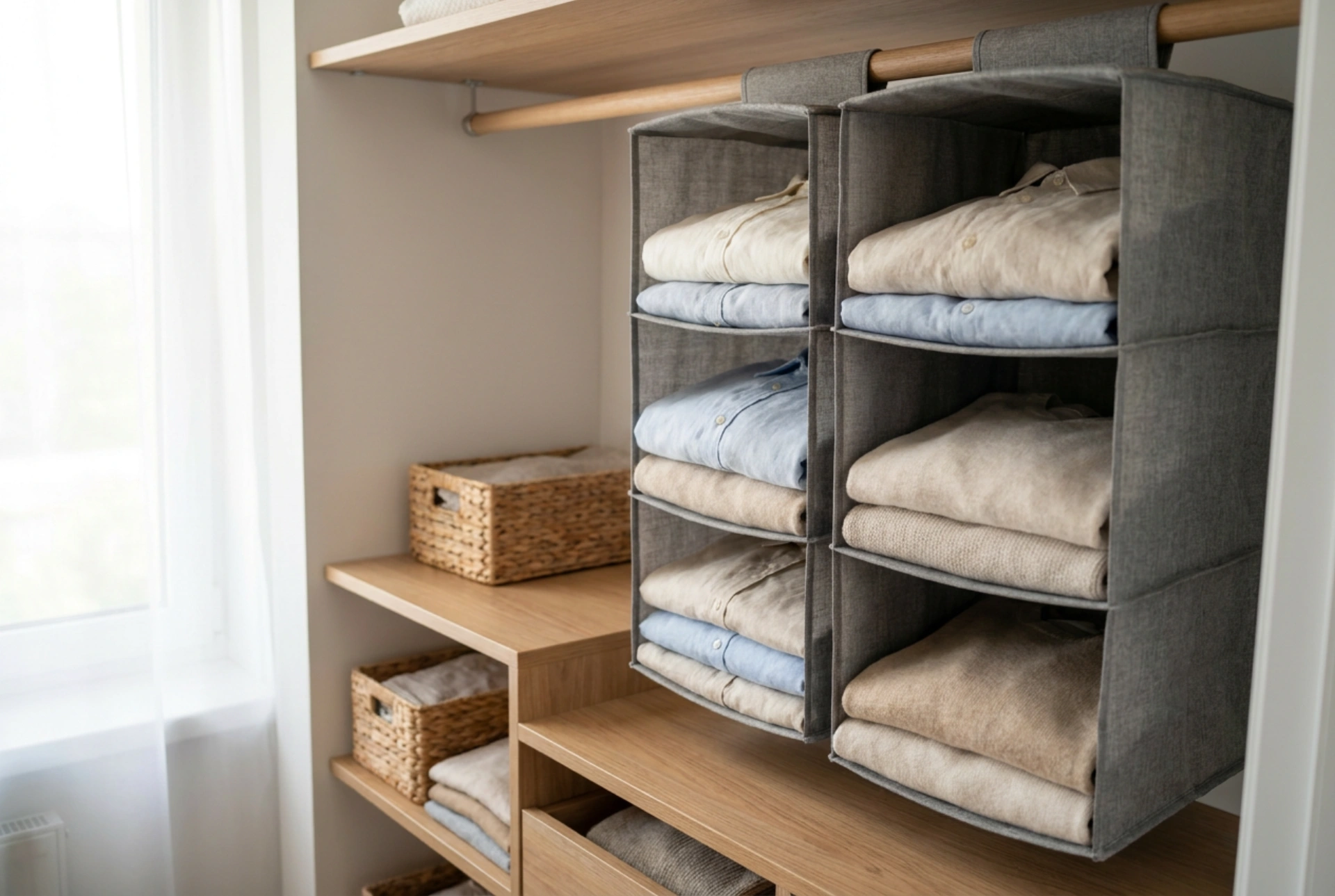
By transitioning lightweight garments to horizontal hanging shelves, the gravitational load is distributed evenly across the entire surface area of the folded fabric. This eliminates localized stress points and allows the textile fibers to rest in a relaxed, neutral state, preventing elongation and preserving the original drape and fit of the garment.
Selecting the Right Hanging Organizer Materials
The structural efficacy of a hanging organizer depends heavily on its material composition and design. When storing lightweight apparel, the primary concerns are breathability and structural rigidity. Non-woven synthetic fabrics like polypropylene offer excellent air permeability, preventing the accumulation of stale air and moisture, which can degrade delicate natural fibers.
However, the mechanical performance of the shelf base is critical. Avoid organizers with unsupported fabric bottoms, as they succumb to the catenary curve effect—sagging under weight, causing folded garments to slide toward the center and compress against each other. Opt for units engineered with rigid internal inserts, typically made from high-density fiberboard (HDF) or reinforced polymer plates. These inserts maintain a perfectly flat plane, ensuring garments remain neatly stacked and uncompressed.
Folding Techniques to Maximize Space and Prevent Creasing
Simply placing garments onto hanging shelves is insufficient; the folding method directly influences fabric compression and accessibility. Standard flat folding is suitable for stiffer fabrics, but lightweight items require specific techniques to remain organized and wrinkle-free:
- The File Folding Method: Instead of stacking shirts vertically, fold them into compact, self-supporting rectangles and place them horizontally side-by-side. This allows you to retrieve a single item without disturbing or dragging the adjacent garments, eliminating friction-induced creasing.
- The Soft Roll Technique: For highly delicate items like silk camisoles or lightweight modal tees, gently rolling the fabric instead of creating sharp folds prevents fiber creasing. Rolling avoids pressing a crease line into the material under the weight of the garment itself.
- The Cushioning Principle: Place the heaviest items at the base of the organizer stack and the lightest, most fragile items on top. This prevents heavy fabrics from compressing the delicate air pockets within lightweight knits.
Managing Airflow and Microclimate in Closed Wardrobes
Air circulation is vital for the long-term preservation of natural fibers like linen, cotton, and silk. When organic fibers are packed too tightly, they trap ambient humidity, creating microclimates conducive to mold growth and musty odors. Hanging shelves should never be packed to maximum capacity.
Aim for a maximum volume utilization of 80% per shelf compartment. Leaving a 20% void allows air to circulate freely around the folded garments, facilitating the evaporation of trace moisture. Additionally, positioning the hanging organizer in the center of the wardrobe rail rather than pushed against the side walls improves lateral airflow, ensuring consistent humidity regulation across all storage compartments.