

Freestanding metal garment racks offer an adaptable solution for wardrobe overflow, yet maintaining their physical stability requires a basic understanding of load distribution and structural mechanics.
The Physics of Balance: Preventing Overturns
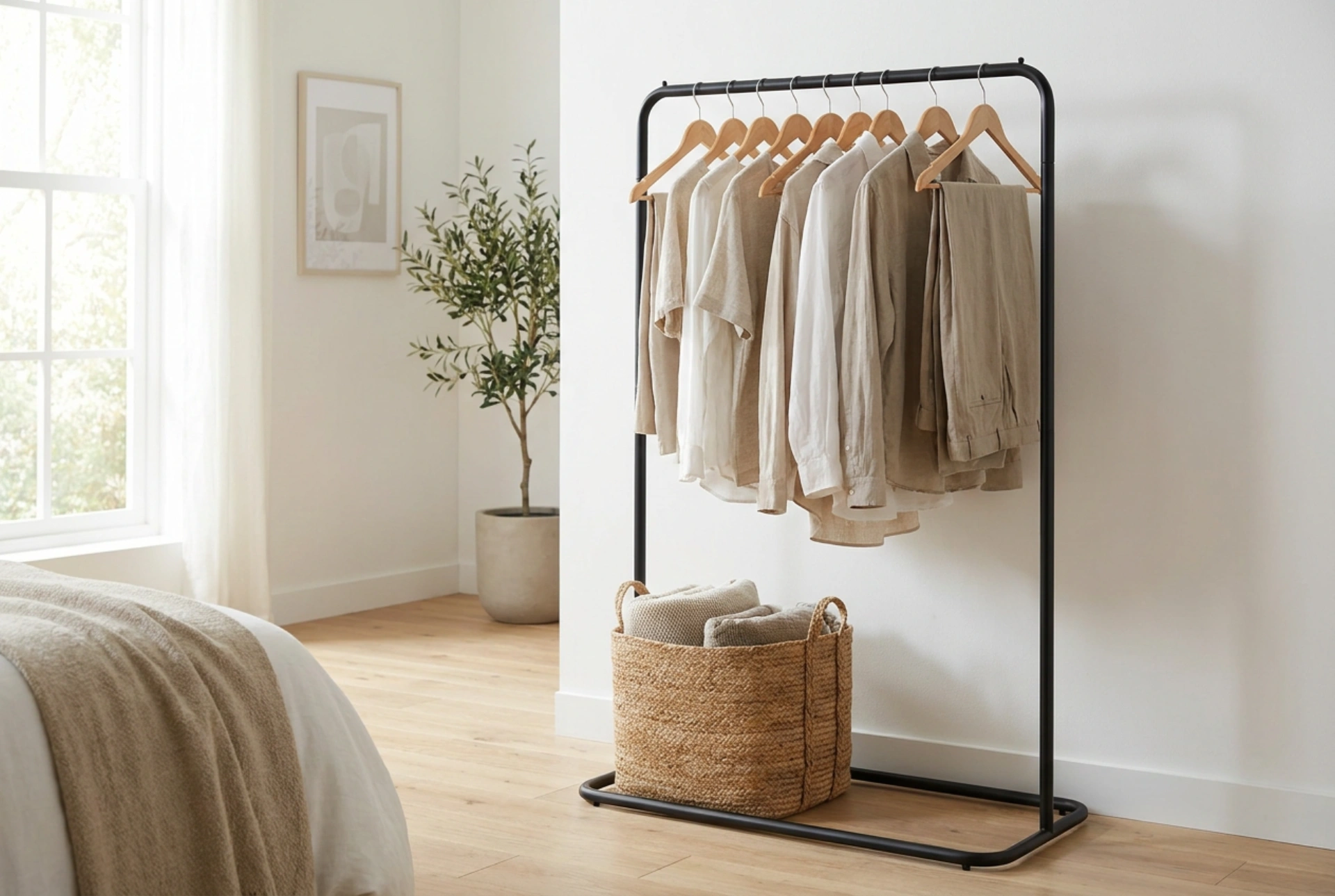
A freestanding rack relies entirely on its base area to counteract the gravitational pull of suspended garments. The key to stability lies in the centre of gravity. When a rack is loaded unevenly, the collective centre of mass shifts away from the central vertical axis, risking a structural tip-over. To prevent this, always place the heaviest items—such as winter coats, denim, and heavy woollen knits—closest to the vertical support posts or concentrated in the exact middle of the horizontal rail. Lighter garments, such as linen shirts and silk blouses, should occupy the outer sections. Furthermore, utilising the bottom shelf or base framework for heavy footwear or storage baskets acts as a counterweight, lowering the overall centre of mass and significantly anchoring the entire structure.
Material Integrity: Steel Tubing and Joint Mechanics
Not all metal racks perform equally under stress. The load-bearing capacity is determined by the gauge of the steel tubing and the engineering of the connecting joints. Hollow steel pipes with a thicker wall gauge resist bending under sustained vertical loads. When choosing or assembling a rack, the fastening mechanism is crucial. Threaded screw connections provide superior shear resistance compared to simple friction-fit slip joints, which can loosen over time due to lateral movement. Matte powder coatings do not just offer aesthetic value; the textured surface increases friction against hanger hooks, preventing them from sliding uncontrollably when you retrieve an item, while protecting the underlying steel from oxidation caused by ambient humidity.
The Chemistry of Airflow and Material Care
Placing clothes too closely together on a rack creates a microclimate that traps stagnant air, dust, and microscopic moisture particles. This can lead to fabric degradation and musty odours. To prevent this, employ the "two-finger rule" between hangers, ensuring at least two centimetres of free space. This gap allows natural convection currents to circulate through the garments, evaporating trace humidity from wear or washing. Avoid hanging damp clothing directly on powder-coated steel; while the coating prevents rust, prolonged exposure to moisture can find microscopic imperfections in the seal, leading to localized under-film corrosion over time.
Optimising Weight Distribution via Hanger Selection
The interface between the rack and your clothing is the hanger, which plays a major role in load distribution. Heavy wooden hangers distribute weight across a broader surface area of the shoulder seams, preserving the garment's shape, but they add substantial dead weight to the rail. For lighter garments, slim metal or structured plastic hangers are preferable to reduce the overall static load on the rack. Smooth chrome rails paired with plastic hangers minimise friction, allowing easy sliding, whereas matte black finishes paired with wooden hooks offer greater resistance, securing items in place in high-traffic or drafty areas.
Levelling and Fine-Tuning the Base
An unstable foundation undermines even the most perfectly balanced rack. Most high-quality metal racks feature adjustable levelling feet. Because residential floors are rarely perfectly flat, small variations can cause a four-legged frame to wobble. Adjust the screw-in feet so that all four contact points exert equal downward pressure on the floor. If your rack features castor wheels, ensure the locking mechanisms on at least two diagonal wheels are engaged to prevent kinetic energy from movement translating into lateral instability.