

Storing trousers without creating unsightly creases requires understanding how different fabrics react to gravity, tension, and pressure. Choosing the correct hanger geometry and using precise draping techniques will preserve the structure of your garments and significantly reduce the need for corrective ironing.
The Physics of Fabric Creasing on Hangers
Creases occur when textile fibers are subjected to localized pressure, moisture, and heat, causing the polymer chains within the yarns to break and reform in bent positions. When trousers are draped over a thin, narrow hanger bar, the entire weight of the garment is concentrated on a minimal surface area. This high pressure, combined with gravity pulling the fabric downward on both sides, creates a sharp, stubborn horizontal fold line.
To prevent this, you must manipulate two physical variables: surface area and friction. Increasing the diameter of the hanging bar distributes the weight of the trousers over a wider curved surface, reducing the mechanical stress on the fibers. Simultaneously, adequate friction prevents the garment from sliding, which would otherwise cause asymmetrical loading and bunching, leading to deep, irregular wrinkles.
Hanger Materials and Their Mechanical Properties
The material of your trouser hanger directly influences how fabric behaves while suspended in your wardrobe. Selecting the right material is a balance between slip resistance and surface smoothness.
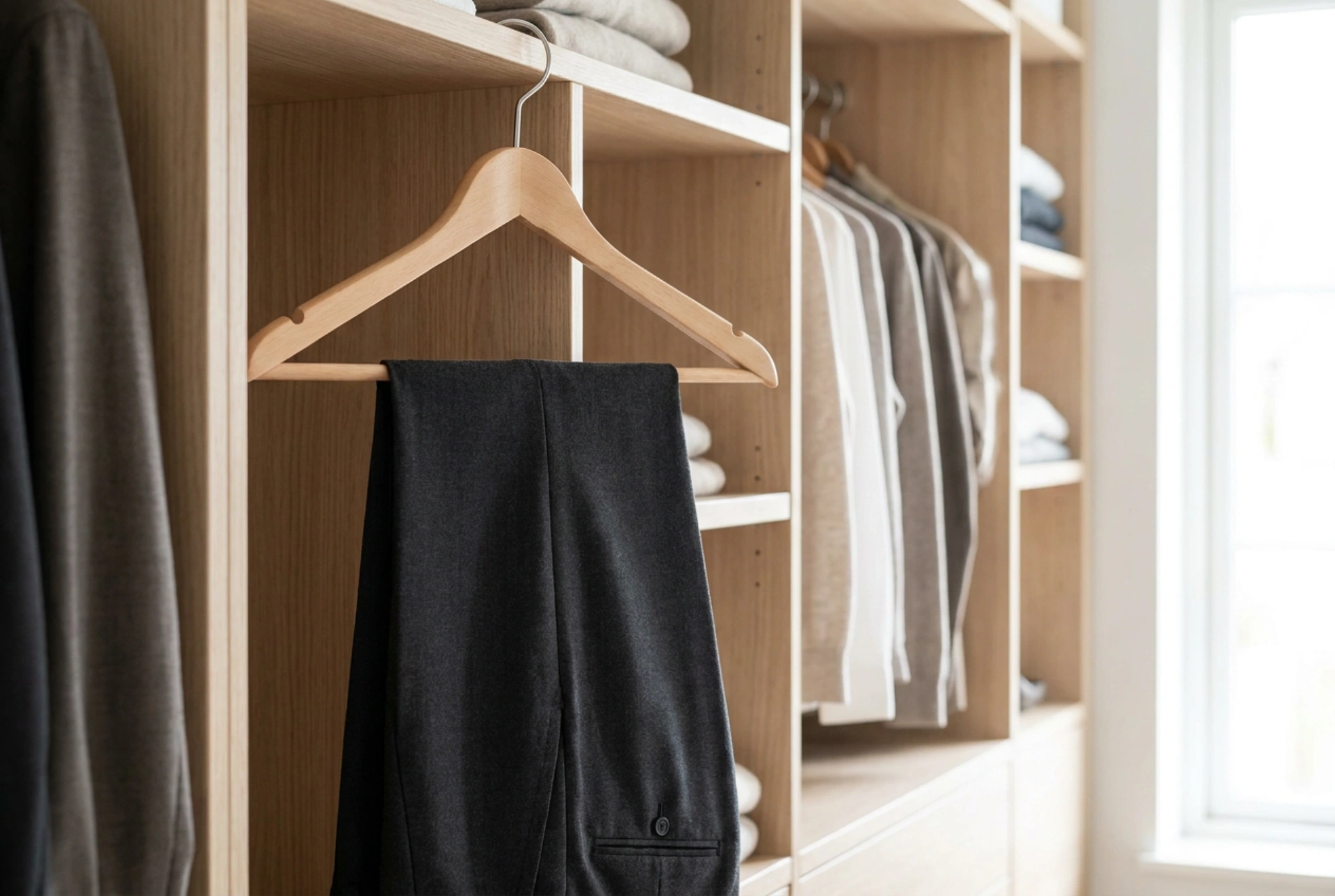
- Wooden Hangers: Wooden bars, particularly those with a wide profile, offer excellent structural rigidity. Untreated or matte-finished wood provides natural friction that keeps smooth wool and synthetic blends from sliding. Additionally, wood has natural moisture-regulating properties, which helps maintain a stable microclimate around the fibers.
- Velvet-Coated Hangers: These hangers utilize electrostatic flocking to create a high-friction surface. They are highly effective for lightweight, slippery fabrics like silk, rayon, or fine cotton. The soft texture prevents sliding without exerting concentrated pressure on delicate weaves.
- Metal and Rubber-Coated Hangers: Thin wire hangers should be avoided entirely, as their narrow diameter creates high-pressure points. However, thick steel hangers coated with non-slip synthetic rubber or foam are highly efficient. The rubber coating increases the coefficient of friction, ensuring that even heavy denim remains anchored without shifting.
Selecting the Best Hanger Design for Your Wardrobe
Different trouser styles and materials require specific mechanical support to maintain their shape. Matching the hanger design to the garment is critical for long-term preservation.
Clamp Hangers for Vertical Suspension
Clamp hangers grasp the trousers securely at either the waistband or the bottom hem, allowing the garment to hang completely straight. This method utilizes the natural weight of the fabric to pull out minor wear-wrinkles over time. Suspending trousers by the bottom hem is particularly effective for heavy wool suit trousers; gravity pulls the heavier waistband downward, naturally tensioning the fabric and restoring its drape.
Open-Ended Bar Hangers for Easy Access
Open-ended hangers feature a single-supported horizontal bar, making it easy to slide trousers on and off. To prevent creasing with this design, ensure the bar has a diameter of at least 1.5 to 2 centimeters. A thick, padded sleeve over the bar is ideal, as it cushions the fold and prevents a sharp horizontal crease from forming across the thighs of the trousers.
Step-by-Step Hanging Techniques to Eliminate Creases
How you fold and position the trousers on the hanger is just as important as the hanger itself. Follow this systematic approach to ensure optimal fabric tension:
First, empty all pockets to prevent uneven weight distribution and localized stretching. For trousers with a distinct front crease (such as dress trousers), hold them by the hem and align the inseams and outseams. This aligns the natural fold lines of the trousers. Gently smooth out any surface wrinkles with your hand using downward strokes.
Next, if using a bar hanger, fold the trousers exactly at the midpoint of the leg length, or use the "Savile Row fold" for slippery fabrics. To execute this fold, drape one leg over the bar through the hanger, then fold the second leg over the first in the opposite direction. This overlapping technique locks the trousers in place using their own weight, preventing them from slipping off the hanger while keeping the fabric perfectly flat.
Wardrobe Dynamics: Airflow and Spacing
Even the best hanger cannot prevent creases if your wardrobe is overcrowded. When hangers are packed tightly together, lateral compression forces the garments against each other. This mechanical pressure, combined with trapped humidity, essentially "presses" wrinkles into the fabric, similar to an iron.
To avoid this, maintain a minimum spacing of 2 to 3 centimeters between each hanger. This gap allows air to circulate freely, keeping the relative humidity low and preventing the fibers from absorbing moisture, which makes them highly susceptible to deformation. Furthermore, a spacious wardrobe allows the fabric to "breathe" and recover its natural elasticity between wears.