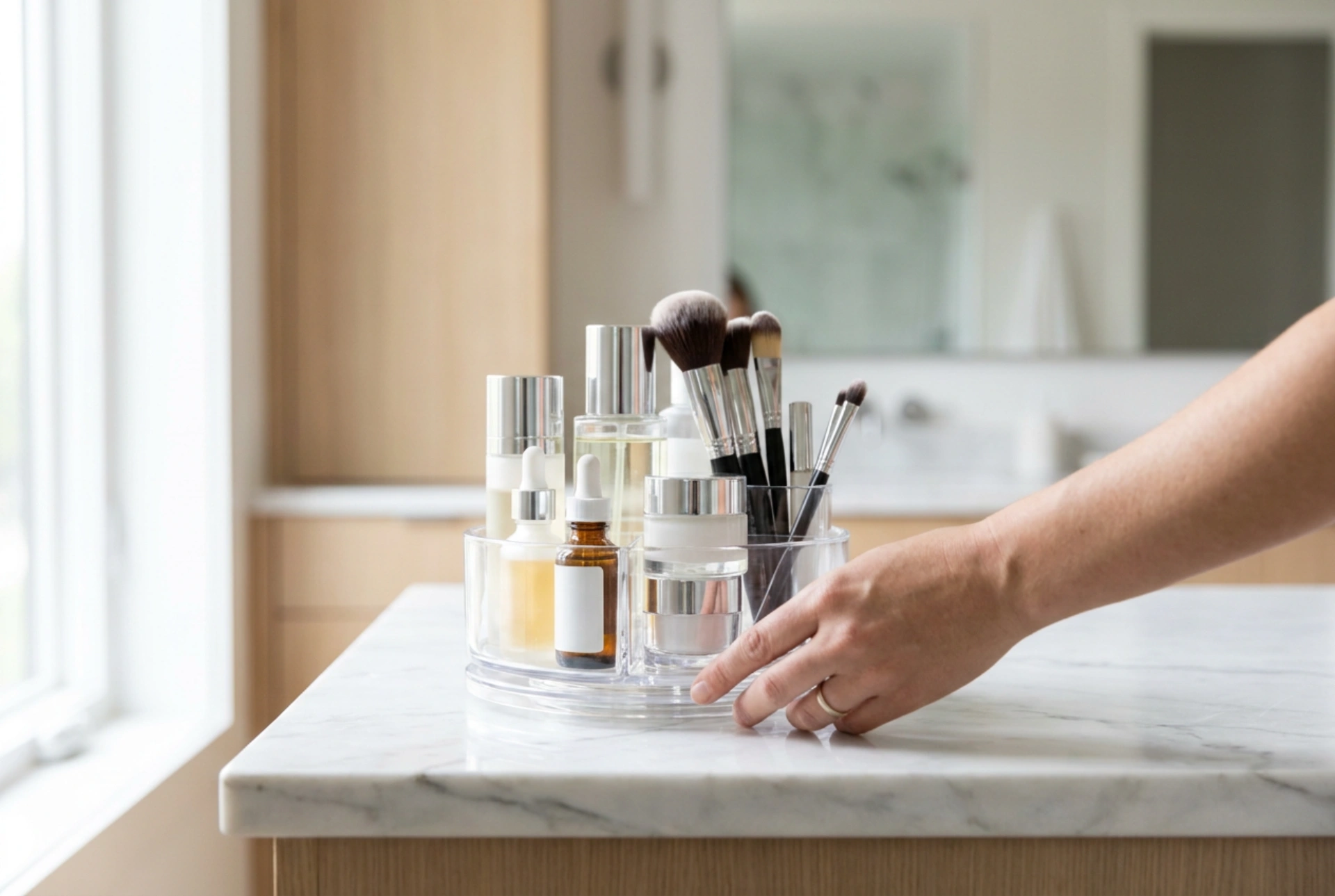


The rotational efficiency of a cosmetic organiser relies on simple principles of physics, namely mass distribution, friction reduction, and gravitational balance.
The Physics of Balance and Rotational Inertia
To achieve a frictionless, silent spin, you must manage the rotational inertia of the organiser. Rotational inertia is a measure of an object's resistance to changes in its rotation speed. In simple terms, the further a heavy object is placed from the central rotational axis, the harder it is to spin the unit smoothly, and the more strain is placed on the bearing mechanism.
To optimise this, place your heaviest items—such as large foundation bottles, thick glass skincare jars, and heavy creams—as close to the centre column as possible. By keeping heavy masses near the central axis, you minimise the torque required to turn the carousel. Conversely, lightweight items like brushes, eyeliner pencils, and cotton pads should occupy the outer trays. This distribution prevents the organiser from tilting and prevents uneven wear on the rollers beneath.
Levelling the Surface to Prevent Centrifugal Drift
Even a minor slope on your dressing table or bathroom countertop can cause a rotating organiser to stall or spin unevenly. Gravity acts on the off-centre mass, pulling the heaviest side to the lowest point. This causes the organiser to self-rotate to a resting position, making it difficult to access items on the opposite side.
Before loading the organiser, verify that the surface is completely level. You can test this by placing a small ball bearing or marble on the surface to see if it rolls. If the surface is uneven, use small adhesive silicone pads beneath the base of the organiser to adjust the height of the lower side. These silicone pads serve a dual purpose: they level the unit and absorb vibrations, preventing the organiser from sliding across your vanity during use.
Maintaining the Bearing Track
Most rotating organisers utilise either a metallic ball-bearing track or a plastic-on-plastic sliding mechanism. Over time, cosmetic powders, loose pigment, spilled oils, and airborne dust accumulate in this track, increasing friction and causing a squeaking or grinding noise.
To restore smooth rotation, disassemble the organiser and clean the bearing track. Wash the components using a mild surfactant, such as dishwashing liquid, mixed with warm water. This easily breaks down grease and cosmetic residues without degrading the acrylic or plastic structure. Avoid using harsh chemical solvents, which can craze or cloud clear plastics.
Once completely dry, apply a tiny amount of cosmetic-grade mineral oil or a dry PTFE-based lubricant to the track. Avoid vegetable oils, which oxidise, turn sticky, and attract dust over time. A single drop of mineral oil distributed evenly across the bearings will drastically lower the coefficient of friction and ensure a silent, fluid glide.
Height Clearances and Centre of Gravity
The height of your cosmetics also dictates the stability of the spin. Tall bottles placed on the top tier create a high centre of gravity, making the entire unit susceptible to wobbling or tipping when spun quickly. Place tall items on the bottom tier where the physical boundary walls of the shelf can support them, keeping the overall centre of mass low. Ensure there is at least a two-centimetre clearance between the tallest item and any surrounding walls, mirrors, or cabinet doors to prevent sudden stops and collisions.