

Maximising a narrow entryway cabinet requires shifting your perspective from horizontal depth to vertical and angular utility. By understanding the physics of tight spaces and utilising clever material organisation, you can transform a restrictive alcove into a highly efficient storage hub.
The Geometry of Angled Storage
Standard horizontal shelving requires a minimum depth of 30 to 35 centimetres to accommodate adult footwear. In a tight hallway, this depth significantly encroaches on the walking path. To bypass this physical limitation, you must exploit angular geometry. Installing shelves at a 45-degree to 60-degree decline reduces the required cabinet depth to as little as 15 centimetres.
When implementing angled storage, friction and gravity must be balanced. Smooth wooden or laminate shelves will cause items to slide off. To counter this, apply high-friction materials such as self-adhesive rubber lining or install a low-profile retaining lip at the bottom edge of each shelf. This lip should be no higher than 1.5 centimetres to prevent blocking access while still successfully resisting the downward kinetic energy of the stored items.
Managing Moisture and Airflow in Confined Volume
Narrow, closed cabinets suffer from severely restricted air circulation. Placing damp shoes, umbrellas, or coats inside a confined, unventilated space raises the relative humidity, creating an ideal microclimate for fungal spores and bacteria to thrive. This leads to unpleasant odours and the degradation of natural materials like leather.
- Passive Ventilation: Drill a series of neat 10-millimetre holes at the top and bottom of the cabinet backboard. This encourages natural convection; warm, moist air escapes through the top vents while pulling cooler, drier air in through the bottom.
- Chemical Absorbents: Place reusable canisters of activated charcoal or silica gel on the lower shelves. Activated charcoal works via adsorption, trapping organic odour molecules within its highly porous structure, while silica gel actively binds water molecules to reduce relative humidity.
- Material Selection: Avoid storing damp items directly on untreated MDF or particleboard, which swell and warp when exposed to moisture. Use non-porous liners or plastic drip trays that can be easily removed and wiped dry.
Hardware and Accessibility Mechanics
In narrow corridors, standard cabinet doors that swing outward at 90 degrees block traffic entirely. Furthermore, protruding handles are constant snagging hazards. The solution lies in choosing alternative mechanical actions for your cabinet faces.
Tilt-out shoe compartments (often called tipper mechanisms) pivot on a lower nylon hinge. When opened, the compartment drops forward at a limited angle, exposing the footwear vertically. This requires only 20 to 25 centimetres of clearance to operate fully. Alternatively, sliding doors on low-friction tracks eliminate outward swing entirely, keeping the hallway path completely unobstructed. To maintain a flush profile, replace traditional knobs with recessed cup pulls or push-to-open magnetic latches that activate with a simple press of the hand or knee.
Vertical Segmentation and Gravity-Based Organisation
When horizontal space is limited, the vertical axis is your primary asset. Standard shelf spacing often leaves substantial unused air pockets. By introducing micro-shelving and vertical dividers, you can segment the cabinet according to the exact dimensions of your items.
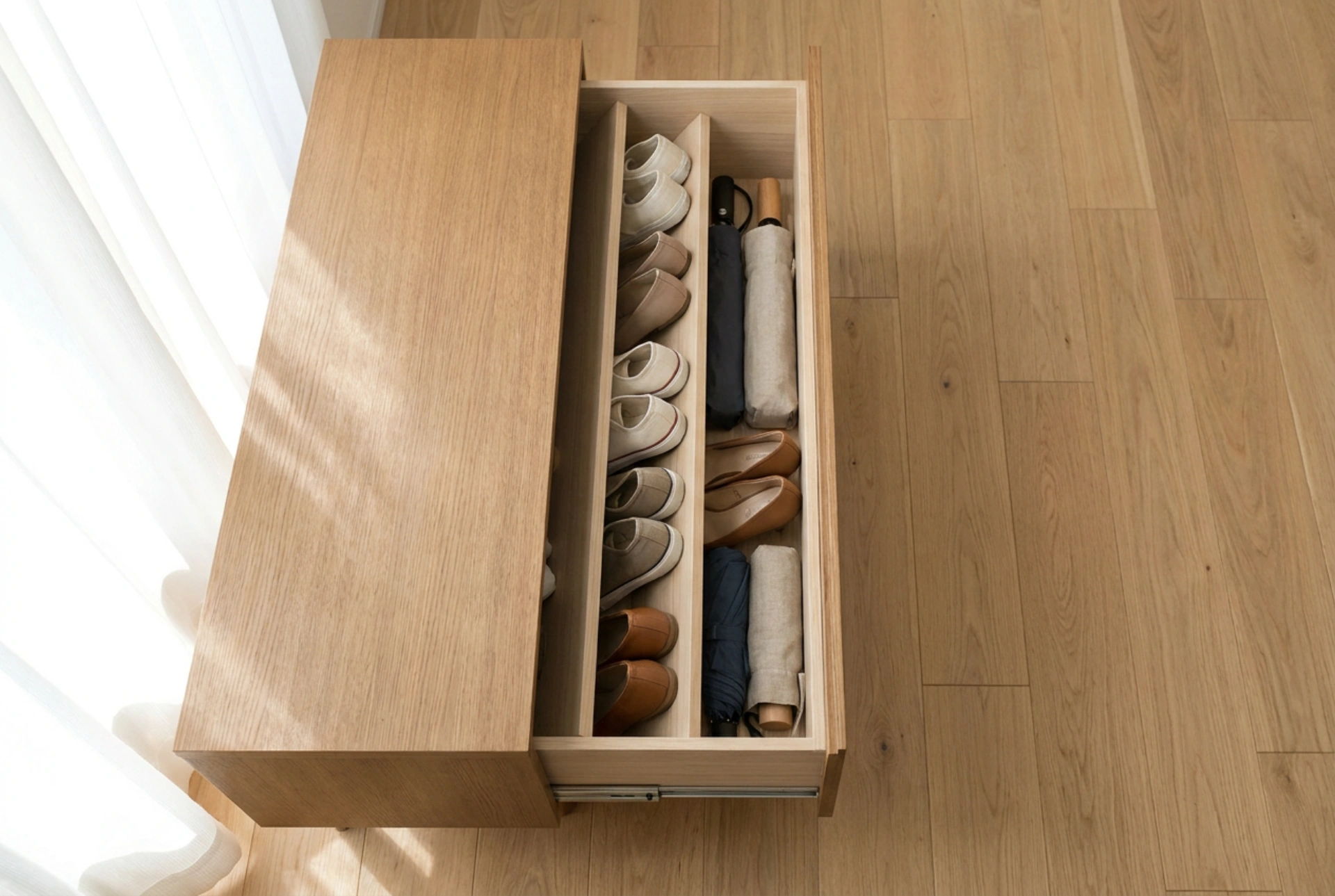
Using tension rods or thin plywood dividers allows you to store umbrellas, shoehorns, and walking sticks vertically alongside each other. This prevents them from cluttering the floor or tangling. For lightweight items, utilise the interior surface of the cabinet doors. Affixing low-profile magnetic strips or shallow adhesive hooks allows you to store keys, dog leads, and shoe brushes securely against the door, exploiting otherwise wasted dead space without adding to the external footprint of the cabinet.