

Selecting the smallest tumble dryer for a compact home requires looking far beyond physical dimensions; failing to account for thermodynamic requirements and air exchange can quickly lead to inefficient drying, appliance damage, or localized mold growth.
The Thermodynamics of Compact Dryers: Heat and Moisture Dynamics
Whether you choose a compact condenser, vented, or heat-pump dryer, every machine operates on the fundamental physical principle of evaporation. Liquid water in wet laundry absorbs thermal energy, turns into vapour, and must be extracted from the drum. In a standard-sized room, the ambient air volume easily absorbs or dissipates this energy. In a restricted space, however, the thermodynamic equilibrium shifts rapidly.
Condenser models extract moisture by cooling warm, damp air over a heat exchanger, converting steam back into liquid water. This process relies on a continuous intake of cool ambient air. If a compact dryer is placed in a tiny, unventilated closet, the surrounding air temperature rises quickly. Once the ambient temperature exceeds 30°C, the temperature differential inside the condenser narrows, significantly reducing condensation efficiency and extending drying times.
The Vented and Heat Pump Variants
- Vented units: These require a direct physical duct to the outside. Without it, they discharge hot, moisture-laden air directly into the room, rapidly raising the dew point and causing condensation on cold surfaces like walls and windows.
- Heat pump units: Although highly efficient, they still release small amounts of heat and require precise ambient operating temperatures (usually between 5°C and 35°C) to allow the refrigerant cycle to function optimally.
The Air Clearance Fallacy: Why Tight Fits Cause Motor Failure
Many homeowners assume that if a mini dryer physically fits into a cabinet or alcove, the installation is successful. This ignores the boundary layer of air required for mechanical cooling. Dryers pull in fresh air to cool their internal electronics and drive the drying cycle, while simultaneously expelling warm air.
When clearances around the top, sides, and back of the machine are less than 50 to 100 millimetres, the appliance begins to recirculate its own exhausted air. This creates a thermal feedback loop. The intake air becomes increasingly hot, causing the drive motor and compressor to overheat. Modern appliances feature thermal cut-off switches to prevent fires, but frequent tripping of these sensors degrades the components, leading to premature motor failure.
Managing the Dew Point and Ambient Relative Humidity
When operating a small dryer in a confined area, managing the ambient relative humidity is paramount. Warm air holds more moisture than cold air. When this warm, humid air contacts a cooler surface—such as a tiled wall or glass window—it drops below its dew point, resulting in liquid water condensation.
To mitigate this without major structural changes, ensure the room has an active air exchange rate. If passive ventilation (such as an open window or a door grille) is insufficient, installing a simple, non-electrical mechanical extraction fan or utilizing a standalone dehumidifier in the adjacent space can help maintain stable air pressure and humidity levels.
Vibration, Surface Mechanics, and Load Distribution
Compact dryers are lightweight, which makes them highly susceptible to kinetic forces during the spin cycle. When damp clothes clump together, they create an asymmetrical load inside the drum, generating significant centrifugal force.
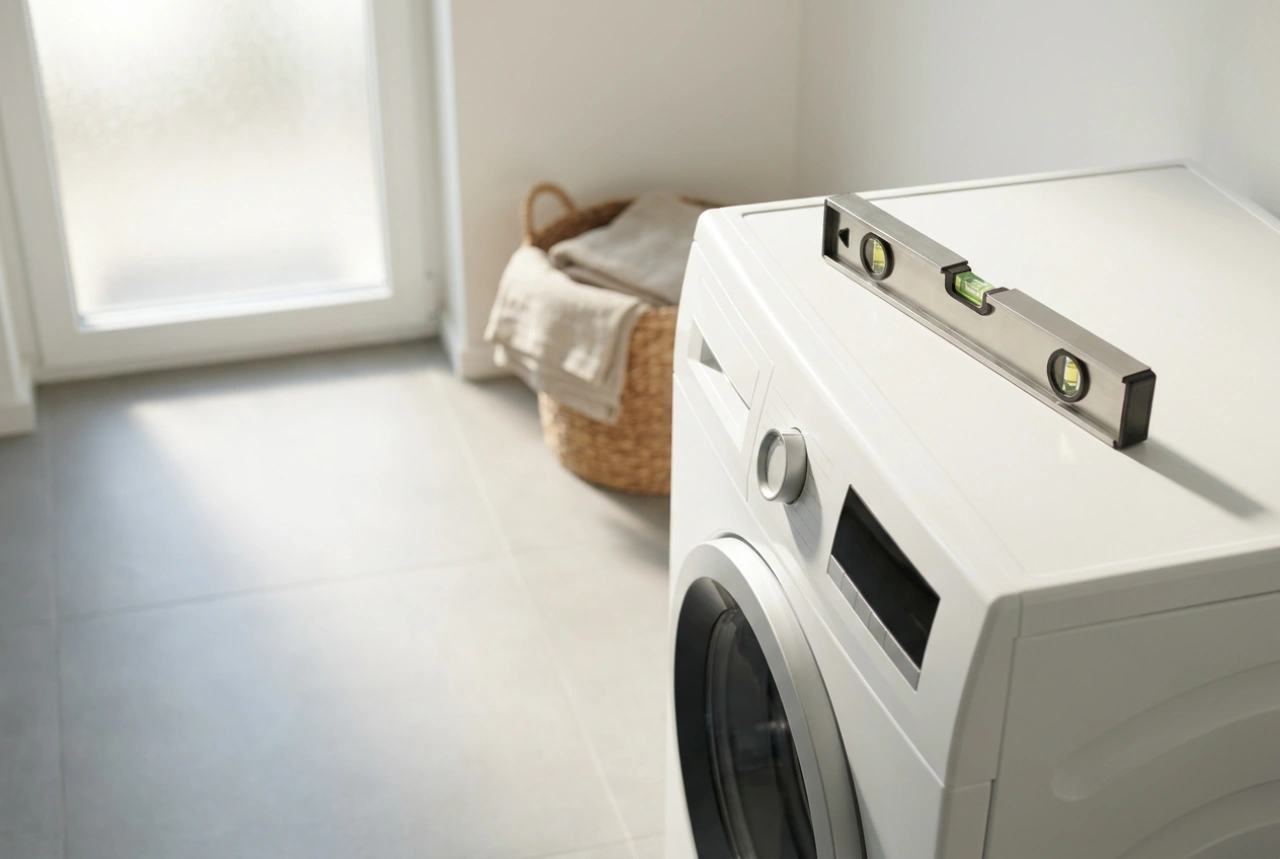
Placing a small dryer on a flexible or uneven surface, such as a hollow-core wooden cabinet or an unreinforced shelf, amplifies these vibrations. This kinetic energy is transferred directly into the surrounding structure, causing irritating noise and slowly loosening structural joints. Ensure the mounting surface is dense, level, and decoupled using a high-density rubber vibration-dampening mat to absorb shear forces.