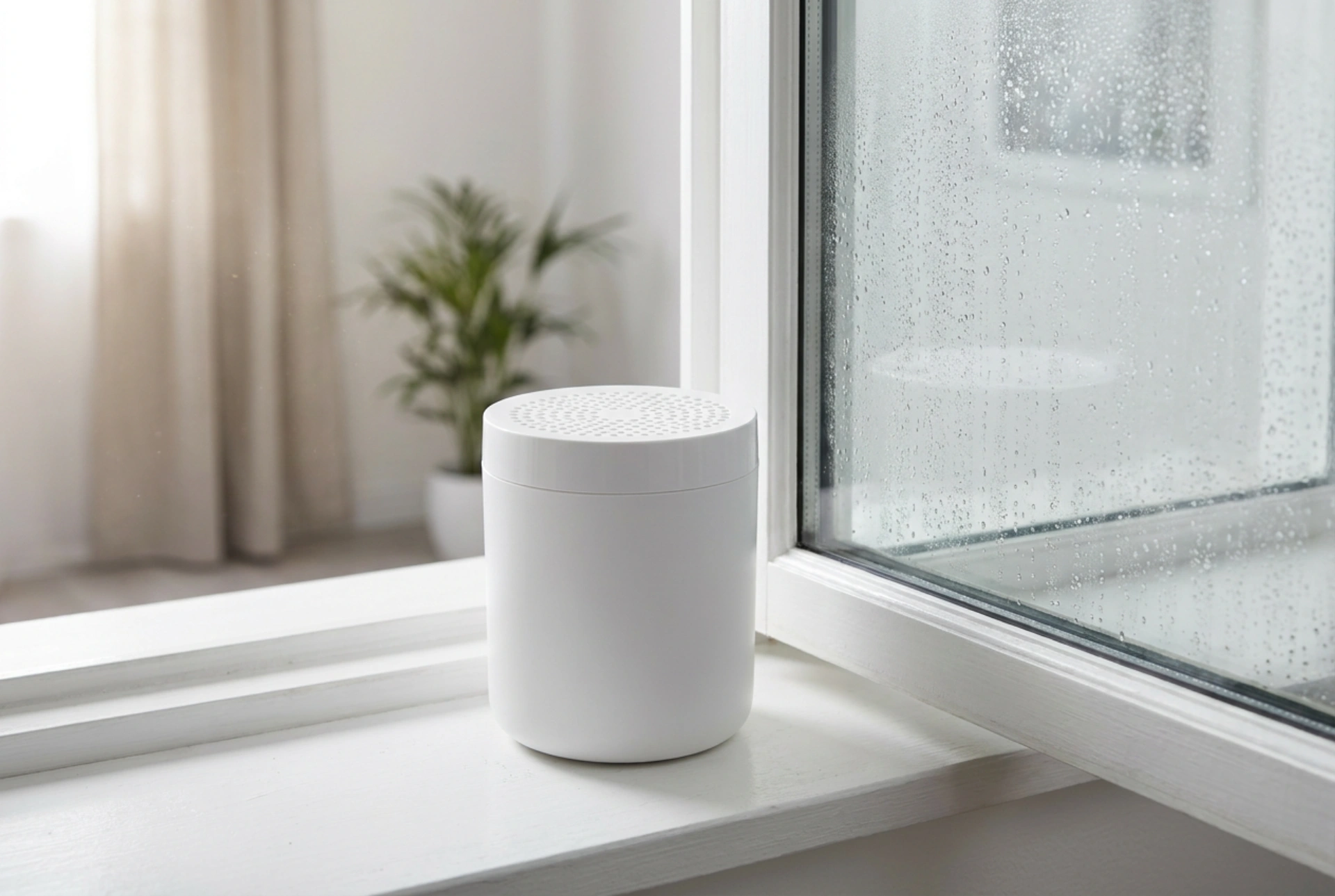


Condensation on windows occurs when warm, humid indoor air meets the cold surface of the glass pane, dropping below the dew point. Placing a non-electric moisture absorber on the windowsill is an effective physical intervention, but its efficiency depends entirely on placement, convection currents, and thermodynamic principles.
The Science Behind Wet Windows: Thermal Bridging and Dew Point
To understand where to place a moisture absorber, we must first understand why moisture accumulates on windows. Windows represent a thermal bridge—a zone where heat escapes more rapidly than through insulated walls. When warm indoor air, which holds water vapor, comes into contact with the cold window pane, the air temperature drops rapidly. Cold air has a lower water-carrying capacity than warm air. Once the air temperature falls below the dew point, the excess water vapor undergoes a phase transition, changing from gas to liquid, and deposits onto the glass as condensation.
This process is highly localized. The air directly adjacent to the glass is significantly colder and more humid than the air in the centre of the room. Therefore, placing a moisture absorber on a distant table will have little to no effect on the microclimate near the window. The device must be placed directly in the path of the local air circulation near the glass to intercept the humid air before it undergoes condensation.
The Role of Convection Currents on the Windowsill
Air in a room is in constant motion due to natural convection. Warm air from radiators rises, while cold air near the window panes sinks. This creates a circular air current. If your radiator is located directly beneath the windowsill, the rising warm air creates a barrier, heating the glass and pushing moisture away. However, if the windowsill blocks this heat flow, or if you use heavy, closed curtains, a stagnant, cold microclimate is created right in front of the glass.
When positioning a moisture absorber, you must work with these convection currents. Placing the absorber too close to the glass can cool the chemical medium inside, reducing its reaction rate. Conversely, placing it too far away might position it outside the cold-air descent zone. The optimal position is in the middle of the windowsill, aligned with the glass but kept at least 5 to 10 centimetres away from both the window frame and any curtains. This allows descending cold, damp air to pass directly over the absorber's intake grilles, maximizing the capture rate.
How Chemical Moisture Absorbers Interact with Air
Most non-electric moisture absorbers rely on anhydrous calcium chloride. This inorganic salt is highly hygroscopic and deliquescent, meaning it has a strong affinity for water and will absorb moisture from the atmosphere until it completely dissolves in its own collected water, forming a liquid brine.
The chemical reaction is exothermic, releasing a small amount of heat as water molecules bind to the crystal lattice of the calcium chloride. This chemical process requires a steady supply of ambient air. If the absorber is crowded by decorative items, potted plants, or trapped behind dense drapes, the local air becomes stagnant. The calcium chloride will quickly dry out the immediately surrounding pocket of air, but because there is no airflow, the broader condensation cycle on the window pane will continue uninterrupted. Keeping the space around the absorber clear is critical for maintaining the chemical reaction.
Practical Steps for Perfect Placement and Maintenance
- Maintain a safety gap: Position the device at least 10 centimetres away from the glass. This prevents the plastic casing of the absorber from getting too cold, which could inhibit the chemical absorption rate.
- Avoid curtain obstruction: Ensure that curtains or blinds do not drape over the moisture absorber. Blocked airflow stops the cycle of convection, rendering the device ineffective.
- Ensure level ground: Windowsills must be perfectly level. As the calcium chloride turns into brine, a tilted unit can leak highly concentrated salt water, which is corrosive to wooden or stone windowsills.
- Regularly empty the reservoir: Once the brine level rises, the exposed surface area of the active crystals decreases. Empty the collected liquid regularly into a drain, rinsing the reservoir with fresh water to prevent salt crusting.
Optimizing Your Home Microclimate
While a moisture absorber is an excellent tool for managing localized relative humidity, it should be part of a broader moisture control strategy. Combine the use of the absorber with short, intense periods of cross-ventilation. Opening windows fully for five minutes replaces warm, wet indoor air with dry, cold outdoor air, which then warms up and can absorb more moisture, working in tandem with your windowsill absorber to keep your glass clear and dry.