

Maximising narrow hallway corridors requires efficient spatial geometry rather than simply reducing the volume of stored items. A rotating shoe cabinet solves the footprint-to-capacity dilemma by utilising vertical space and a 360-degree rotational axis to provide instant access without requiring traditional swinging clearance.
The Spatial Geometry of Rotational Storage
Traditional shoe cabinets with hinged doors require a double allocation of space: the physical footprint of the unit itself, plus the clearance arc required for the doors to swing open. In narrow hallways, this clearance often blocks the primary walkway, creating physical bottlenecks. A rotating shoe cabinet operates on a fixed vertical axis, meaning its operating footprint remains identical whether it is open, closed, or in motion. This spatial independence allows the cabinet to be placed directly adjacent to doors, tight corners, or architectural recesses without obstructing the flow of traffic.
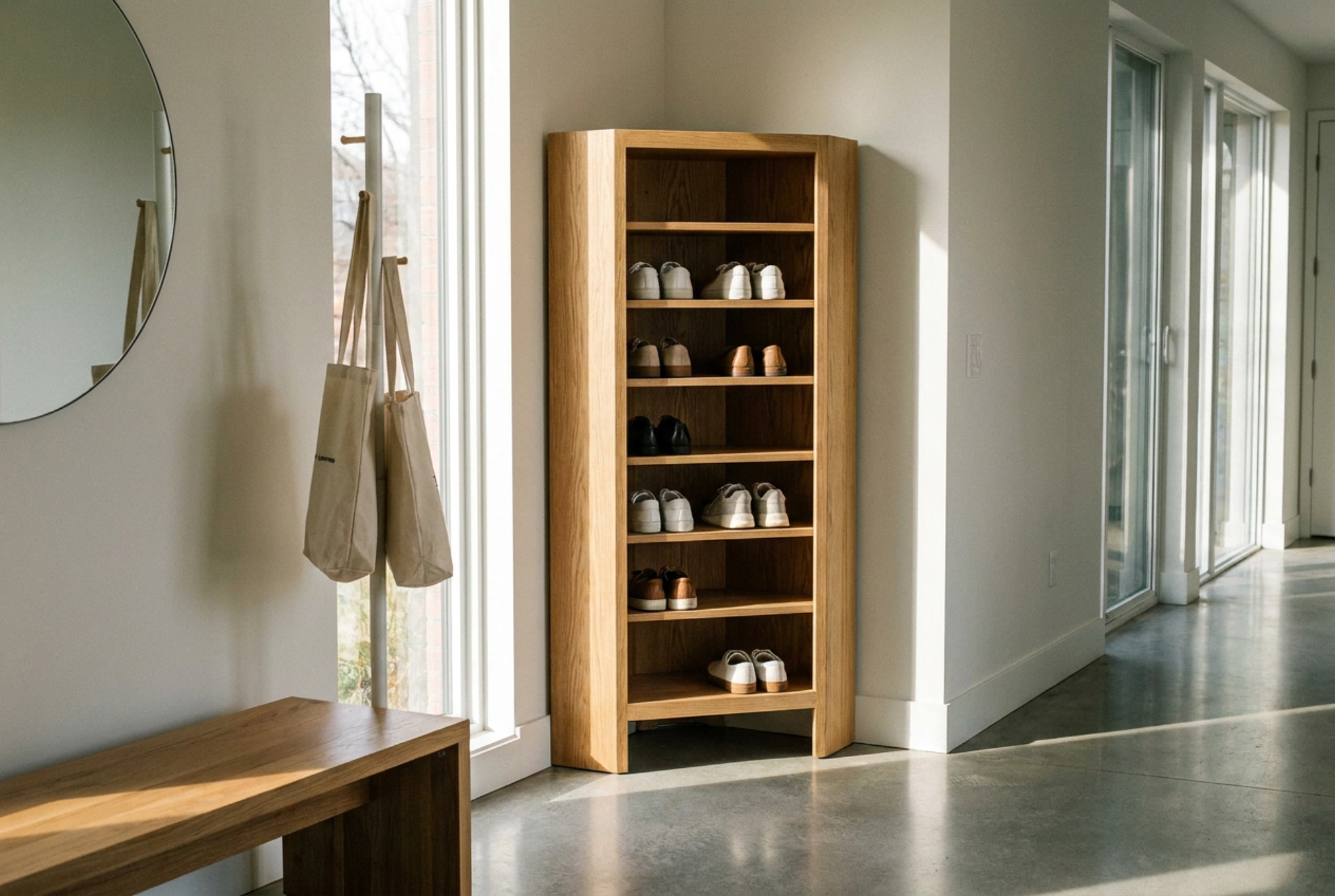
By employing a cylindrical or slim rectangular carousel design, these units utilise the corners of a room—areas that are typically underutilised due to difficult access. When you rotate the cabinet, the rotational path stays within a tightly defined radius. This geometric efficiency allows you to store up to three times more footwear per square metre of floor space compared to flat, wall-mounted racks or deep chest drawers, converting dead corner volume into highly functional storage space.
Mechanical Equilibrium and Load-Bearing Dynamics
The core of a rotating cabinet's longevity lies in its central axis and bearing mechanism. High-quality swivel mechanisms utilise steel ball-bearing rings that distribute the vertical load evenly across a circular race. This reduces friction, allowing hundreds of Newtons of weight to rotate with minimal force. The moment of inertia dictates that a heavier spinning object requires more force to start and stop; therefore, managing the weight distribution is critical to both ease of use and structural preservation.
To ensure smooth rotation and prevent mechanical wear, proper weight distribution is essential. Heavy winter boots, thick-soled leather shoes, and safety footwear must be placed on the lowest shelves of the rotating column. This placement lowers the centre of gravity of the entire structure, stabilising the unit against wobbling during rotation and reducing the shear stress on the upper guide pivots. Lighter footwear, such as sandals, canvas shoes, and slippers, should occupy the upper tiers to maintain a stable, bottom-heavy equilibrium that prevents tipping and uneven wear on the rotating track.
Microclimatic Benefits and Footwear Preservation
Storing shoes in dark, unventilated enclosures can accelerate the deterioration of materials. Footwear absorbs sweat and environmental moisture during use. When sealed inside a standard airtight cabinet, this moisture cannot evaporate, leading to hydrolysis—the chemical breakdown of polyurethane soles and adhesives—and providing a breeding ground for mould and bacteria. Natural leathers can dry out unevenly or develop mildew if stored damp in a stagnant environment.
Rotating shoe cabinets often employ semi-open vertical slats or open-backed designs that facilitate natural air convection. As the cabinet is rotated during daily use, the physical movement pushes ambient air through the shelves, accelerating the evaporation of residual moisture. This active and passive airflow helps regulate the relative humidity around the shoes, preserving natural leather fibres, maintaining adhesive integrity, and preventing the accumulation of stale odours in the entryway.
Ergonomic Advantages and Daily Order of Operations
Retrieving items from the back of deep, low shelves requires deep bending and awkward stretching, which places unnecessary strain on the lumbar spine. A vertical rotating cabinet brings the shoe to the user rather than forcing the user to conform to the furniture. By rotating the desired tier to face forward, you can access any pair from a comfortable, standing posture. To optimise this system, follow a logical arrangement based on ergonomics:
- Analyse usage frequency: Place daily-use items at waist-to-chest height for immediate, effortless retrieval without bending.
- Seasonal rotation: Spin off-season footwear to the back-facing side of the internal carousel, keeping current weather-appropriate pairs readily accessible at the front.
- Symmetrical loading: Distribute weight evenly across the left and right halves of each shelf to prevent the unit from drifting or rotating automatically due to gravitational imbalance.
- Seasonal rotation: Spin off-season footwear to the back-facing side of the internal carousel, keeping current weather-appropriate pairs readily accessible at the front.