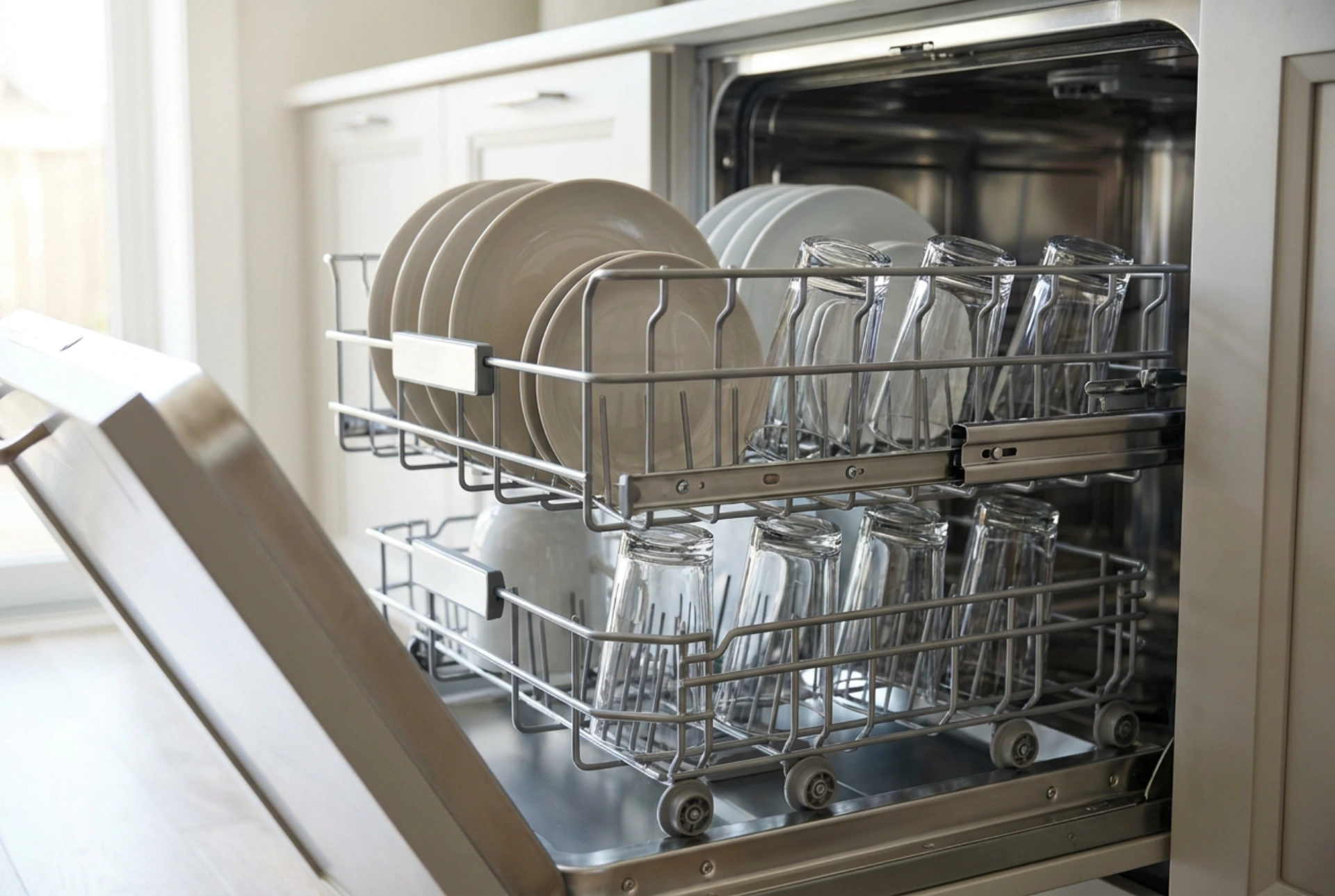


Dishwashers with lifting lower racks offer outstanding ergonomic convenience, but their sophisticated mechanical linkages and telescoping runners are highly sensitive to weight distribution. Understanding the mechanical forces at play and applying strategic loading techniques will prevent premature wear, structural misalignment, and costly repairs of your appliance.
The Mechanics of Assisted-Lift Racks
Unlike standard dishwashers where the lower rack simply rolls out onto the open door, lifting-rack systems employ a complex network of spring-assisted hinges, hydraulic dampers, and heavy-duty slide rails. When you pull the rack forward and lift, you are engaging a mechanical linkage designed to counteract gravity. This mechanism is calibrated for a specific maximum load and, more importantly, a balanced center of gravity.
When the rack is lifted, the leverage exerted on the metal runners increases exponentially. If the rack is unbalanced, it introduces torsional stress (twisting forces) to the parallel slide tracks. Over time, asymmetric forces bend the delicate ball-bearing slides or misalign the tracks, leading to rough operation, jamming, or complete failure of the lifting lock system.
Strategic Loading and Weight Distribution
To protect the mechanical integrity of the lifting runners, you must load the rack with physics in mind. Universal rules of weight distribution prevent uneven wear on the telescoping rails:
- Even lateral balance: Always distribute heavy items, such as stoneware plates and glass dishes, evenly between the left and right sides of the rack. Loading all heavy cookware on one side causes the rack to tilt, putting immense lateral friction on a single runner track.
- Concentrate weight near the pivot: Position the heaviest items toward the rear or middle of the rack. Placing excessively heavy items at the absolute front increases the leverage ratio when the rack is lifted, amplifying the effective weight handled by the spring-assist linkages.
- Respect the weight limit: Refer to your appliance manual for the precise weight capacity, but as a rule of thumb, avoid loading multiple heavy ceramic baking dishes in a single cycle. Use the upper rack or hand-wash exceptionally dense items.
The Ergonomics of Safe Operation
The way you physically interact with the lifting mechanism dictates its operational lifespan. Applying sudden force or pulling at incorrect angles can easily bypass the safety tolerances of the runners.
Always use the dedicated central handle to initiate both the pull-out and the upward lifting motion. Grabbing the rack by its outer wire frames or pulling from one side introduces skewed forces that twist the slide rails. Pull the rack outward in a smooth, continuous motion until it reaches its outer limit, then allow the lifting mechanism to gently pivot the rack upward. Avoid jerky movements; acceleration increases the dynamic load on the physical stops and dampers, causing micro-fractures in plastic components and bending metal guides.
Maintaining Slide Rail Performance
The environment inside a dishwasher is harsh, combining high temperatures, detergents, and food debris. For telescoping runners to slide smoothly, they must remain clean and free from physical obstructions.
Regularly inspect the tracks for trapped food particles, hard-water limescale deposits, or congealed grease. A build-up of debris increases friction, forcing you to pull harder and putting unnecessary stress on the mechanical linkages. To clean the runners, wipe them down with a soft, damp cloth and a mild citric acid solution to dissolve mineral build-up. Never apply standard household lubricants, as these will wash into the wash water, contaminate your dishes, and degrade the food-grade grease used to lubricate the internal ball bearings of the slides.