

Vertically smoothing garments with a handheld steamer relies on thermodynamics and mechanical tension, bypassing the traditional ironing board while preserving the natural loft and texture of fibers. By understanding how heat and moisture interact with different fabric structures, you can achieve professional, crease-free results using only a hanger and gravity.
The Physics of Steam: How Fibers Relax
At the molecular level, fabrics wrinkle because their polymer chains are locked in place by hydrogen bonds. Daily wear, folding, and moisture from sweat or wash cycles cause these bonds to break and reform in distorted positions. Standard dry ironing relies on heavy mechanical pressure and direct conduction heat to flatten these bonds, which can crush the fabric's natural volume and create unwanted shine on seams.
A handheld garment steamer operates on a different principle: convection heat and high-humidity penetration. The hot water vapor molecules physically penetrate the microscopic spaces between the fibers. This influx of heat and moisture temporarily disrupts the hydrogen bonds, making the molecular chains highly flexible. In this relaxed state, the fibers can be easily reshaped. As the fabric cools and the moisture evaporates, the hydrogen bonds reform in a straight, relaxed alignment, eliminating the wrinkle.
Setting Up the Vertical Tension Zone
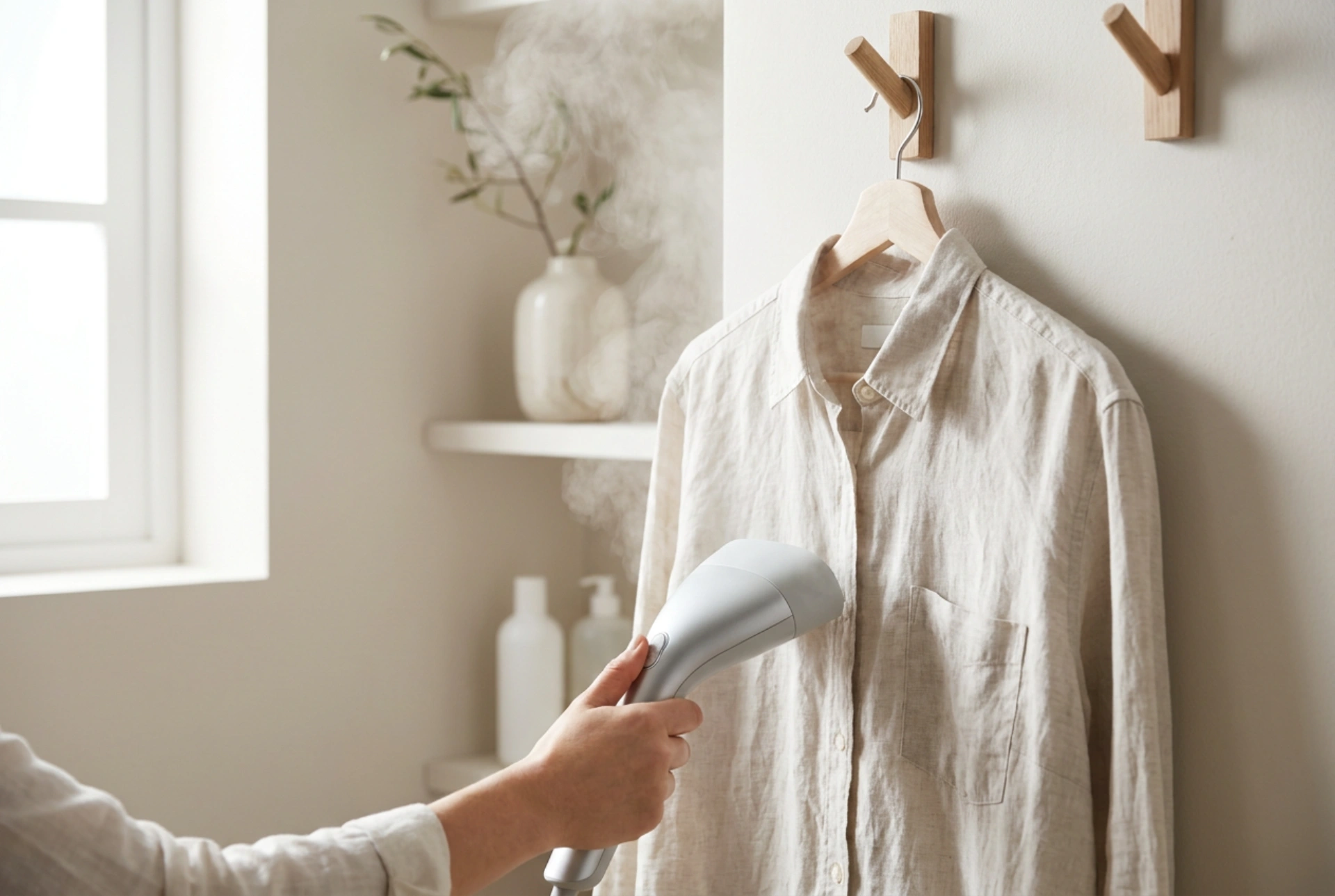
Without an ironing board to provide resistance, you must create a tension zone using gravity and manual leverage. The garment must hang freely at a height that allows you to work comfortably from the collar to the hem.
- Choosing the Anchor Point: Suspend the hanger from a sturdy hook, a door frame, or a shower rod. Ensure there is solid support behind the top of the garment so it does not sway excessively when touched.
- Creating Manual Tension: Steam alone cannot remove deep creases; it only softens the fibers. To straighten them, you must apply light downward or outward tension. Grasp the hem of the garment with your free hand and pull the fabric taut. This creates a flat plane against which the steamer head can glide.
- Preventing Distortion: Avoid pulling too hard on bias-cut fabrics or loose knits, as this can permanently stretch the garment out of shape. Pull just enough to make the surface smooth and receptive to the steam.
Technique and Motion: The Bottom-Up Rule
The sequence of your movements determines both the efficiency of the process and the quality of the finish. Always work from the bottom of the garment upward.
As steam rises naturally, working from the hem upward allows the escaping vapor to pre-heat and pre-moisten the fabric directly above your working area. This prepares the upper fibers, reducing the number of direct passes required. Hold the steamer head flat against durable fabrics like cotton and linen, moving in slow, vertical sweeps. For delicate materials, hover the head approximately one to two centimeters away from the surface to prevent water spotting and thermal damage.
For sleeves, insert your hand inside the cuff to pull the sleeve taut, then run the steamer down the outer length. When steaming collars or pockets, steam from the inside out to avoid pressing pocket outlines onto the front of the garment.
Fabric-Specific Protocols: Chemistry and Heat Sensitivity
Different textile fibers react uniquely to heat and moisture. Adjusting your distance and steam volume prevents permanent material degradation.
- Cotton and Linen (Cellulose Fibers): These materials have high crystalline structures and strong hydrogen bonds, requiring maximum heat and high steam volume. Keep the metal or ceramic plate of the steamer in direct, firm contact with the fabric, pulling it tightly to force the moisture deep into the dense weave.
- Wool and Cashmere (Protein Fibers): Wool fibers have a natural scale structure that can felt or shrink under direct pressure and excessive wet heat. Steam these garments from a slight distance to relax the fibers, then gently brush the surface to restore the natural loft.
- Synthetics (Polyester, Nylon, Acrylic): These are thermoplastic materials that melt or glaze under high temperatures. Use low steam settings and maintain a constant, rapid motion to prevent heat localization. Never press the hot plate directly against synthetic fibers.
The Essential Cooling Phase
The steaming process is not finished when the wrinkles disappear; it is complete when the fabric stabilizes. Because the fibers are highly malleable when warm and damp, wearing the garment immediately will cause instant, deep creasing at the elbows, waist, and hips. Allow the steamed garment to hang undisturbed for five to ten minutes in a well-ventilated area. This permits the excess moisture to evaporate fully and allows the hydrogen bonds to lock into their newly straightened configurations, securing a crisp, lasting finish.