

Top-loading washing machines offer an exceptionally narrow footprint ideal for tight spaces, but maximizing their efficiency requires a deep understanding of vertical clearance and spatial ergonomics.
The Geometry of Spatial Footprints
In compact architectural layouts, every square centimeter of floor space dictates the flow of movement. Traditional front-loading washing machines require a significant horizontal clearance zone directly in front of the unit to accommodate the door swing, which typically ranges from 45 to 60 centimeters. In contrast, top-loading machines operate on a vertical axis. With standard widths of just 40 to 45 centimeters, compared to the 60-centimeter norm of front-loaders, they minimize the physical footprint floor-wise, making them ideal for narrow utility niches, hallway closets, or tight bathroom corners.
By shifting the operational clearance from the horizontal plane to the vertical plane, top-loaders allow the floor space directly in front of the appliance to remain completely unobstructed. This mechanical layout means you do not need to factor in extra standing room for bending down to load or unload garments, optimizing the overall kinetic flow of the room.
Optimizing Vertical Clearance and Shelving Kinematics
While top-loaders save valuable floor area, they introduce a distinct spatial challenge: the vertical lid clearance. A standard top-loader lid requires between 40 and 50 centimeters of unobstructed vertical space above the machine to open fully and remain upright during loading. Failing to plan for this swing radius results in restricted access and repetitive physical strain.
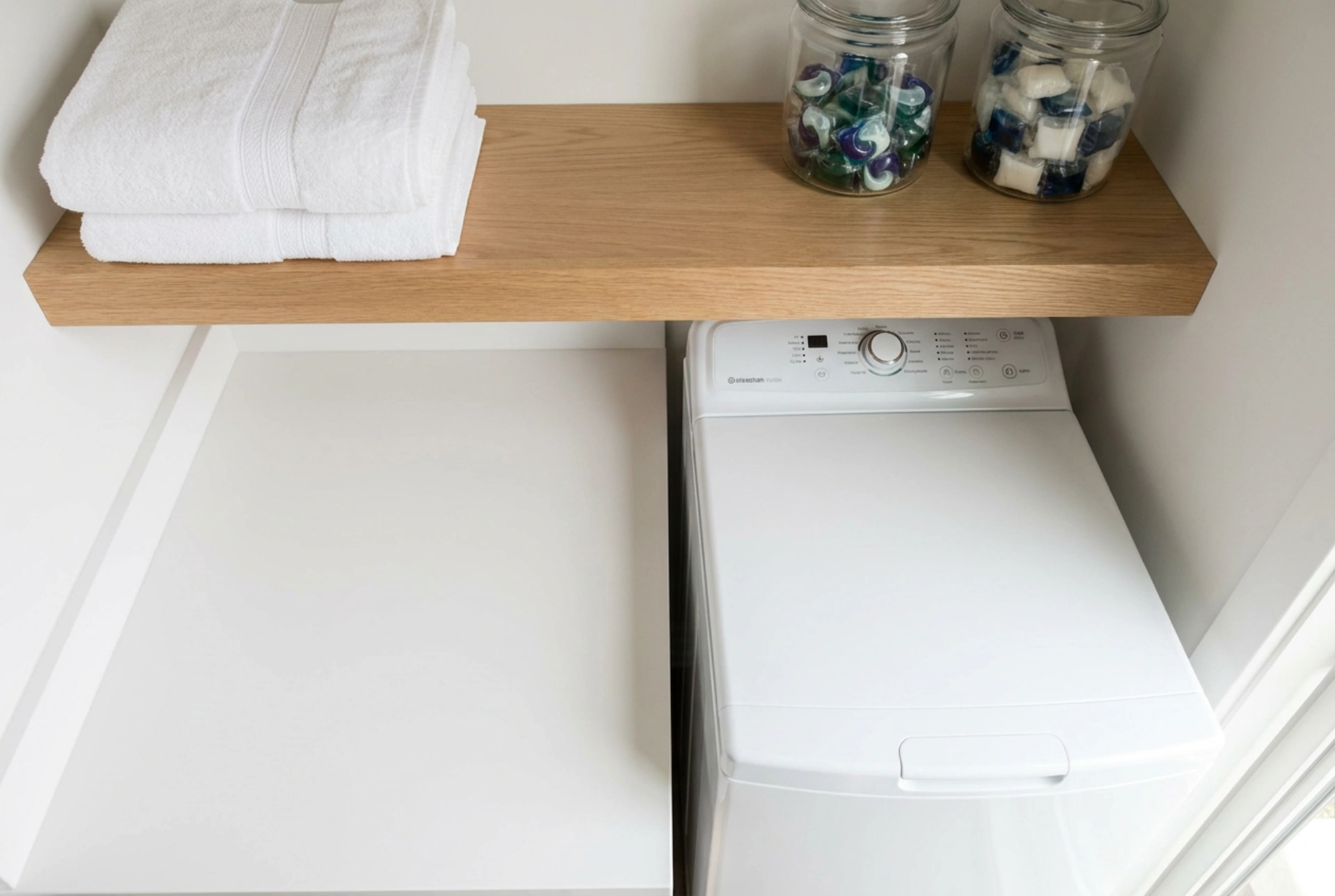
To utilize the vertical wall space above the appliance without obstructing the lid, implement modular shelving systems with a calculated offset. The lowest shelf must be positioned at least 50 centimeters above the machine’s closed top panel. Alternatively, utilizing shallow shelves (under 20 centimeters in depth) allows the lid to fold up in front of the shelves without contact. For maximum efficiency, sliding or telescopic track shelves can be installed, allowing storage units to slide laterally when the machine is in use, maintaining accessibility to both the storage and the washer drum.
Thermodynamics of Airflow and Moisture Prevention
Unlike front-loaders, which lock moisture inside a tightly sealed rubber gasket, top-loaders utilize gravity to keep water within the drum basin. However, leaving the lid closed immediately after a wash cycle traps warm, humid air, creating an ideal environment for microbial growth. Maintaining a clean machine requires keeping the lid open between cycles to allow evaporative cooling and moisture dissipation.
This necessity impacts the material science of any shelving or cabinetry situated directly above the machine. Unsealed wood, low-grade fiberboards, or non-treated metals will warp, swell, or rust over time due to the rising humid air currents. When designing the surrounding enclosure, opt for powder-coated steel, marine-grade plywood treated with polyurethane, or natural hardwoods finished with water-resistant oils. Ensure a minimum ventilation gap of 5 centimeters on the sides and rear of the appliance to facilitate continuous convective airflow, which accelerates drying of both the drum and the surrounding microenvironment.
Ergonomic Workflow and Structural Loading
The mechanical advantage of a top-loader lies in the elimination of deep lumbar bending. To maximize this ergonomic benefit, organize the surrounding workspace to support a fluid, top-down workflow. Position detergent dispensers and sorting bins at waist height to minimize reaching or twisting movements.
When organizing heavy items, utilize the physics of load distribution. Keep heavy chemical containers, such as liquid oxygen bleaches or liquid detergents, on lower, easily reachable shelves adjacent to the machine rather than overhead. This lowers the center of gravity of your shelving units and reduces the risk of accidental spills onto the appliance control panel. By aligning your physical movements with the vertical axis of the machine, you create a highly efficient, fatigue-reducing laundry sequence.
Key Spatial Rules for Top-Loader Installation
- Allow at least 50 cm of vertical clearance directly above the lid for comfortable loading.
- Maintain a 5 cm lateral ventilation envelope around the machine's perimeter to prevent heat buildup.
- Select moisture-resistant materials for overhead storage to prevent warping from humid air currents.
- Position heavy items below shoulder height to maintain safe structural load dynamics and prevent accidental spills.