

Optimizing a compact dishwasher requires understanding fluid dynamics and spatial geometry rather than simply forcing items into the rack. Overloading a mini dishwasher limits water coverage and prevents detergents from dissolving properly, leading to film residue and unhygienic cycles.
The Physics of Water Flow in Small Chambers
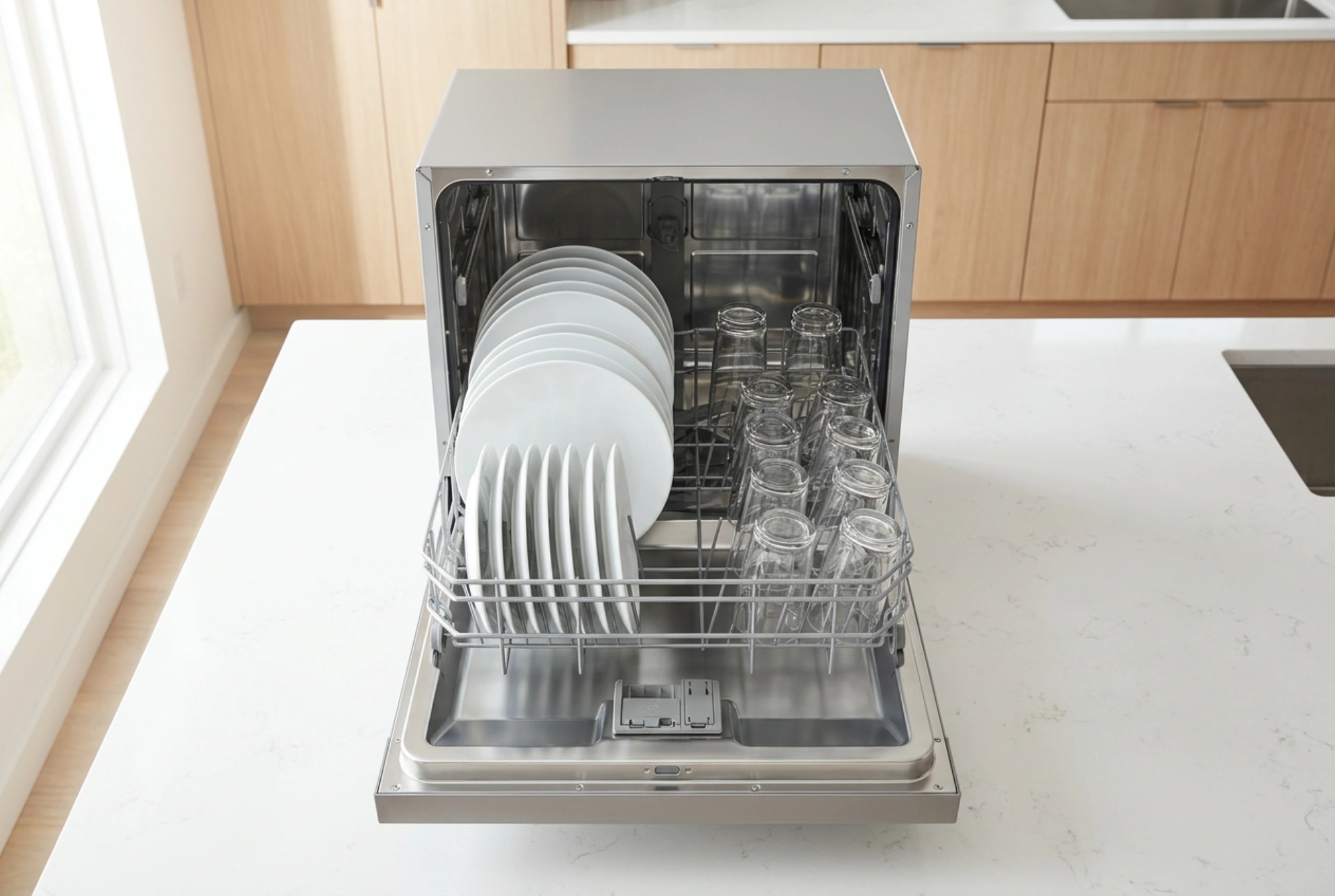
In a standard compact dishwasher, water is distributed via a single or dual rotating spray arm system. Unlike larger units with multiple high-pressure zones, compact appliances rely heavily on uninterrupted water trajectories. When dishes are packed too closely, they create "spray shadows"—zones where water cannot physically penetrate. To prevent this, every plate and bowl must be angled downward toward the center spray arm. This orientation utilizes gravity to guide water down the dirty surfaces, carrying loosened food soil away rather than letting it settle in pools.
The 45-Degree Angle Rule
The inclination of your tableware is critical for drainage. Placing flat plates perfectly upright can block the water path for neighboring items, while placing them completely flat prevents dirty water from running off. An optimal angle of approximately 45 degrees allows the high-velocity water jets to strike the surface, break the chemical bonds of the soil, and cascade downward freely. This angle also prevents water pooling on the concave bottoms of cups and mugs, which is a major cause of spotting during the drying phase.
Material Sorting and Thermal Heat Retention
Different materials absorb and retain heat at varying rates, which directly affects how they dry. Ceramics and glass have high thermal mass; they absorb heat during the wash cycle and release it slowly, which aids in the evaporation of residual moisture. Plastics, having low thermal mass, cool down rapidly, leading to condensation. In a mini dishwasher, place plastics on the outer edges of the rack where they are less likely to block the thermal radiation from the heating element and won't flip over from the force of the water spray.
Preventing Spoon Nesting and Cutlery Overcrowding
Cutlery is highly susceptible to incomplete cleaning due to "nesting"—the physical phenomenon where curved surfaces, like spoons, stack perfectly against one another, sealing out water and detergent. To avoid this without a dedicated cutlery drawer, alternate the orientation of your utensils. Place some handles up and others down. Fork tines should point upward for maximum exposure to the spray arm, while knives should be loaded handle-up for safety. If your compact dishwasher has a small basket, distribute heavy spoons across different compartments to keep them separated by water-permeable barriers.
Surfactant Action and Water Temperature in Small Volumes
Because compact dishwashers use significantly less water (often only 5 to 8 liters per cycle), the ratio of detergent to water must be carefully balanced. Over-dosing leads to an excess of surfactants that cannot be rinsed away, leaving a slippery, chemical film on glassware. Use powder or liquid detergents that can be measured precisely, rather than oversized multi-action tablets designed for full-sized machines. Ensure the cycle temperature reaches at least 50°C to activate the enzymes that break down starches and proteins, and utilize a rinse aid to lower the surface tension of the water, allowing it to sheet off the surfaces smoothly and prevent mineral spotting.