

The sanitise cycle on modern dishwashers is a highly effective tool for thermal disinfection, but utilising it incorrectly can damage kitchenware or fail to achieve the desired hygienic results. Knowing when to deploy this high-temperature function—and which materials cannot withstand its thermal stress—is key to maintaining both a hygienic home and the structural integrity of your utensils.
The Science of Thermal Sanitisation
To understand when to use the sanitise cycle, it is necessary to examine the physics of thermal disinfection. Standard dishwashing programs operate at temperatures between 45°C and 65°C, which are sufficient for dissolving fats and removing food debris when paired with surfactants. However, these temperatures do not guarantee the elimination of all pathogenic microorganisms. The sanitise cycle elevates the final rinse temperature to at least 70°C (often reaching 72°C or 75°C) and sustains this peak for a minimum of ten continuous minutes.
This prolonged exposure to high heat works through a process called thermal denaturation. The heat transfers into the cellular structure of bacteria, viruses, and fungal spores, permanently disrupting the molecular bonds of their proteins and nucleic acids. Once these vital proteins fold incorrectly or break apart, the pathogens lose their structural integrity and are rendered inactive. This is a purely physical process that does not rely on chemical additives, making it highly reliable for targeting stubborn biological residues.
When to Activate the Sanitise Cycle
Because the sanitise cycle requires significant electrical energy to heat water to these elevated temperatures, it should be used selectively rather than as a default setting. There are specific scenarios where thermal disinfection is highly recommended:
- Infant Feeding Equipment: Developing immune systems require rigorous protection. Sanitising glass baby bottles, silicone teats, and heat-resistant plastic feeding accessories helps eliminate residual milk proteins that can host rapid bacterial growth.
- Raw Food Prep Utensils: Cutting boards, knives, and prep bowls that have been in direct contact with raw poultry, meat, or seafood are prime candidates for sanitisation to prevent cross-contamination of pathogens like Salmonella or Campylobacter.
- Preserving and Canning Jars: Glass jars intended for home preserves must be sterile to prevent food spoilage. Running them through a sanitise cycle immediately before filling provides an excellent sterile baseline.
- Periods of Household Illness: When a family member is recovering from a viral or bacterial gastrointestinal infection, sanitising their frequently touched cups, plates, and cutlery prevents the pathogens from spreading to other household members.
Materials That Cannot Withstand the Heat
The intense thermal energy of a sanitise cycle can be destructive to several common household materials. Understanding how different substances react to heat helps prevent irreversible damage:
1. Thermoplastics and Non-Resistant Plastics
Many everyday plastic containers are made from polymers with a low glass transition temperature. Under the high-temperature rinse of a sanitising cycle, these polymers begin to relax and realign, leading to warping, shrinking, or complete structural deformation. Furthermore, excessive heat can accelerate the leaching of chemical plasticisers from the polymer matrix, which can contaminate subsequent wash cycles or compromise the food-safety rating of the container.
2. Natural Wood and Bamboo
Wood is a highly porous, organic material containing bound moisture. When exposed to hot water and steam at sanitising temperatures, the moisture within the wood expands rapidly, while the natural oils and resins that bind the wood fibres are stripped away. As the wood dries, it contracts unevenly, leading to cracking, splitting, and warping. Additionally, any laminated wooden items or those held together with organic glues will quickly disassemble as the heat breaks down the adhesive bonds.
3. Lead Crystal and Fine Glassware
Fine glassware, particularly lead crystal, is highly sensitive to rapid temperature changes, a phenomenon known as thermal shock. The sudden transition from a hot wash to a cooler rinse phase can cause microscopic fractures to propagate, shattering the glass. Moreover, frequent exposure to high-temperature water accelerates glass corrosion (silicate leaching), leaving a permanent, cloudy film on the surface that cannot be washed away.
4. Aluminium and Cast Iron
Anodised aluminium relies on a delicate oxide layer for protection. High heat, combined with alkaline dishwasher detergents, strips this layer away, leaving a dull, dark grey finish and exposing the raw metal to rapid oxidation. For cast iron, the sanitise cycle strips away the polymerised fat layer (seasoning) that protects the iron from moisture, leading to immediate rusting upon contact with the humid air inside the machine.
Optimising the Sanitisation Process
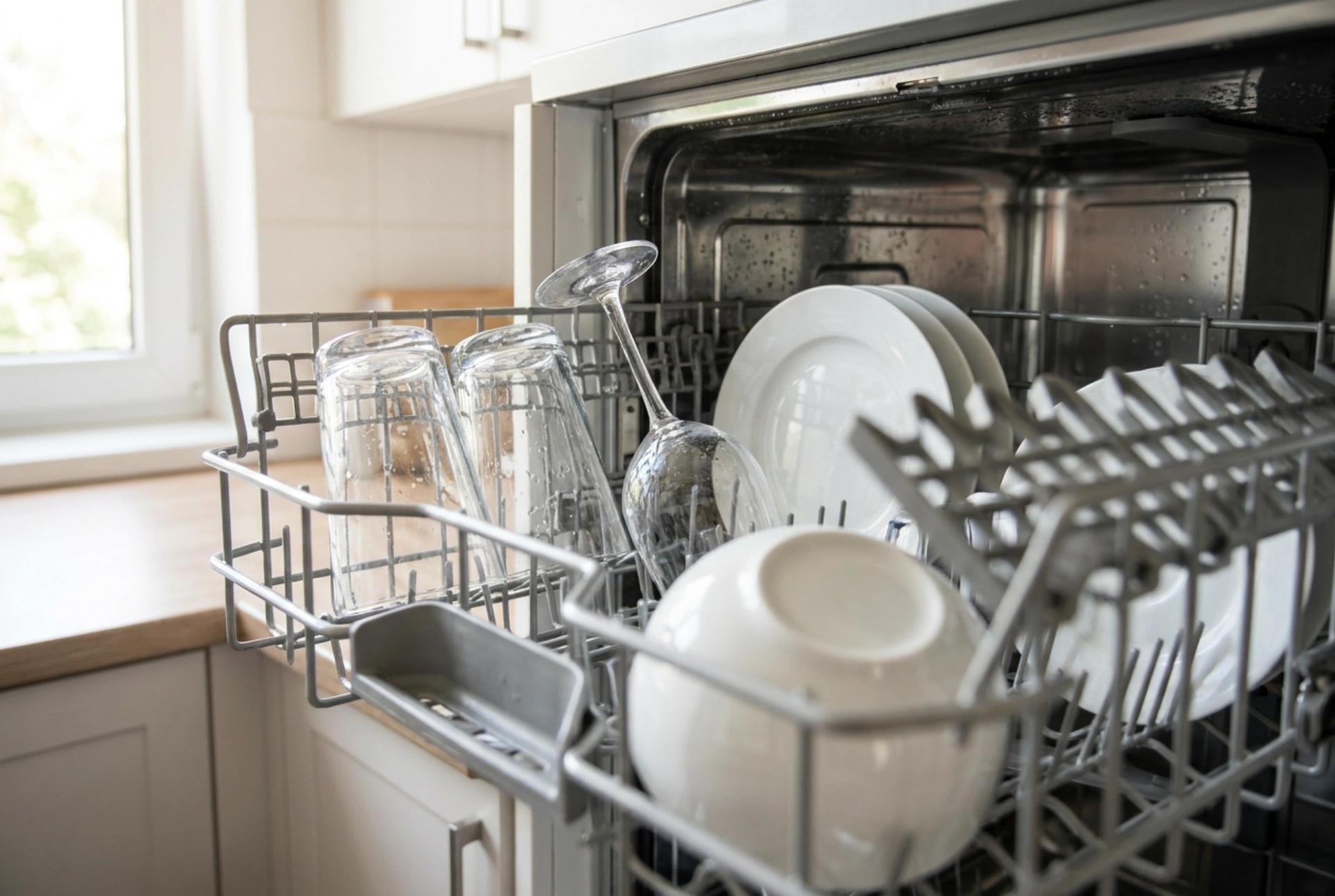
To ensure the sanitise cycle operates at peak efficiency, correct loading is vital. Avoid overcrowding the racks; water must circulate freely to transfer thermal energy evenly across every surface. Position items with deep recesses, such as jars or bottles, at an angle to prevent water from pooling, which lowers the localized temperature. Once the cycle finishes, cracked or slightly opened doors allow steam to escape gradually, preventing a sudden drop in temperature that could induce thermal shock in delicate ceramics.