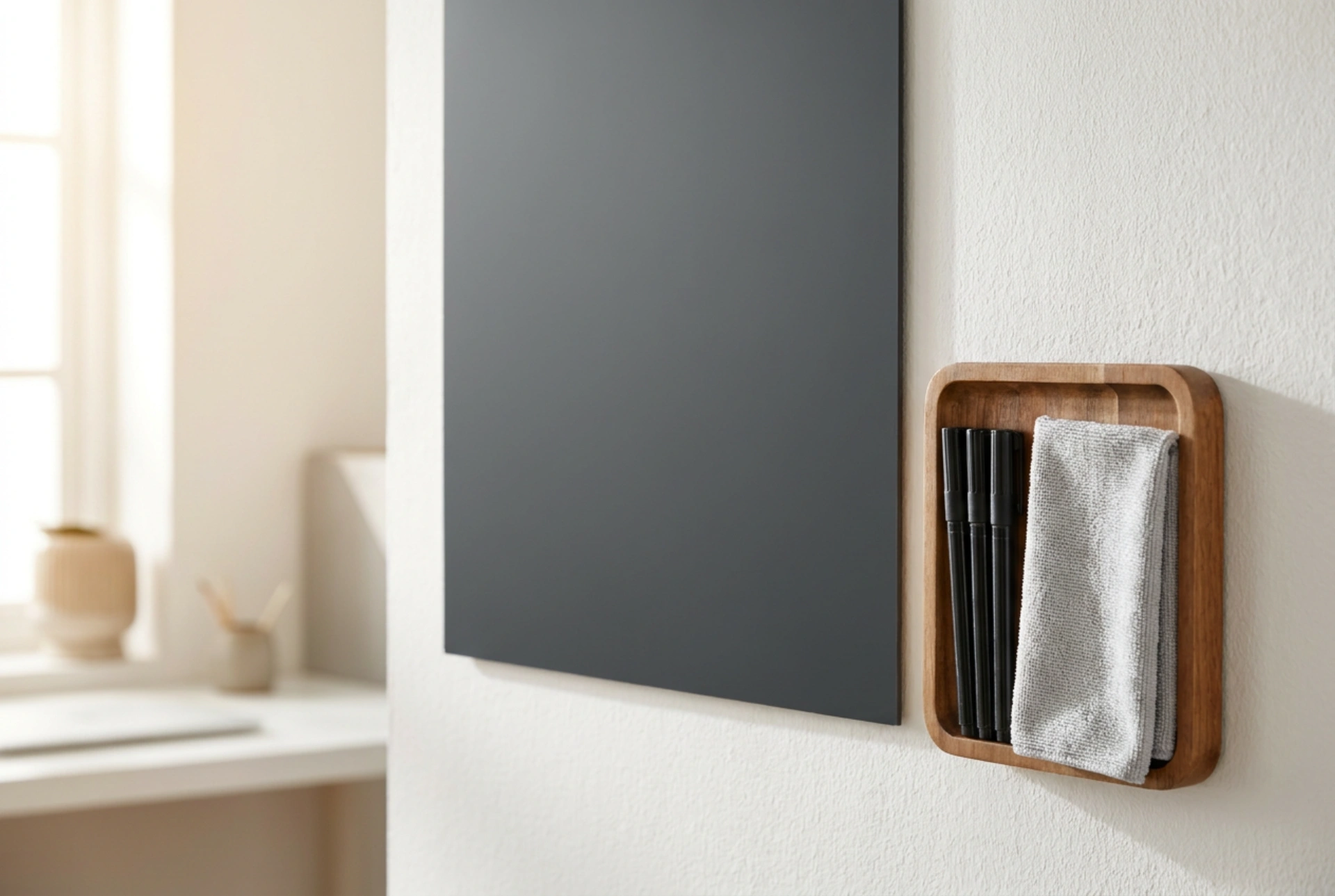


Maintaining an erasable writing surface in a child's study area requires an understanding of polymer chemistry and surface tension to prevent permanent staining and ghosting. This guide explains how to restore and preserve magnetic dry-erase and liquid chalk surfaces using physics and basic household chemistry.
The Chemistry of Dry-Erase Surfaces and Ghosting
Dry-erase boards typically consist of a base material—such as steel, aluminium, or medium-density fibreboard—coated with a non-porous polymer layer, usually melamine, acrylic, or porcelain enamel. The efficacy of this surface relies on its ultra-smooth, hydrophobic nature. Dry-erase markers contain colour pigments, a solvent (usually an alcohol), and a silicone release agent. When you write, the solvent evaporates, leaving behind a dry polymer film that does not adhere strongly to the hydrophobic surface, allowing for easy removal.
Staining or "ghosting" occurs when pigment particles trap themselves within microscopic imperfections, scratches, or degraded areas of the board's topcoat. Melamine boards, being more porous than porcelain or glass, degrade over time due to UV exposure and mechanical wear. When the silicone release agent fails to form a complete barrier, the pigment binds directly to the substrate, leaving a persistent shadow of previous drawings or notes.
Scientific Methods for Removing Stubborn Residues
When dry-erase ink remains on a board for too long, the polymers cross-link and harden, making simple dry wiping ineffective. To remove these residues without stripping the protective topcoat, you must employ the chemical principle of "like dissolves like." Avoid abrasive powders, steel wool, or harsh acidic cleaners, which micro-scratch the surface and permanently ruin its erasable properties.
- Isopropyl Alcohol (IPA): A solution of 70% to 90% isopropyl alcohol is highly effective. The alcohol acts as a solvent to break down the hardened binder polymers of the ink without dissolving the underlying melamine or acrylic coating. Apply the solution to a clean cloth, allow it to sit on the stain for 30 seconds to soften the polymer, and wipe gently.
- The Dry-Erase Marker Method: For stubborn, dried-on ink, draw directly over the old writing with a fresh black dry-erase marker. The fresh solvent in the new marker dissolves the old, dried binder, allowing both layers to be wiped away simultaneously.
- Water and Mild Surfactants: For daily maintenance of water-based liquid chalk boards, a solution of warm water (approximately 40 degrees Celsius) and a single drop of neutral surfactant (dishwashing liquid) lowers the surface tension of the water, allowing it to penetrate and lift the chalk pigment.
Optimising Cleaning Techniques and Materials
The tools and mechanical actions used during cleaning are just as critical as the chemical agents. Standard paper towels can be abrasive on a microscopic scale and often leave lint behind, which creates new nucleation sites for ink adhesion. Instead, utilise a high-density microfiber cloth.
Microfiber cloths feature split polyester and polyamide fibres that are finer than a human hair. These fibres create a massive surface area and generate a mild electrostatic charge when dry, pulling pigment particles away from the board rather than smearing them across the surface. When wiping, use circular motions with light, even pressure to lift debris out of the micro-texture of the board, followed by a straight, linear pass to collect any remaining particles.
Long-Term Preservation and Environmental Control
To extend the lifespan of your child's creative board, consider the environmental factors in the room. Relative humidity levels between 40% and 60% are ideal. Excessively dry air can cause dry-erase markers to dry out prematurely on the tip, while high humidity can introduce moisture to the board's surface, preventing the proper formation of the dry polymer release film. Additionally, ensure the board is positioned away from direct sunlight, as ultraviolet radiation breaks down the polymer chains of melamine and acrylic, leading to premature yellowing and permanent porosity.