

Achieving highly functional cabinet lighting requires understanding the physics of light dispersion, sensor angles, and power delivery methods to eliminate shadows and prevent frequent battery replacements.
Strategic Positioning for Shadow-Free Illumination
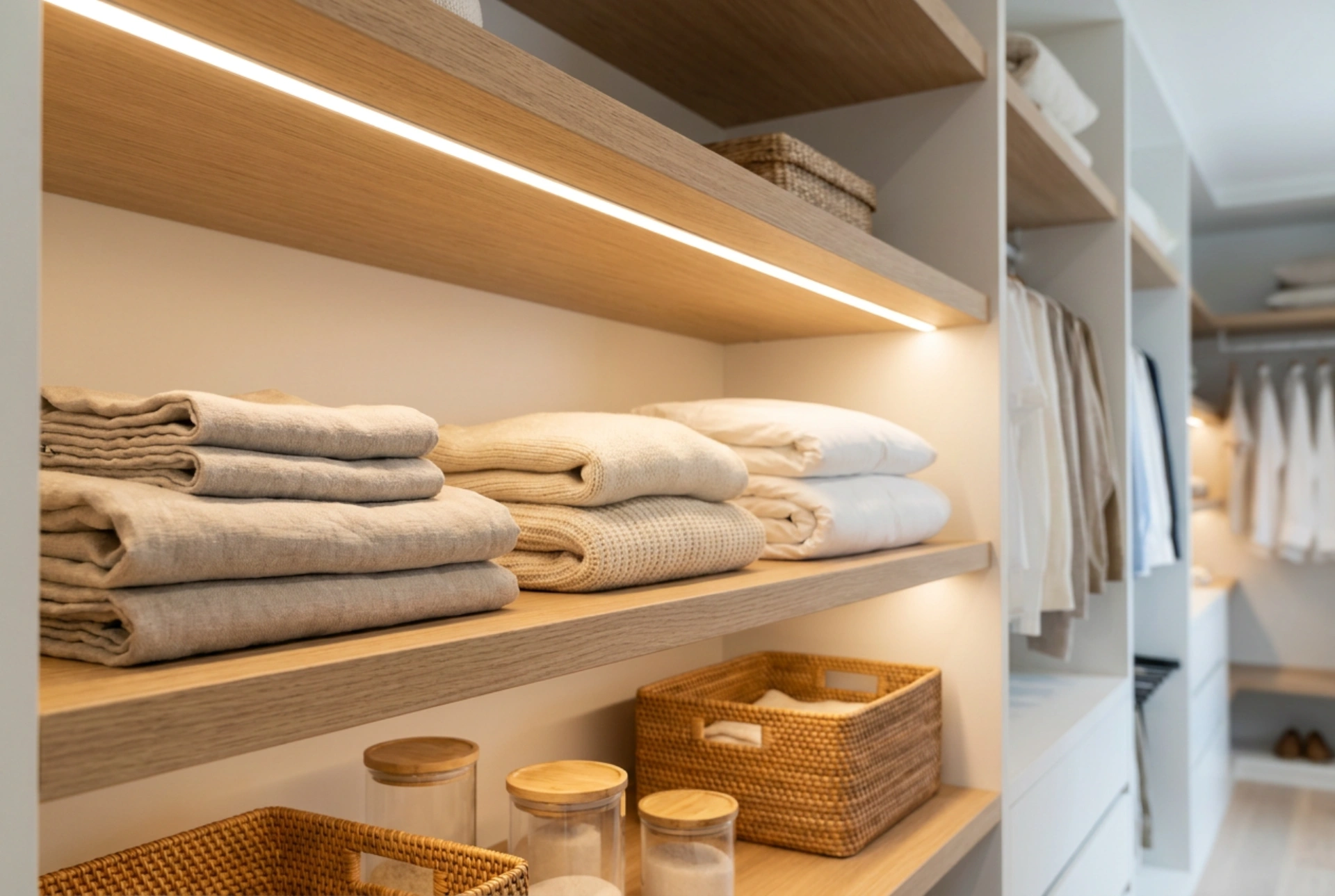
The primary error in cabinet lighting is mounting LED strips flat against the back wall. This configuration causes severe backlighting, leaving the front of your folded clothes in deep shadow while blinding you with direct glare. To achieve optimal visibility, position the light source on the inner front frame of the cabinet, directing the light path inward and downward at a 45-degree angle.
Using an asymmetric aluminium profile is key to this technique. The angled profile directs the light cone precisely onto the shelves while shielding your eyes from the raw light-emitting diodes. Furthermore, aluminium profiles do not just direct light; they act as essential thermal heat sinks. LEDs lose efficiency and degrade rapidly if the heat generated at the p-n junction of the diode is not dissipated. The metal body draws this heat away, preserving the phosphorus layer and maintaining bright, consistent light for years.
Selecting the Activation Sensor: PIR vs. Magnetic
A convenient cabinet light must activate instantly when the door is opened. Choosing between Passive Infrared (PIR) sensors and magnetic reed switches depends on your cabinet structure.
- Passive Infrared (PIR) Sensors: These sensors detect changes in thermal radiation. When a hand enters the detection field, the sensor registers the movement of body heat. For a PIR sensor to work effectively, it must have an unobstructed line of sight. Position the sensor near the front edge of the shelf, ensuring its typical 120-degree detection cone intersects the path of the opening door. Avoid deep corners where clothing might block the sensor's view.
- Magnetic Reed Switches: Ideal for hinged or sliding doors, these switches rely on a magnetic field. A small magnet is mounted on the door, and the sensor is placed on the cabinet frame. When the door is closed, the magnet keeps the electrical circuit open. When opened, the physical separation of the magnet closes the circuit, instantly triggering the LEDs. This mechanical method consumes zero standby power, unlike PIR sensors which constantly draw a micro-current to monitor thermal fluctuations.
Power Sources and Thermal Efficiency
For retrofitting cabinets without built-in electrical conduits, low-voltage battery-operated systems are highly practical. Lithium-ion (Li-ion) rechargeable packs are vastly superior to standard alkaline batteries because of their flat discharge curve. While alkaline batteries cause the LEDs to dim gradually as the voltage drops, Li-ion cells maintain a steady voltage output, keeping your cabinet illuminated at full brightness until the battery is nearly empty.
If you are connecting your lighting to the mains power, always use a dedicated low-voltage class II transformer (typically stepping down to 12V or 24V DC). This reduces heat emission inside confined wooden spaces and ensures safe, low-temperature operation. Run the cables through non-conductive, fire-retardant channels behind the shelves to keep the installation tidy and physically protected.
Colour Temperature and Material Interaction
The visual success of your cabinet lighting depends heavily on colour temperature and colour rendering. For wardrobes and pantry cabinets, choose LEDs with a Colour Rendering Index (CRI) of 90 or higher (Ra > 90). Lower CRI values lack red spectral wavelengths, causing navy blues to look black and earth tones to appear washed out.
For bedroom wardrobes, a warm-white light (3000K) matches ambient residential lighting and creates a serene atmosphere. For utility cabinets, shoe racks, or kitchen pantries, a neutral-white light (4000K) is preferred as it increases contrast and makes text on labels or small items easily readable. Avoid cool-white light (6000K and above), as the high blue-light content creates harsh, unpleasant reflections on wooden and plastic surfaces.