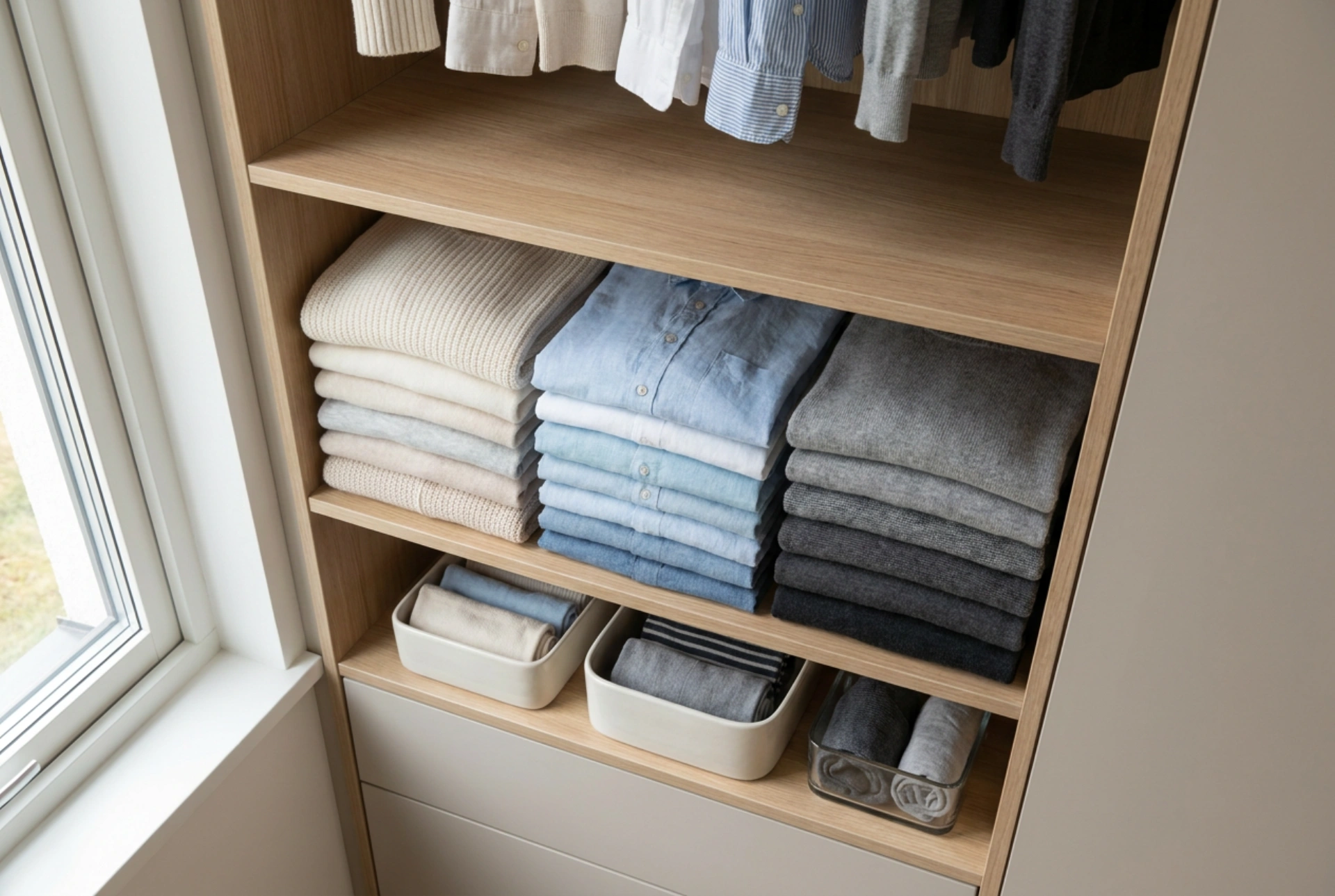


Maximising wardrobe efficiency and preserving textile integrity on open shelves depends on understanding the physical forces of compression, friction, and moisture retention acting on your garments.
The Physics of Stacking: Gravity and Fiber Elasticity
When garments are stacked on a shelf, gravity exerts downward pressure that increases with each additional layer. This mechanical stress directly impacts the molecular structure of textile fibers. Natural fibers like wool, cotton, and linen possess varying degrees of elasticity and resilience. Wool, structured with keratin proteins, has a natural crimp that allows it to bounce back from deformation. Cotton, made of cellulose, is far more prone to plastic deformation. This means once it is compressed under weight, the temporary hydrogen bonds within the fibers break and reform in bent positions, creating deep, stubborn creases.
To counteract this, arrange your stacks by fabric density and weight. Always place heavy, high-density garments like denim, heavy-gauge cotton knits, and thick woollen sweaters at the base of the stack. Lightweight, delicate items such as linen shirts, fine cotton t-shirts, and silk blouses must sit at the top. This gradient prevents the delicate fibers of lighter garments from being crushed, maintaining the loft and breathability of the textiles.
Folding Dynamics: Standardising the Rectangle
Uniformity is the key to structural stability. Stacks of varying widths and lengths create uneven weight distribution, causing piles to lean, slide, or collapse under lateral forces. To achieve a stable stack, you must standardise the footprint of every folded item. This can be achieved by using a simple rigid template, such as a plastic folder or a thin cutting board, placed in the centre of the garment's back during the folding process.
- Lay the garment flat, face down, and smooth out any pre-existing wrinkles to avoid locking them into the fold.
- Place the template below the collar, fold the sleeves and sides inward over the edges of the template, creating a clean, consistent rectangle.
- Fold the bottom third of the garment upward, then fold it over once more. Slide the template out from the top.
This method ensures that the edges of every garment in the stack align perfectly, transferring the downward force straight through the vertical columns of fabric rather than shifting weight to one side.
Managing Friction and Airflow between Textiles
The friction coefficient of different materials determines how easily items can be retrieved without disrupting the entire stack. Smooth fabrics like silk, satin, and synthetic polyesters have low surface friction, making them prone to slipping. Coarse fabrics like linen, denim, and textured wool have high friction coefficients. Mixing these materials in a single stack can lead to frustration; pulling a high-friction cotton shirt out from between two low-friction silk camisoles will likely pull the surrounding items with it.
Group similar fabric types together. Keep cotton t-shirts stacked with cotton, and woollen items with wool. Furthermore, pay attention to airflow. Textiles are hygroscopic, meaning they absorb moisture from the surrounding air. Densely packed shelves restrict airflow, trapping ambient humidity and creating microclimates ripe for mustiness and fabric degradation. Maintain a gap of at least five centimetres between stacks, and never load shelves to the ceiling of the compartment.
The Critical Stack Height Limit
No matter how perfectly folded, any stack that exceeds a height of twenty-five to thirty centimetres becomes structurally unstable and difficult to manage. For standard cotton t-shirts, this equates to a maximum of six to eight items per stack. For thick sweaters, the limit is three to four. Exceeding these limits increases the compression on the bottom layers to a point where air is completely expelled, leading to permanent fabric compaction. If your shelves are tall, utilise physical acrylic shelf dividers to create separate compartments, allowing you to build side-by-side columns rather than excessively tall stacks.