

Recirculating cooker hoods rely on the physical phenomenon of adsorption to purify indoor air, making the maintenance of activated carbon filters essential for a healthy kitchen environment. Unlike ducted systems that vent air outside, recirculating models pass cooking fumes through a multi-stage filtration process before returning the scrubbed air to the room.
The Science of Adsorption: How Carbon Filters Work
To understand why carbon filters require regular replacement, it is necessary to examine the molecular mechanics of activated carbon. Unlike absorption, where a substance permeating a liquid or solid becomes part of it, adsorption is a surface phenomenon. Activated carbon is processed to have an incredibly high surface area-to-mass ratio, containing millions of microscopic pores that trap volatile organic compounds (VOCs), odours, and moisture particles.
As kitchen air is drawn through the filter, odour molecules adhere to the internal pore walls of the carbon matrix through weak intermolecular forces known as van der Waals forces. However, this holding capacity is finite. Once every microscopic pore is saturated with organic compounds and lipid particles, the filter can no longer trap new odour molecules, and the air passes through completely untreated. This is why timely replacement is a matter of material physics, not just a recommendation.
Determining Replacement Frequency
The lifespan of a carbon filter is determined by cooking frequency, cooking style, and the efficiency of the primary grease filter. For a standard household cooking daily, a typical disposable activated carbon filter remains effective for approximately three to six months, translating to roughly 120 to 150 hours of active extraction time.
Several indicators signal that a carbon filter has reached its saturation point:
- Lingering Odours: If cooking smells persist in the kitchen for more than an hour after the cooktop has been switched off, the carbon pores are fully saturated.
- Reduced Airflow: Accumulated microscopic grease particles block the passage of air, forcing the fan motor to work harder, which often results in a louder hum during operation.
- Physical Weight: A saturated carbon filter is noticeably heavier than a fresh one due to the mass of trapped organic compounds and moisture.
Step-by-Step Replacement Protocol
Replacing the carbon filter requires precision to ensure a perfect seal, preventing unfiltered air from bypassing the active carbon bed. Always disconnect the appliance from the electrical mains before starting the process.
Step 1: Wash the Grease Filters. The metallic mesh grease filters must be removed first. Clean them thoroughly using hot water and a degreasing surfactant or sodium carbonate. The grease filter must be completely dry and free of oil before reinstallation, as grease is the primary enemy of activated carbon, quickly coating the pores and rendering the carbon useless.
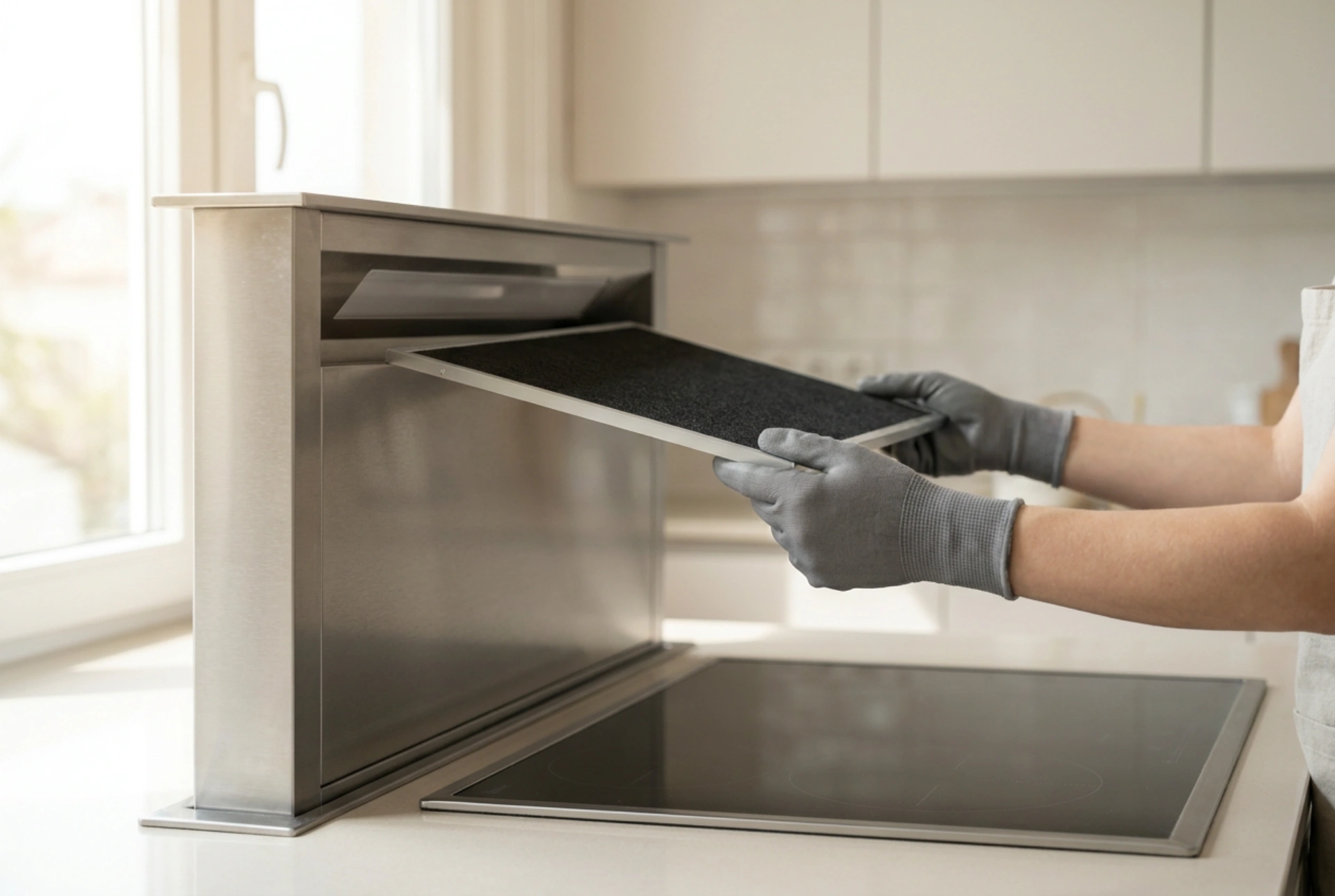
Step 2: Access and Extract the Carbon Cartridge. Carbon filters are positioned behind the metal grease filters, directly in front of the motor housing. Depending on the design, they are secured with plastic clips or a central twist-lock mechanism. Carefully release the fasteners and pull the cartridge straight out to avoid spilling any loose carbon granules.
Step 3: Insert the New Filter. Align the new filter with the guide rails or central spindle. It is critical to secure the filter tightly. Any gaps around the edges will create a path of least resistance, causing the air to bypass the carbon media entirely (a phenomenon known as air bypass).
Step 4: Restore the Assembly. Reinstall the dry metal grease filters, ensuring they click firmly into place. Restore power to the hood and run it on a low setting for two minutes to verify that there are no unusual vibrations or air leaks.
Disposable vs. Regenerative Carbon Filters
Most standard extraction hoods use disposable filters containing granulated activated carbon encased in a plastic grid. These must be replaced and discarded. However, some modern systems utilise regenerative carbon filters. These specialized filters can be thermally reactivated in a standard domestic oven. Every three to four months, these filters are washed by hand without detergent and then baked at approximately 150 to 200 degrees Celsius. The heat drives off the adsorbed organic compounds, clearing the pores and restoring up to ninety percent of the filter's original adsorption capacity. This cycle can typically be repeated for up to three years before the material structure breaks down completely.