

Achieving an efficient kitchen workflow relies heavily on the spatial organisation of daily utensils within drawer inserts. By understanding the physical characteristics of storage materials and applying geometric principles to tool placement, you can eliminate physical friction and accelerate meal preparation.
Material Science: Wood, Polymer, or Metal?
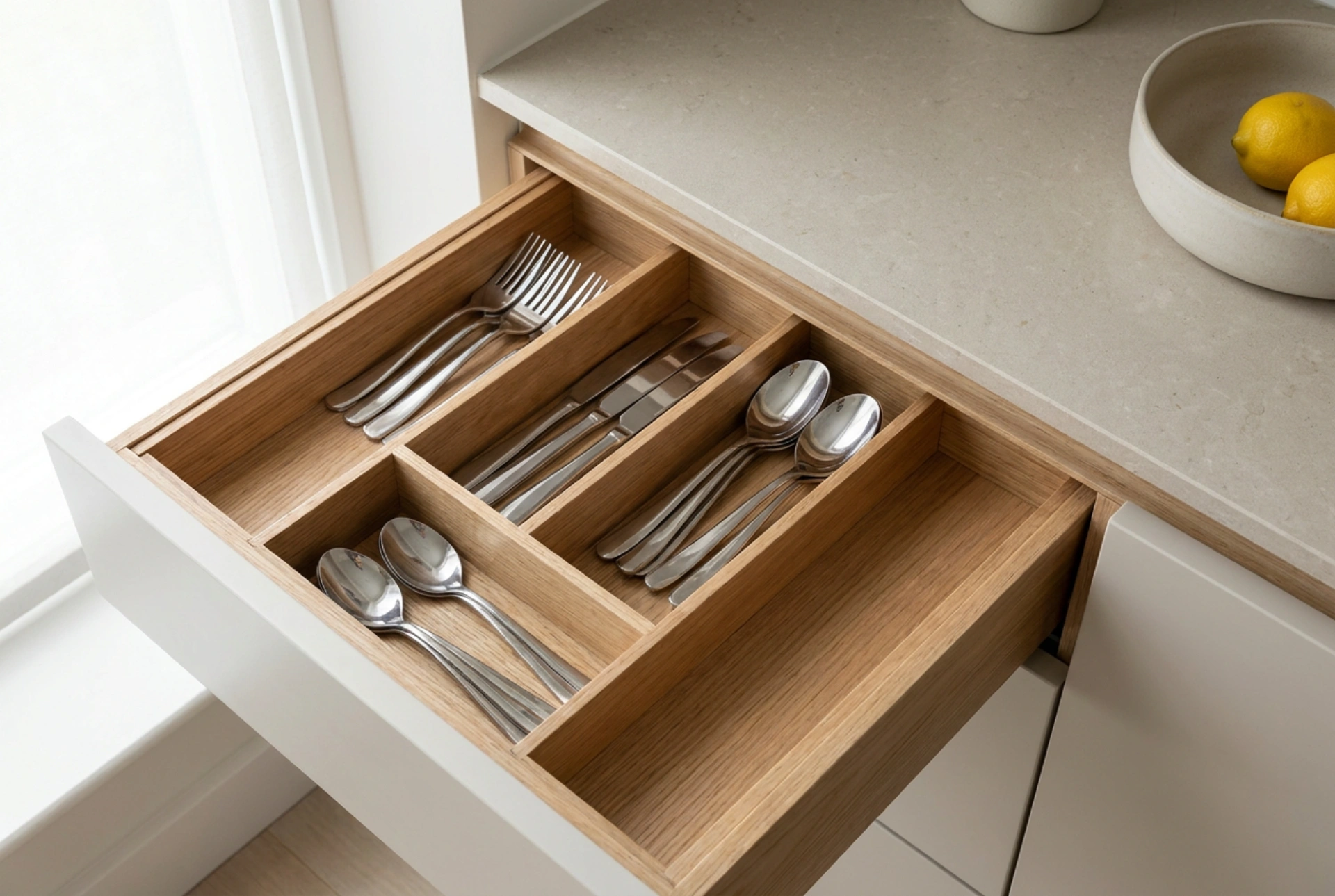
Choosing the right material for a cutlery insert involves more than aesthetics; it directly impacts the acoustics, durability, and hygiene of your kitchen. Wood, such as oak or bamboo, possesses natural cellular structures that act as acoustic dampeners. This significantly reduces the harsh clatter of metal utensils striking the organiser. Furthermore, wood has a high coefficient of static friction, which naturally prevents knives and forks from sliding when the drawer is opened or closed. However, wood is a hygroscopic material, meaning it absorbs and releases moisture in response to environmental humidity. To prevent warping, splitting, or mould growth, wooden inserts must be treated with food-grade mineral oils that seal the pores and create a hydrophobic barrier.
Polymers, such as high-density polyethylene, offer distinct chemical advantages. They are entirely non-porous, highly resistant to acidic food residues, and easy to clean. However, plastic lacks the acoustic dampening properties of wood and can easily accumulate static electricity, attracting fine dust and hair. Metals, such as stainless steel inserts, provide unmatched mechanical durability but require rubber or silicone feet to prevent metallic noise and sliding during drawer movement.
Geometric Partitioning and Ergonomic Reach
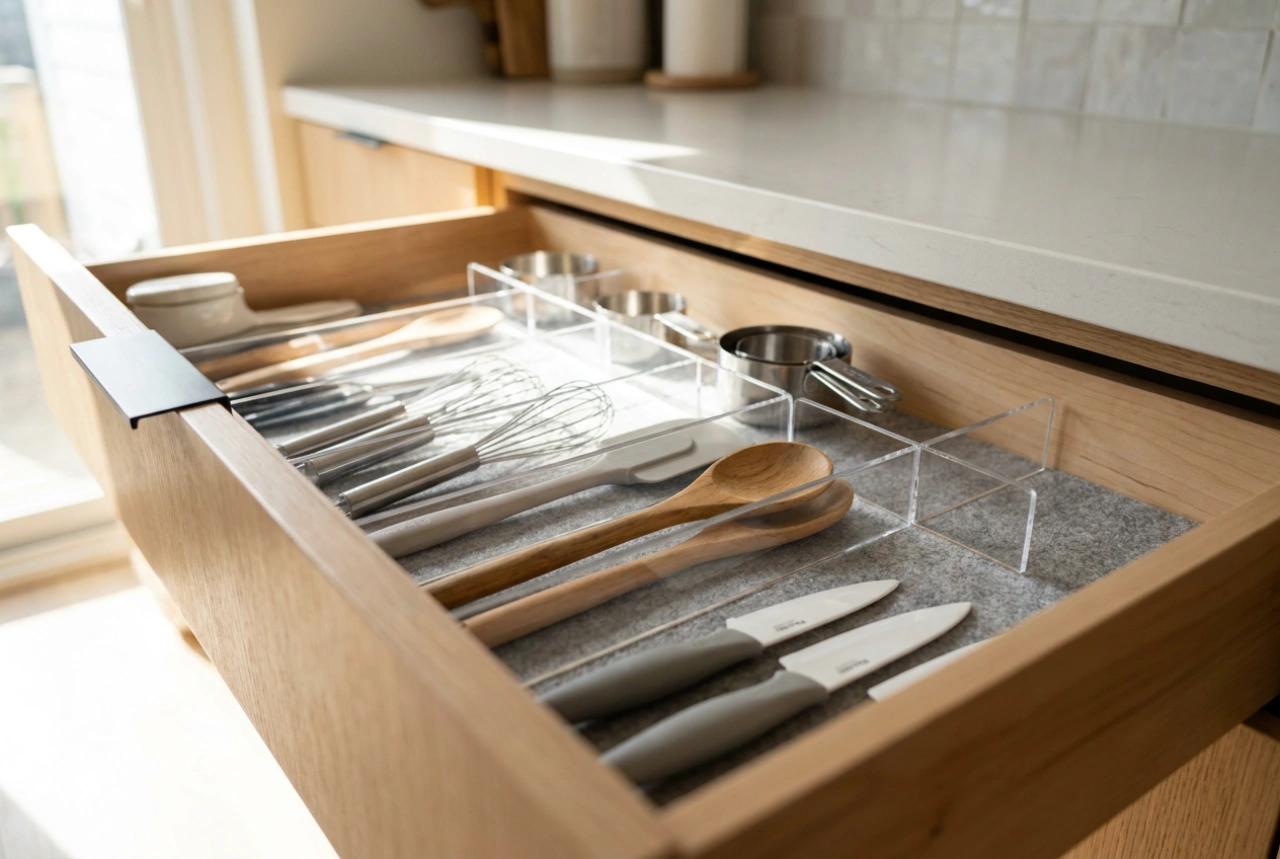
The human body moves through natural kinetic arcs during cooking. To optimise your workspace, cutlery drawers must be partitioned according to frequency of use and physical reach. The drawer space should be divided into three distinct zones based on the depth of the compartment:
- The Primary Zone (Front): Positioned closest to the body, this area should hold high-frequency utensils like table knives, forks, and spoons. Accessing these items should require minimal arm extension.
- The Secondary Zone (Middle): This section is ideal for food preparation tools used several times during a cooking session, such as vegetable peelers, paring knives, and small whisks.
- The Tertiary Zone (Back): Reserved for low-frequency items like bottle openers, specialised baking tools, or structural accessories.
To prevent utensils from sliding and colliding—which dulls sharp edges and accelerates wear—compartments must match the length of the tools they house. When a drawer is pulled open, the cutlery experiences kinetic energy. If the compartment is excessively long, the items slide forward abruptly. Utilising fitted dividers or adding non-slip silicone liners at the base of each compartment absorbs this kinetic energy, protecting both the utensils and the drawer runner mechanisms.
Preventive Hygiene and Surface Maintenance
Kitchen drawers are micro-environments prone to collecting food debris, moisture, and dust, making proper maintenance vital. For wooden inserts, avoid liquid submersion at all costs. Water penetration causes the wood fibres to swell unevenly, leading to structural warping. Clean wooden organisers using a microfibre cloth slightly dampened with a weak surfactant solution, and dry immediately with a clean towel. Reapply mineral oil every six months to maintain the protective surface tension.
For polymer organisers, avoid abrasive scouring pads. Abrasives create micro-scratches on the surface, increasing the roughness profile of the plastic. These tiny grooves provide a protective anchor point for bacterial biofilms, making future sanitisation difficult. Instead, clean with a soft sponge and a diluted isopropyl alcohol solution, which disinfects and evaporates rapidly without leaving chemical residues.