

A chaotic entryway leads to misplaced keys and daily friction, but a scientifically planned key cabinet solves this by utilising spatial ergonomics and cognitive triggers. By understanding reach zones, material wear, and structural mechanics, you can establish an intuitive organisation system that serves every member of the household seamlessly.
Ergonomics of Accessibility: Finding the Right Height and Location
The physical placement of a key cabinet determines whether household members will actually use it. In ergonomics, the 'zone of convenient reach' dictates where objects should be placed to minimise physical strain. For a multi-generational family, this zone must accommodate varying heights. Mounting the cabinet at a median height of 130 to 140 centimetres from the floor allows adults to access their keys without bending, while still keeping basic hooks within reach for older children.
Positioning relative to the doorway is equally critical. The cabinet should be installed on the lock-side of the main entry door, rather than the hinge-side. This aligns with the natural flow of movement upon entering the home: your dominant hand unlocks the door, pushes it open, and is immediately positioned to place the keys into the organiser. Ensure the cabinet is mounted outside the maximum arc of the door swing to prevent physical impacts that could damage the wall or the cabinet itself.
Material Science: Selecting Durability and Minimising Wear
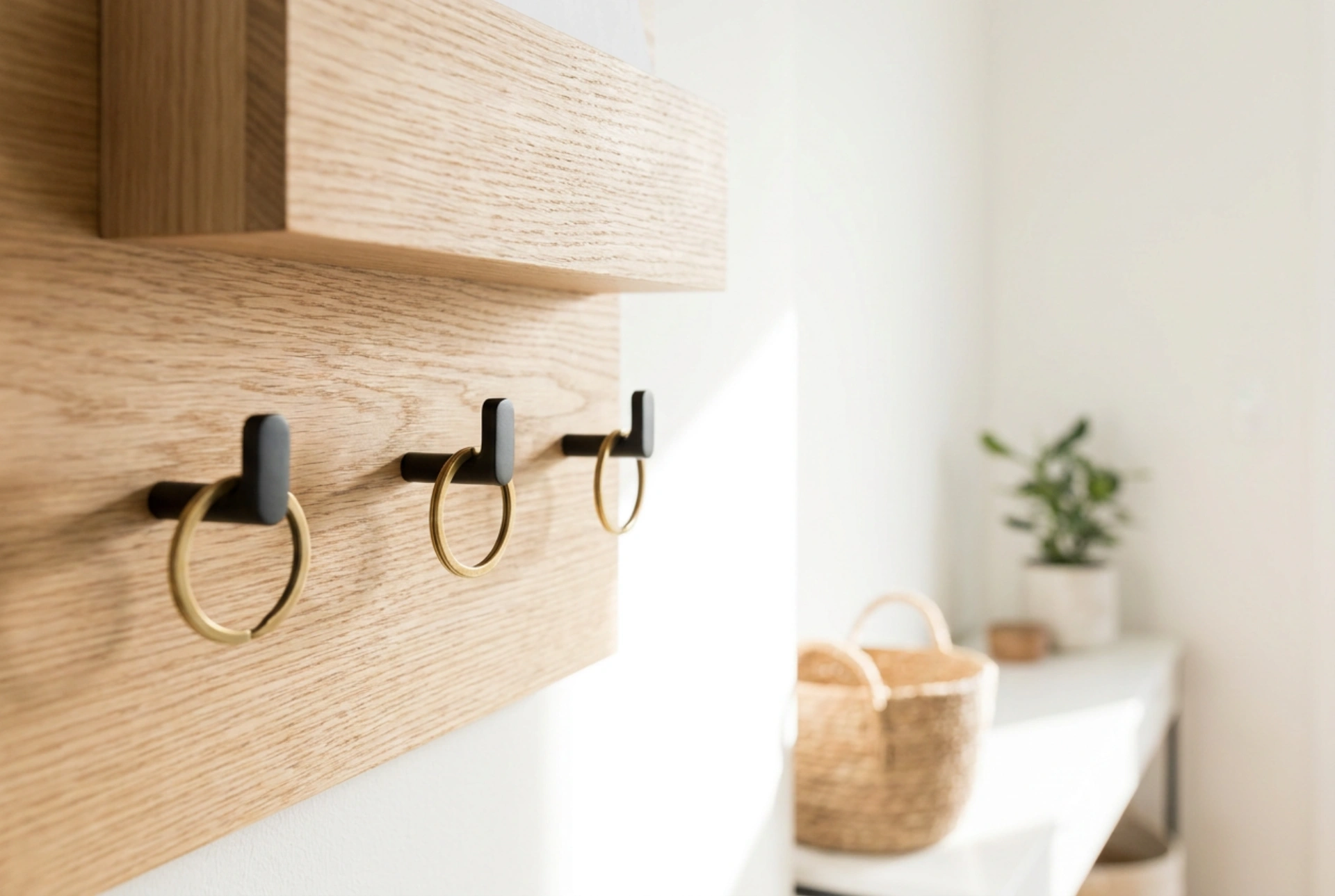
Key rings are subjected to constant friction, impact, and mechanical stress. The materials chosen for both the hooks and the cabinet body must withstand these daily forces. Metals like solid brass, stainless steel, or anodised aluminium are ideal for hooks. Brass offers natural antimicrobial properties due to the oligodynamic effect, which is highly beneficial for frequently touched family surfaces. Stainless steel provides excellent tensile strength and resistance to scratching from hardened steel key rings.
When selecting the cabinet backing, hardwoods such as oak, walnut, or maple are superior to softwoods or synthetic laminates. Hardwoods possess a dense cellular structure that absorbs the kinetic energy of swinging keys, dampening sound and preventing surface denting. If you prefer a lined interior, felt or heavy-duty cork sheeting provides excellent acoustic dampening and prevents the wood from getting scratched over years of use.
Spatial Layout and Hook Distribution
The internal architecture of the cabinet must prevent physical tangling and cognitive overload. To achieve this, maintain a minimum horizontal spacing of 6 to 8 centimetres between hooks. This distance prevents bulky keychains from overlapping and tangling. Vertical clearance is equally important; car keys with remote fobs require at least 12 to 15 centimetres of vertical space to hang freely without resting on the hooks below.
- Active Daily Keys: Positioned at eye level on dedicated individual hooks for quick retrieval during morning routines.
- Seasonal and Utility Keys: Placed in a lower or separate section of the cabinet, clearly labelled to avoid confusion with daily transit keys.
- The Secondary Storage Tray: A shallow wooden or felt-lined tray at the base of the cabinet serves as a landing zone for temporary items, preventing surfaces from becoming cluttered.
Micro-Climate and Maintenance Protocols
Entryways are transition zones prone to temperature fluctuations and humidity spikes. Rainwater or hand sweat carried on key rings can introduce moisture into an enclosed cabinet, leading to wood warping or musty odours. To mitigate this, choose a cabinet design with passive ventilation, such as a slatted door or small ventilation grommets at the back. When cleaning, avoid harsh solvent-based cleaners that can degrade protective wood lacquers or strip the protective oxide layer from brass and copper hooks. A dry microfiber cloth paired with occasional applications of natural beeswax is sufficient to maintain the timber's integrity and lustre.