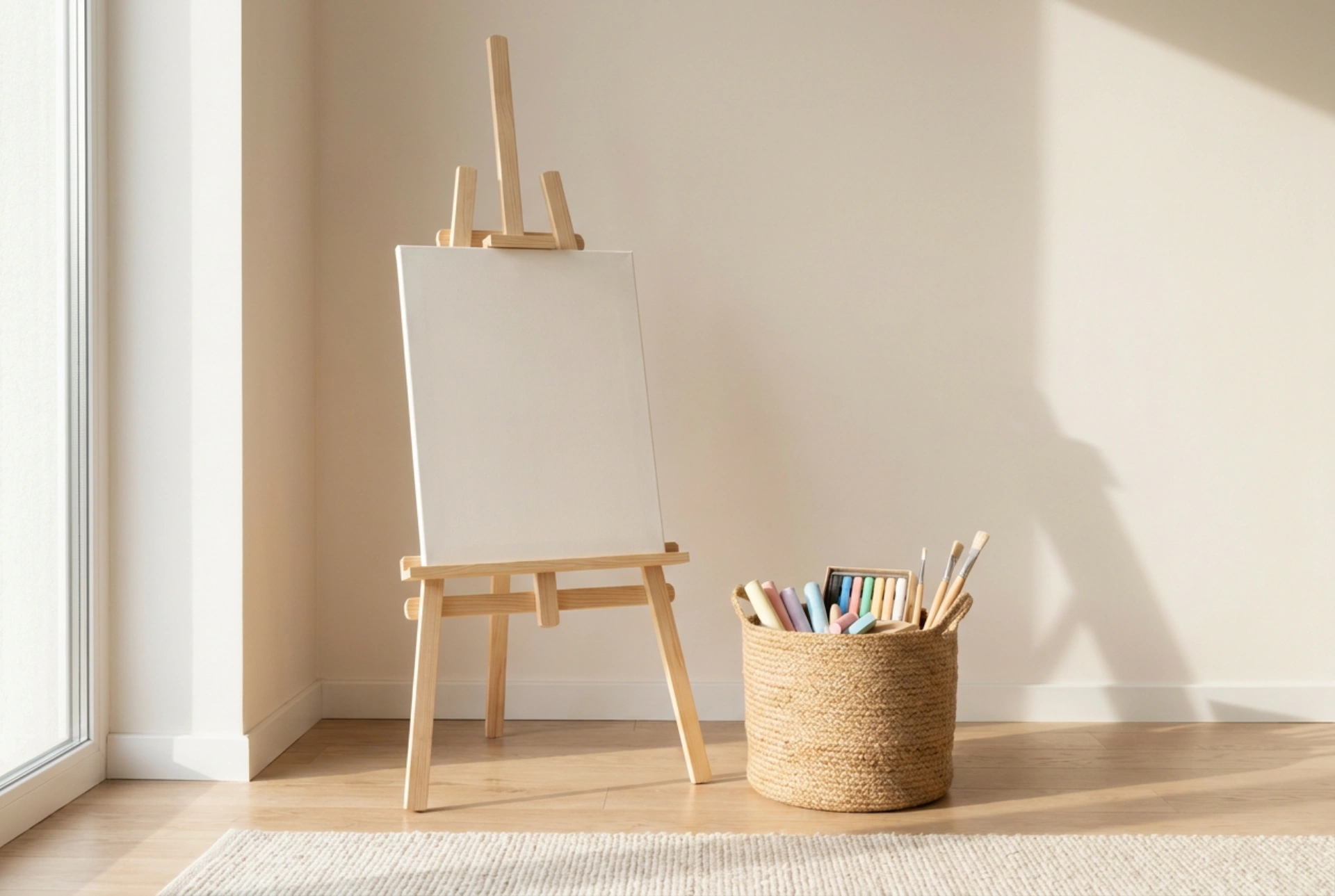


Creating a dedicated drawing board corner requires more than just hanging a board; it demands careful consideration of light angles, surface physics, and dust containment to ensure a safe, functional, and clean space.
Choosing the Right Surface: Porosity and Material Science
The efficiency of a drawing corner hinges on the molecular structure of the writing surface. Traditional chalkboards rely on slightly porous materials to grip calcium carbonate particles. If using chalkboard paint, apply it to an ultra-smooth MDF or gypsum backing. Even minor surface imperfections create microscopic valleys where pigment gets trapped, leading to 'ghosting'—residual ghost images of previous drawings that are difficult to erase. To prevent this, apply three coats of high-quality paint, sanding lightly with fine-grit sandpaper (minimum 240 grit) between layers to eliminate brush texture and achieve a perfectly level plain.
Dry-erase boards, on the other hand, require completely non-porous surfaces like porcelain-on-steel or melamine. Porcelain-on-steel boards are magnetically receptive and highly resistant to chemical staining because the glass-like surface prevents solvent-based dry-erase inks from penetrating. Melamine is more budget-friendly but degrades over time as micro-abrasions from cleaning trap ink pigments, making periodic restoration with specialized isopropyl-alcohol-based solutions necessary to dissolve the bound polymer resins.
Optimising Lighting and Ergonomics
Positioning the board relative to light sources directly impacts usability and eye strain. Avoid placing the board directly opposite windows to prevent specular reflection (glare), which obscures the drawing surface and leads to squinting. Instead, position the board perpendicular to the main window. For right-handed children, the light source should ideally come from the left side to prevent their arm from casting a shadow over their work area, and vice-versa for left-handed children.
Ergonomics dictate the height and angle of the writing surface. The optimal height aligns the center of the board with the child's chest level, allowing their shoulder joint to operate within a natural, fatigue-free range of motion. For younger toddlers, a slight tilt of 10 to 15 degrees (typical of a classic easel) reduces wrist strain and utilizes gravity to assist hand-eye coordination. Older children can comfortably use fully vertical wall-mounted surfaces as their fine motor skills mature.
Dust Management and Chalk Chemistry
Chalk drawing inevitably generates airborne particulate matter, which consists of calcium carbonate. To control this, implement the principles of gravity and humidity. Position a deep, solid metal or wooden trough directly beneath the drawing board. A deep trough traps falling particles before they drift onto the floor or nearby carpets. Avoid woven fabric baskets for storing drawing utensils directly under the board, as their fibers collect fine dust that is difficult to wash out.
Opt for high-density, dustless chalks. These are formulated with heavy binder agents like vegetable oils or organic waxes, which make the particles heavier, causing them to fall straight down into the tray rather than floating into the breathing zone. For cleanup, use the wet-wiping method: a microfiber cloth dampened with clean water is highly effective because split microfibers carry a natural electrostatic charge that attracts dust particles, while water prevents them from becoming airborne. Never use dry felt erasers, which simply redistribute the dust back into the room's atmosphere.
Acoustic Dampening and Wall Integration
The scraping sound of chalk or markers on a hard board can create unpleasant acoustic resonance, especially in minimalist rooms with hard floors. To dampen these high-frequency vibrations, apply a backing layer of self-adhesive cork sheet or dense wool felt directly to the wall before mounting the drawing board. This dampening layer acts as a mechanical decoupler, absorbing vibrational energy rather than reflecting it back into the room. This makes the creative space significantly quieter and more pleasant for the entire household.