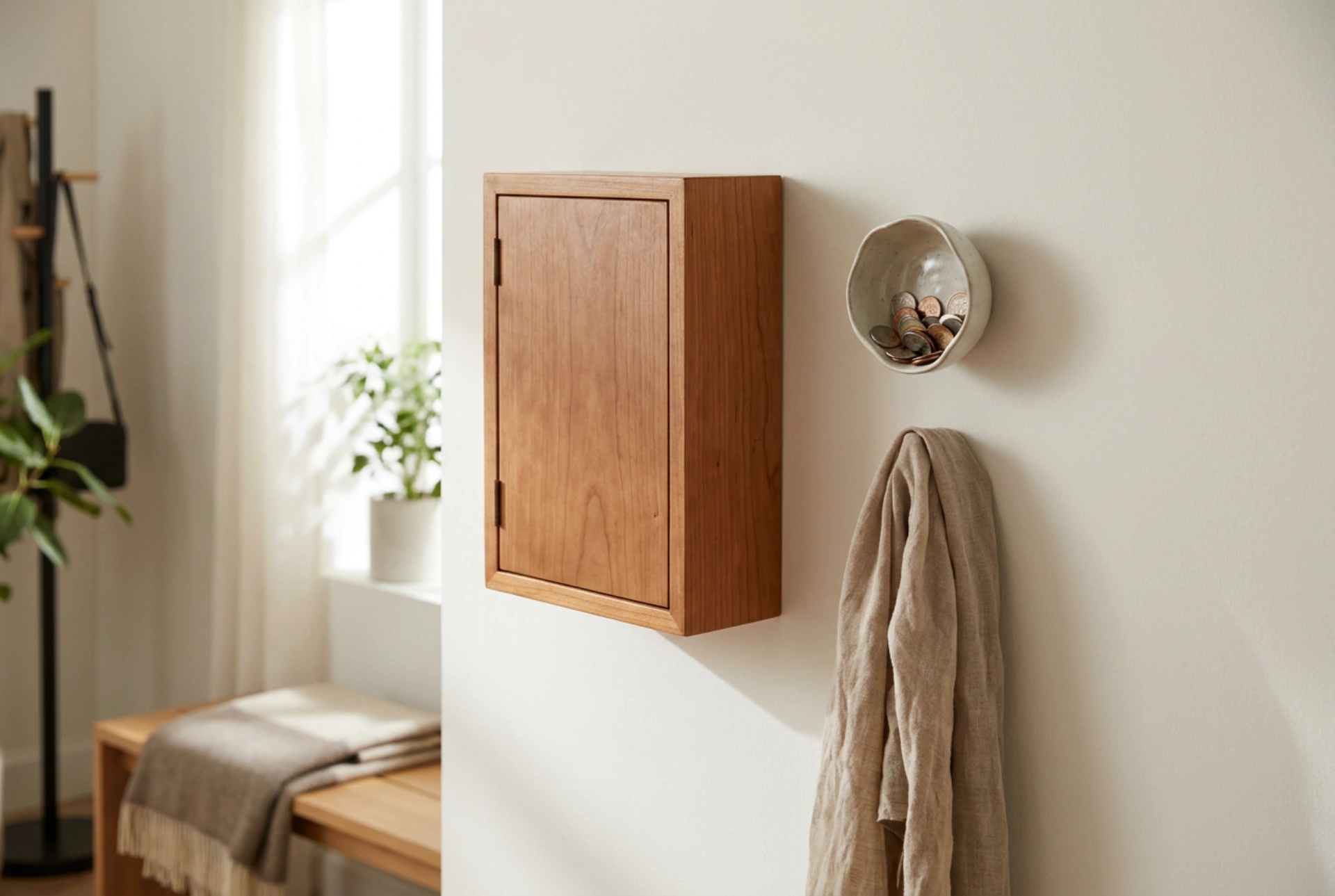


Establishing an organised entryway relies on creating dedicated spatial zones for small, high-frequency items like keys, preventing clutter from accumulating on flat surfaces. A wall-mounted wooden key cabinet serves as a functional focal point that protects both your wall surfaces from repetitive impact and your keys from misplacement.
The Microclimate of the Entryway: Why Material Choice Matters
The entryway is a transitional zone subjected to constant fluctuations in temperature and relative humidity every time the external door opens. This microclimate directly affects wooden furniture. Solid wood is a hygroscopic material, meaning it continuously absorbs and releases moisture to equilibrate with its surrounding environment. Under high humidity, wood fibres expand perpendicular to the grain; in dry winter air, they contract.
To ensure a key cabinet remains stable without warping or splitting, select hardwoods such as oak, walnut, or ash. These species possess dense cellular structures that resist dimensional movement better than softwoods like pine. Furthermore, the construction of the cabinet should allow for minor wood movement, utilising joinery such as tongue-and-groove or floating panels rather than rigid, glued mitres that can crack under tension.
Mechanical Stability: Secure Mounting and Ergonomics
A key cabinet must withstand daily physical forces, specifically the downward pull when removing heavy key rings and the outward pull when opening the cabinet door. Relying on simple adhesive strips or unstable single-point hangers will lead to structural failure, wall damage, or misaligned operation over time.
- Wall Assessment: Identify the wall substrate. Use expansion rawlplugs for masonry, toggle bolts for plasterboard, or wood screws directly into studwork.
- Dual-Point Mounting: Utilise a minimum of two horizontal fixing points, preferably using recessed keyhole brackets on the back of the cabinet. This prevents the unit from pivoting when you open the door.
- Ergonomic Height: Position the cabinet at chest level (approximately 140 to 150 cm from the finished floor level). This height aligns with the natural line of sight and arm reach, preventing awkward physical strain and reducing the likelihood of dropping keys during retrieval.
Optimising Internal Layout to Prevent Wear and Noise
Metal keys colliding with wooden backboards can cause surface abrasions, chipping the protective finish of the wood over time. To mitigate this mechanical wear, the interior design of the cabinet should incorporate specific material combinations and spatial intervals.
The distance between hooks should be at least 5 to 7 cm horizontally and 10 to 12 cm vertically. This spacing accommodates modern car key fobs and multi-key bundles without overlap, preventing tangling and reducing the metallic clatter when retrieving items. To protect the wood from scratches, consider lining the backplate with a thin layer of natural wool felt or vegetable-tanned leather. These materials act as shock absorbers, dampening sound and preserving both the wood surface and the finish of your keys.
Surface Preservation: Combating Friction and Hand Oils
The external door handle and the cabinet front are subject to constant contact with human hands, transferring natural skin oils, moisture, and dirt. Over time, these acidic oils can break down traditional chemical lacquers, leading to a sticky, discoloured surface.
To preserve the wood, apply a hardwax oil or a natural beeswax and linseed oil blend. These penetrating finishes bond with the wood fibres rather than forming a brittle plastic layer on top. They allow the wood to breathe while repelling water and oils. For maintenance, avoid harsh chemical detergents or spray polishes containing silicone, which build up a greasy residue. Instead, wipe the cabinet weekly with a dry, lint-free microfibre cloth to remove dust, and reapply a thin coat of natural wax once a year using a circular buffing motion to restore the protective barrier.