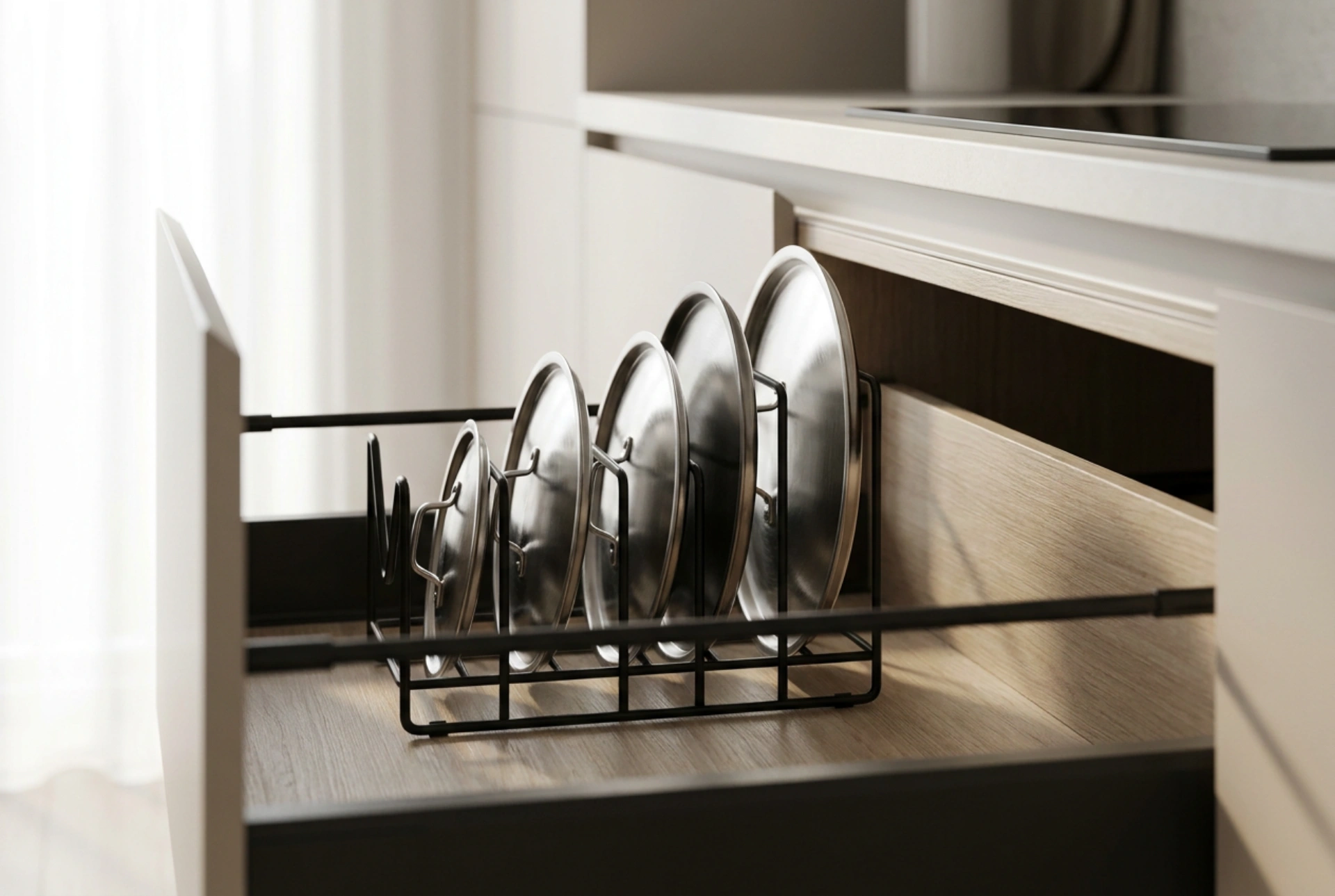


Storing pot lids horizontally in deep drawers or stacked on top of pots creates an unstable, noisy, and inefficient kitchen environment. Shifting to a dedicated vertical organiser utilises basic gravity and mechanical separation to prevent damage, eliminate clatter, and streamline your cooking workflow.
The Mechanical Challenge of Curved Cookware
Standard pot lids present a unique storage challenge due to their geometric design. Most lids feature a convex or dome-shaped surface with a protruding central handle—either a knob or a loop. When stacked horizontally, these handles offset the centre of gravity, causing the lids to tilt and slide. The coefficient of friction between polished stainless steel, aluminium, or tempered glass is exceptionally low, meaning even minor vibrations from closing a nearby drawer can cause a stacked pile to collapse.
Furthermore, constant metal-on-metal contact leads to micro-abrasions along the rims and surfaces of your cookware. Over time, these scratches can compromise the structural integrity of tempered glass or strip away protective coatings. By isolating each lid, you eliminate this friction and prevent the wear and tear associated with shifting piles.
The Physics of Vertical Organisation
Storing lids vertically inside a slotted organiser fundamentally changes how gravity interacts with your cookware. Instead of resting their weight on one another, each lid is supported independently by the dividers of the rack. This setup translates the downward gravitational force directly into the base of the cabinet or drawer, eliminating the lateral forces that cause slipping.
Vertical alignment also utilises spatial volume more efficiently. A cabinet drawer that can only hold three or four nested pots with their lids can easily accommodate double that amount when the lids are separated and stored upright in a dedicated rack. This arrangement also provides immediate visual feedback, allowing you to select the correct size instantly without rummaging.
Selecting the Right Organiser: Materials and Mechanics
The efficiency of a vertical organiser depends heavily on its design, material composition, and placement within your kitchen architecture.
Powder-Coated Steel Wire Racks
Heavy-duty steel wire organisers coated with a matte polymer or silicone layer are highly effective. The polymer coating increases surface friction, preventing the lids from rattling or sliding when the drawer is opened or closed. This soft-touch barrier also acts as a shock absorber, protecting delicate glass edges from impact chipping.
Adjustable Peg Systems
Typically installed in deep drawers, peg systems use a perforated baseboard with movable wooden or plastic pegs. This allows you to customise the slot width based on the depth of your lids. Deep, domed lids require wider spacing, while flat, tempered glass lids can be packed more densely. Customising the slot width prevents the lids from leaning too far, keeping their centre of gravity directly over the base.
Cabinet Door Mounts
Utilising the inside of cabinet doors is an excellent space-saving technique, but it introduces dynamic forces. Every time the cabinet door is opened and closed, momentum is transferred to the lids. Door-mounted organisers must have secure, deep loops or baskets that cradle the lid handles, ensuring they cannot bounce out of their slots during movement.
How to Arrange Lids for Optimal Workflow
To maximise the utility of your organiser, follow a systematic arrangement process. Start by grouping your lids by diameter and then by depth. Place the largest and heaviest lids at the back of the organiser (if on a shelf) or at the rear of the drawer. This keeps the physical weight distributed close to the drawer runners, maintaining smooth mechanical operation.
Ensure all handles are oriented in the same direction—preferably facing outward or upward depending on the rack design. This prevents the loops or knobs from tangling with adjacent lids, allowing you to pull a single lid straight out of its slot without catching others. Keep your most frequently used lids in the most accessible slots, reducing the time spent reaching into the back of the cabinet.
Acoustic Control and Maintenance
To completely eliminate the metallic clang of kitchen organisation, consider adding small elastomer or silicone bumpers to the contact points of your organiser if it lacks a built-in protective coating. These dampeners absorb kinetic energy and eliminate acoustic resonance. Additionally, keep the organiser clean. Kitchen grease can settle on the rack over time, lowering friction and causing lids to slip. Wipe down the organiser periodically with a mild degreasing agent to maintain a high-grip surface.