

Ironing sprays streamline the removal of stubborn creases by temporarily relaxing fiber bonds, but improper application often leads to frustrating scorched spots or greasy-looking residues. Understanding the physical and chemical interaction between heat, moisture, and fabric polymers is the key to achieving a flawless finish without staining your garments.
The Chemistry of Ironing Aids and Scorching
Most commercial ironing sprays rely on either natural starch (amylose and amylopectin suspended in water) or synthetic polymers (such as polyvinyl acetate). These agents coat the textile fibers, temporarily hardening them upon heating to create a crisp, smooth surface. However, when these compounds are subjected to excessive heat or concentrated in one spot, chemical reactions occur. Natural starch undergoes caramelization at high temperatures, turning a distinct yellow or brown. Synthetic polymers, on the other hand, can melt and scorch, leaving a plastic-like sheen or dark residue that binds directly to the fabric matrix.
The Physics of Atomization: Distance and Distribution
Staining is rarely caused by the product itself, but rather by poor distribution. When you spray too close to the fabric, the liquid does not atomize into a fine mist; instead, it lands as large droplets. To prevent these concentrated wet spots, you must adhere to a strict application technique:
- Maintain Distance: Always hold the spray bottle at least 25 to 30 centimeters away from the garment. This allows the conical spray pattern to disperse fully before contacting the fibers.
- Continuous Movement: Sweep your hand in a steady, horizontal motion while pressing the trigger. Never spray in a single, stationary spot.
- Clear the Nozzle: Dried starch or polymer residue can clog the nozzle orifice, distorting the spray pattern and causing spitting. Regularly rinse the spray head under warm running water to maintain micro-atomization.
The Penetration Window: Why You Must Wait
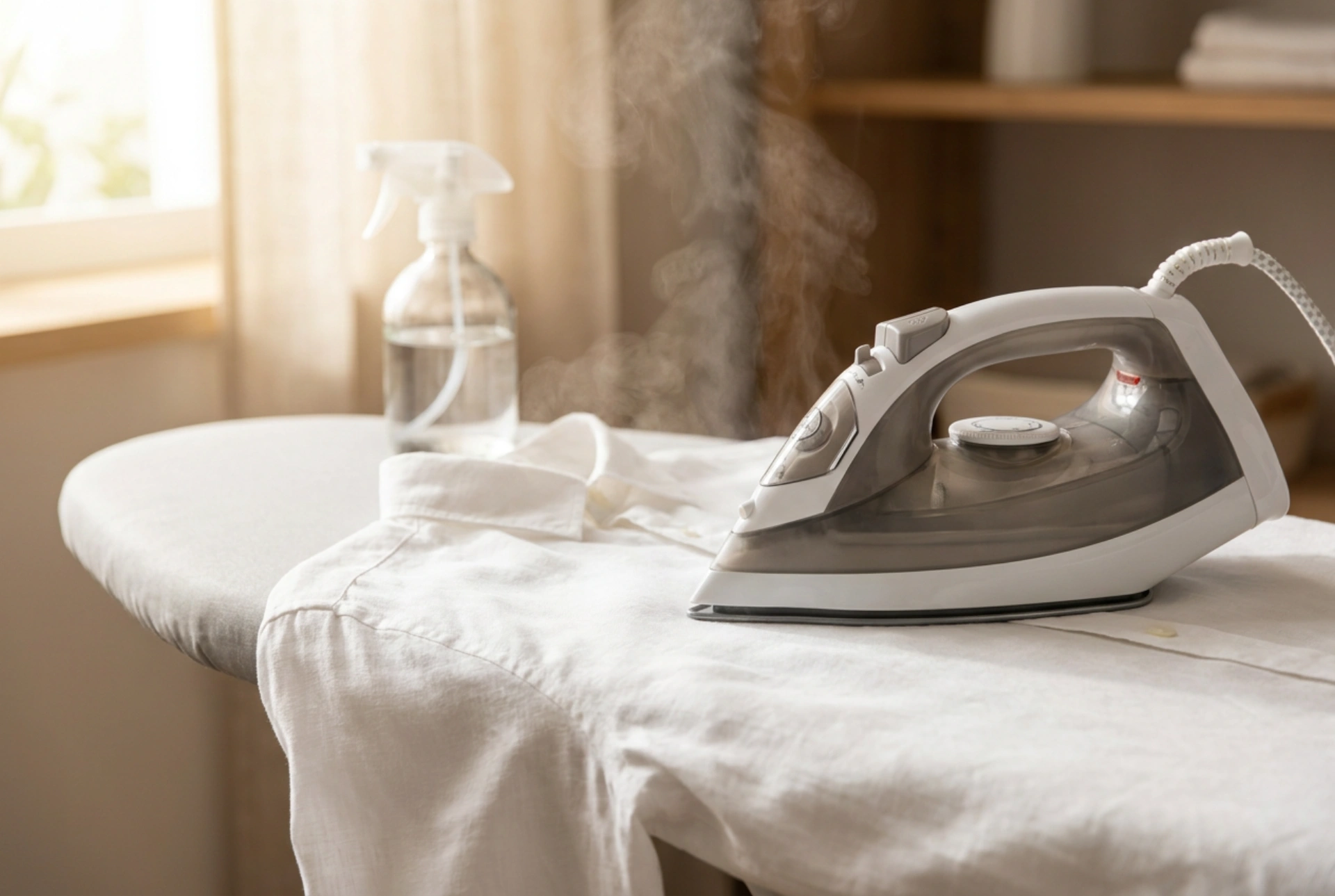
One of the most common mistakes is placing a hot iron directly onto freshly sprayed, wet fabric. When liquid sits on the surface of the fibers, the sudden contact with a soleplate exceeding 150°C causes rapid boiling. This flash evaporation traps the starch or polymer on the very surface of the fabric, leading to localized buildup and eventual scorching. Instead, implement a brief waiting period. Give the misted fabric 15 to 30 seconds to absorb the moisture. This allows the liquid to penetrate deep into the yarn structure, relaxing the cellulose or synthetic fibers from within. When the heat is applied, the starch sets uniformly within the weave rather than sitting on top as a burnable film.
Calibrating Heat and Iron Management
Different materials require precise thermodynamic management to avoid chemical breakdown of the ironing aid. When using starch-based sprays, stick to cotton and linen settings, but ensure you do not exceed the threshold where caramelization occurs. If you notice the iron sticking slightly or dragging, the temperature is too high, or the spray was applied too heavily. Keep a clean cotton cloth handy; if a spot looks too wet, blot it gently before pressing. Additionally, clean your iron's soleplate regularly. Starch buildup on the metal plate will carbonize over time, transferring black streaks onto your clean laundry. A paste of sodium bicarbonate (baking soda) and water can be used on a cold soleplate to gently lift these deposits without scratching the surface.