

Maximising the efficiency of a small built-in dishwasher requires more than just cramming items into the racks; it demands an understanding of fluid dynamics and thermal mechanics. In compact appliances, typically measuring 45 centimetres in width, the margin for error is slim, and improper loading directly compromises water circulation, thermal distribution, and detergent activation.
The Hydrodynamics of the Spray Arm
Inside a compact dishwasher, water relies on mechanical force delivered by rotating spray arms. These arms distribute water in precise, circular patterns, projecting pressurized jets upward at calculated angles. When plates are nested too closely together, a phenomenon known as hydrodynamic shielding occurs. The first plate physically blocks the water jet, preventing it from reaching the face of the adjacent plate, leaving food residue behind.
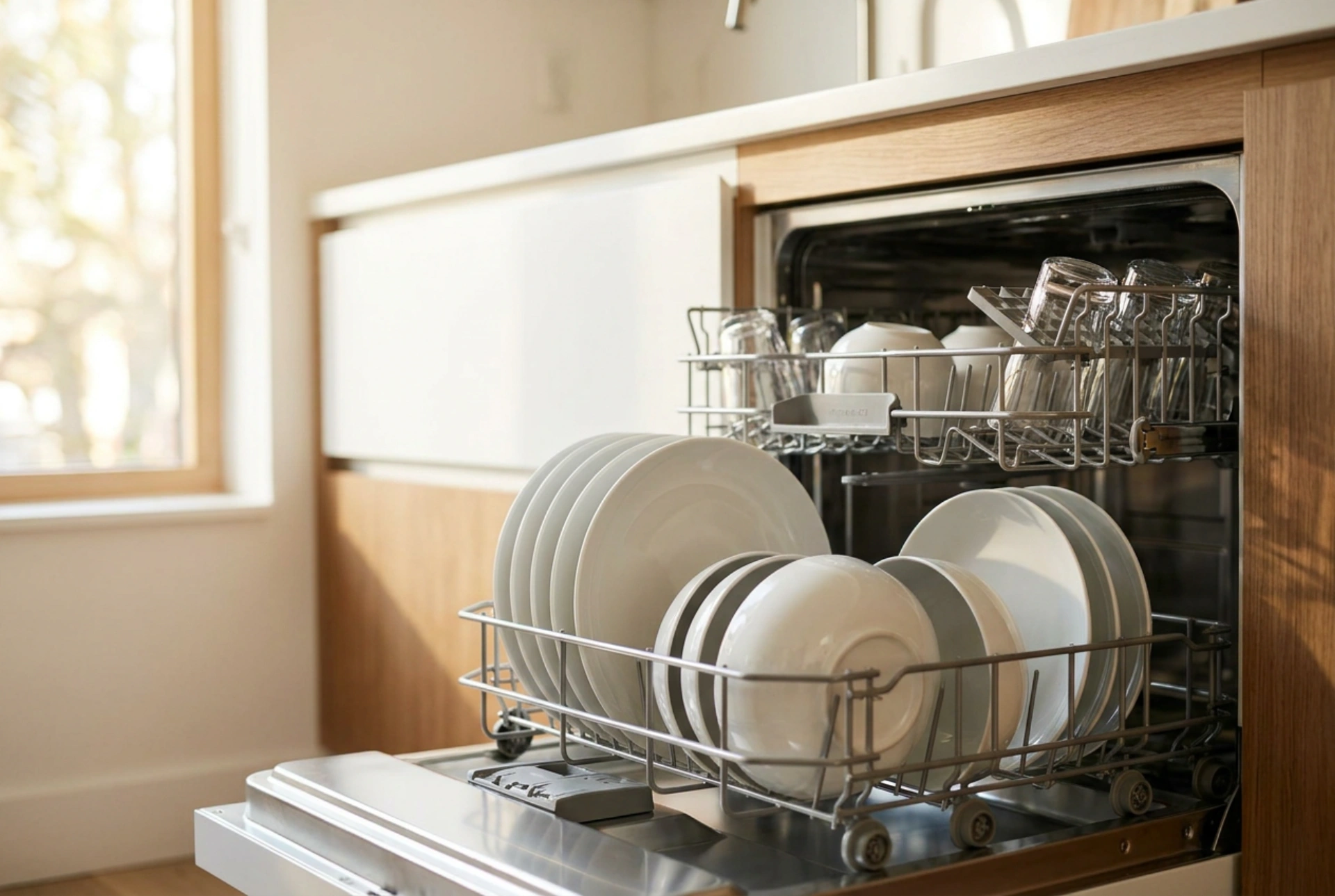
To prevent this shadowing effect, plates must always face inward toward the centre of the rack where the spray arm's rotational axis lies. Additionally, tilting plates slightly downward ensures that the kinetic energy of the water strikes the soiled surfaces directly, dislodging food particles through shear stress rather than relying solely on chemical dissolution by the detergent.
Capillary Action and Surface Tension: Why Spacing Prevents Spots
The chemistry of dishwasher detergent and rinse aids relies heavily on surfactants, which reduce the surface tension of water. This reduction allows water to sheet off ceramic and glass surfaces smoothly in a thin film, rather than forming droplets that leave behind mineral deposits upon evaporation. However, if two plates touch or sit too close, capillary action takes over.
Capillary action draws and holds water into the narrow gap between the contacting ceramic surfaces. This trapped water cannot drain freely, neutralizing the gravity-assisted sheeting effect. As the drying cycle begins, this trapped, soiled water evaporates slowly, leaving concentrated rings of calcium carbonate and detergent residue on your tableware. Proper spacing breaks this capillary bridge, allowing gravity to pull water down and away.
A Systematic Protocol for Loading Compact Racks
Achieving optimal clean cycles in small spaces requires a methodical approach to spatial organisation. By establishing a consistent loading order, you ensure unobstructed water paths and efficient drying:
- Size Alternation: When loading the bottom rack, alternate between large dinner plates and smaller side plates. This variance in height prevents the plates from nesting together, maintaining a physical gap of at least two centimetres for water penetration.
- The Centre Focus: Position plates so their soiled faces point toward the centre spray hub. The outermost slots should hold plates angled inward, while the innermost plates should align with the direction of the water rotation.
- Dispensary Clearance: Always check the path of the detergent dispenser flap. Placing large plates or chopping boards at the front-left of the bottom rack can physically block the door from springing open, preventing the timely release of the cleaning agent.
- Tine Alignment: Utilise the built-in rack tines to hold plates upright. Flat-lying plates block the upward spray from reaching the upper basket, starving the top glasses of necessary water pressure.
Thermal Dynamics and Condensation Drying
Most modern small built-in dishwashers utilise condensation drying rather than exposed heating elements. This process relies on the latent heat capacity of the stoneware and ceramic plates. During the final hot rinse, the heavy plates absorb heat. Once the water drains, the interior stainless steel walls cool down faster than the dense ceramic tableware.
This temperature differential causes moisture to evaporate from the warm plates and condense onto the cold steel walls, eventually running down to the drain. If plates are packed too tightly, they cannot absorb sufficient heat during the rinse cycle, and air cannot circulate to carry the evaporated moisture away. Proper spacing is therefore just as vital for dry, spot-free plates as it is for clean ones.