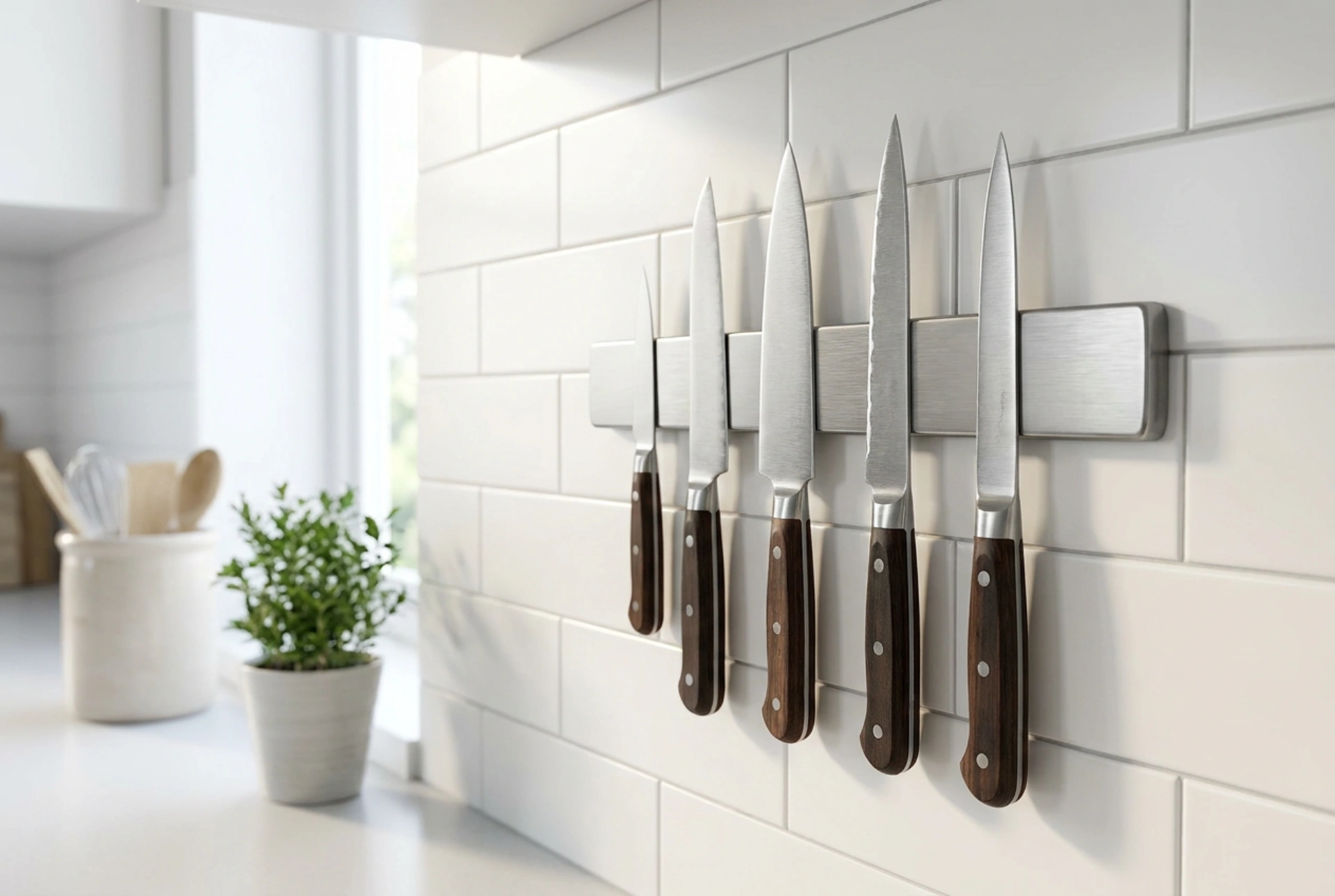


Installing a magnetic knife strip without drilling is a practical solution for renters and homeowners alike, but holding sharp blades securely requires understanding the chemistry of adhesives and the physics of shear load.
The Physics of Adhesive Mounting on Kitchen Surfaces
When you mount a magnetic knife strip, the adhesive bond faces two primary forces: tensile stress (pulling directly away from the wall when you grab a knife) and shear stress (the downward gravitational pull of the strip and the knives). Standard tiles, glass backsplashes, and polished stone are non-porous surfaces. While they are excellent for hygiene, their ultra-smooth texture offers very little mechanical grip for standard glues. To achieve a permanent, risk-free hold, you must rely on chemical adhesion rather than mechanical interlocking.
Kitchen environments also present unique challenges such as high humidity, airborne grease particles, and temperature fluctuations from cooking. These factors can rapidly degrade inferior adhesives, leading to catastrophic bond failure. Therefore, the selection of the adhesive material and the microscopic cleanliness of the substrate are the two most critical variables for a successful, drill-free installation.
Choosing the Right Adhesive Material
To support the weight of heavy carbon steel or stainless steel kitchen knives, you must bypass generic double-sided tapes and opt for high-performance materials designed for structural or outdoor bonding. There are two primary reliable options:
- Acrylic Foam Tapes: These are thick, pressure-sensitive adhesive tapes. The acrylic foam core has viscoelastic properties, meaning it absorbs vibrations and distributes stress evenly across the bonded area. They form an airtight seal that prevents moisture from penetrating and weakening the bond over time.
- Modified Silane (MS) Polymer Adhesives: These are high-tack, elastic mounting adhesives that cure in the presence of atmospheric moisture. MS polymers provide incredibly high initial grab and remain flexible after curing, which prevents the bond from becoming brittle under the constant impact of knives being attached and detached.
Step-by-Step Surface Preparation and Installation
A failure in drill-free mounting is almost always caused by improper surface preparation rather than adhesive failure. Follow this precise sequence to ensure maximum load capacity:
1. Micro-Cleaning the Substrate
Clean the designated wall area thoroughly. Do not use household glass cleaners or dish soaps, as they often leave behind surfactant films or polishing agents that act as release agents. Instead, use pure isopropyl alcohol (90% or higher) or denatured alcohol. Wipe the surface with a lint-free microfibre cloth until it is completely dry and squeaky clean. Repeat this process on the back of the magnetic strip itself.
2. Alignment and Marking
Use a spirit level and a pencil or masking tape to mark the exact boundaries of the strip. Once high-performance adhesive makes contact with the wall, adjusting its position is highly difficult without damaging the adhesive layer.
3. Applying the Adhesive
If using acrylic foam tape, apply vertical strips along the entire length of the magnetic holder. Vertical strips allow any condensation or moisture to run down rather than pooling on top of a horizontal barrier. If using MS polymer adhesive, apply it in vertical beads, leaving gaps to allow air and moisture to reach the adhesive for proper curing.
4. Activating the Bond
Press the strip firmly against the wall. For pressure-sensitive acrylic tapes, the bond strength is directly proportional to the amount of pressure applied during installation. Press firmly across the entire surface for at least 60 seconds. Do not load the strip immediately; let the adhesive cure. Acrylic tapes reach about 90% strength after 24 hours, while MS polymers may require 24 to 48 hours to cure fully depending on humidity levels.
Safe Interaction: The Peel-and-Twist Method
The way you interact with your magnetic knife strip determines its lifespan. Pulling a knife straight toward you exerts maximum tensile force on the adhesive bond, which can gradually peel the strip away from the wall. To eliminate this risk, always use the 'peel-and-twist' method. To remove a knife, grip the handle, twist the blade slightly to rest the spine against the strip, and roll it off. This leverages physics to break the magnetic contact easily without applying outward force to the adhesive backing.