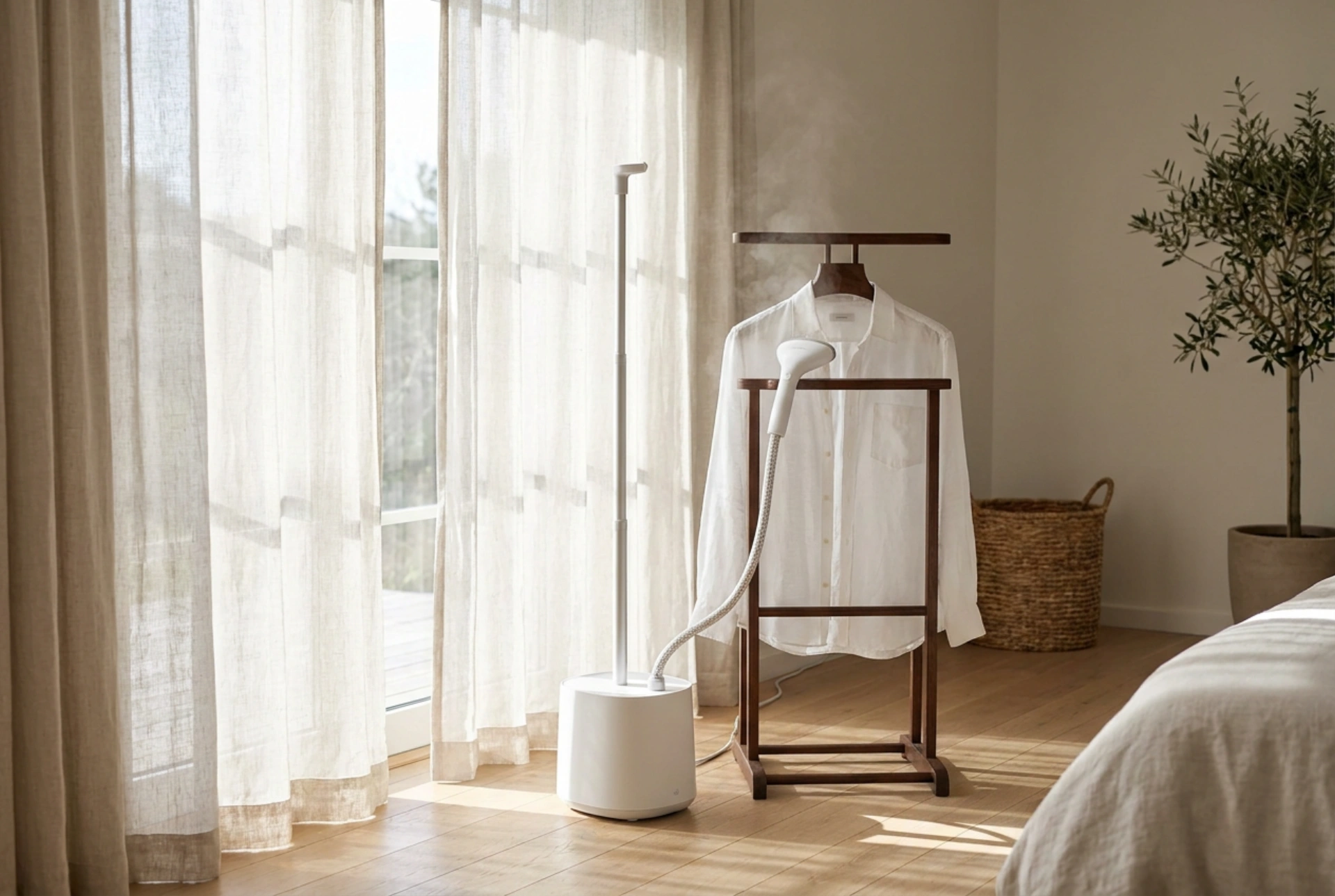


Upright garment steamers offer a gentle, contact-free method to smooth out creases and sanitise textiles by leveraging the thermodynamic properties of high-temperature water vapour. Unlike traditional flat irons, which rely on heavy mechanical pressure and dry heat, steaming relaxes polymer chains within fabric fibres to restore their natural drape.
The Science of Steam: How Vapour Relaxes Fibres
To understand why steaming is highly effective, one must look at the molecular structure of textile fibres. Natural fibres such as cotton, linen, and wool are bound together by internal hydrogen bonds. When garments are worn, folded, or compressed, these bonds lock into distorted positions, resulting in visible creases.
An upright steamer works by projecting gaseous water molecules at temperatures exceeding 100°C directly into the weave. The combination of heat and moisture temporarily breaks the weak hydrogen bonds within the amorphous regions of the polymer chains, such as cellulose in cotton or keratin in wool. Once these bonds are disrupted, gravity and slight manual tension allow the molecules to realign into their original, stress-free configuration. As the fabric cools and dries, new hydrogen bonds reform in this relaxed state, leaving the garment perfectly smooth.
Material Sensitivity and Heat Management
Different textile fibres react uniquely to thermal energy, making temperature and distance management crucial when operating an upright steamer. Applying the wrong technique can lead to permanent structural damage, such as glazing or melting.
- Natural Plant Fibres (Cotton, Linen): These materials have high thermal resistance and absorb moisture readily. They require high-volume, direct steam to fully penetrate their dense crystalline structures. Keep the steamer head close to the fabric and pull the hem taut to maximise tension.
- Animal Proteins (Wool, Silk): Silk is highly heat-sensitive, while wool fibres have a protective lipid layer. For silk, hold the steam nozzle 2–3 centimetres away from the surface to prevent water spotting. For wool, steam from the inside out to lift the pile and restore loft without flattening the scales of the wool fibres.
- Synthetic Polymers (Polyester, Nylon, Acrylic): Synthetics have low glass transition temperatures. Excessive heat can melt the plastic-based fibres, creating shiny patches or physical warping. Always steam synthetics from a distance of at least 5 centimetres and utilise a continuous, sweeping motion.
The Correct Technique: Order of Operations
Achieving professional results with an upright steamer depends heavily on gravity, tension, and systematic movement. Haphazardly waving the steam head across a garment yields uneven results and wastes energy.
First, ensure the water tank is filled with distilled or demineralised water. Tap water contains calcium and magnesium ions that precipitate into limescale under high heat, clogging the steam vents and potentially spitting mineral residue onto clean clothes. Turn the unit on and allow it to reach its optimal operating temperature before touching the fabric.
Begin by hanging the garment securely on the integrated hanger system. Secure any buttons or zip closures to provide structural stability. With one hand, pull the bottom hem of the garment downward to create slight tension. Hold the steam head vertically and press it lightly against the inside of the fabric, moving from the bottom upward. This technique allows the rising steam to pre-heat the fabric above, opening the weave before the nozzle even reaches it. For collars, cuffs, and plackets, use a heat-resistant pressing mitt behind the fabric to apply flat counter-pressure without burning your skin.
Odour Neutralisation and Sanitisation Chemistry
Beyond crease removal, upright steamers serve as powerful tools for wardrobe sanitisation and deodorisation. Perspiration and stale odours are primarily caused by volatile organic compounds (VOCs) produced by microbial activity. Traditional washing processes use chemical surfactants to lift these compounds, but frequent washing accelerates fabric wear.
The high thermal energy of steam breaks down the weak chemical bonds of VOCs, volatilising them so they evaporate into the air. Simultaneously, temperatures above 100°C denature the proteins in bacteria, dust mites, and fungal spores residing in the weave, effectively sterilising the fabric without chemical intervention. This makes steaming an ideal maintenance step for heavy garments, suits, and outerwear that cannot be laundered frequently.