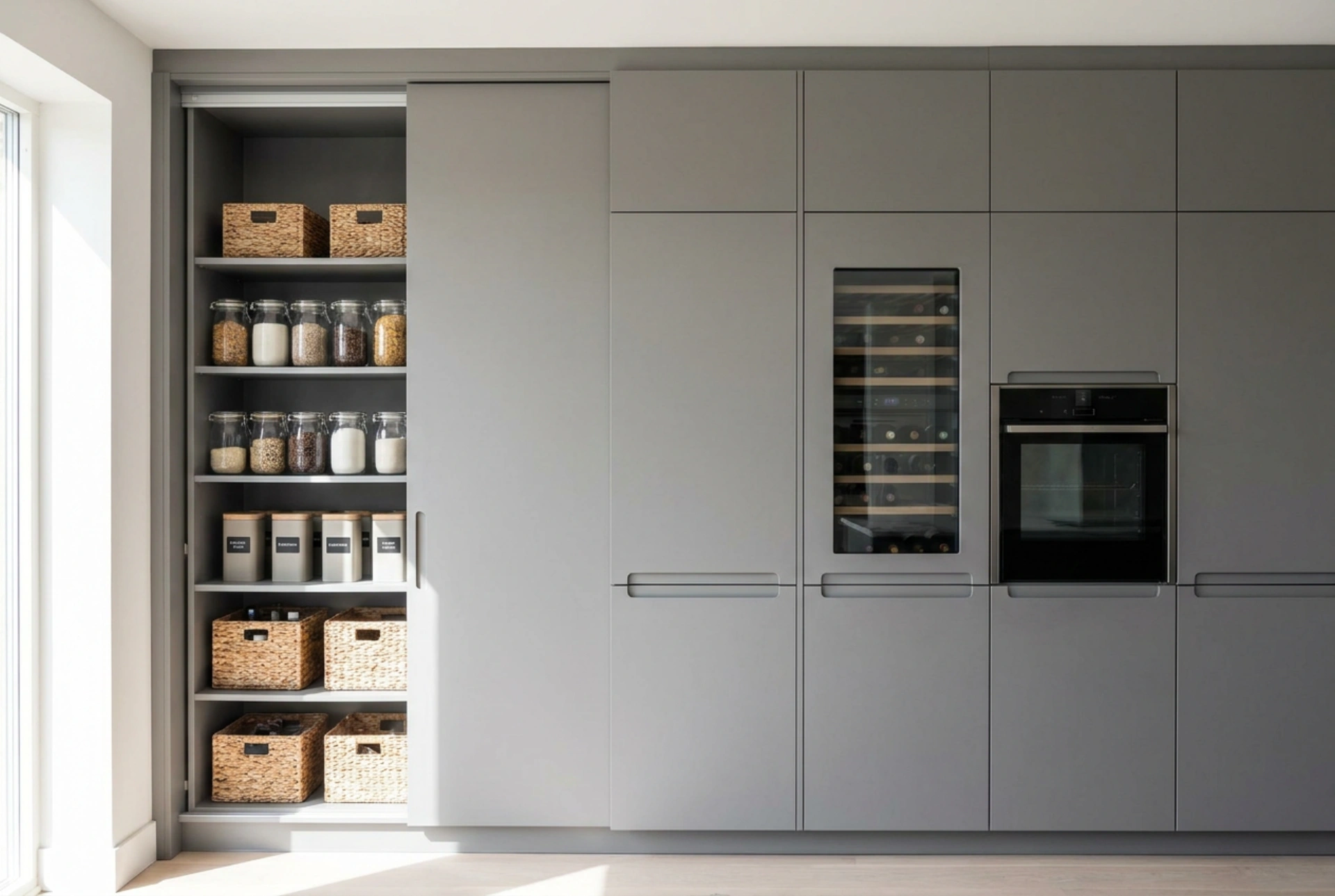


Selecting an integrated fridge-freezer requires a precise understanding of ventilation physics, cabinetry dimensions, and door hinge mechanics to prevent premature compressor failure and ensure seamless cabinet integration.
The Thermodynamics of Integrated Cooling: Why Ventilation is Critical
A refrigerator does not generate cold; instead, it removes thermal energy from its interior and expels it into the surrounding environment. In free-standing units, this heat dissipates easily into the room. However, when an appliance is enclosed within wooden cabinetry, the thermal energy becomes trapped. Without proper airflow, the ambient temperature around the condenser coils rises, forcing the compressor to run continuously to maintain internal temperatures. This increases energy consumption and dramatically shortens the lifespan of the compressor.
To prevent thermal stagnation, a built-in kitchen niche must be designed as a functioning chimney. Air must enter through an intake vent located in the plinth (kickplate) at the base of the cabinet, travel upward behind the rear wall of the refrigerator, and exit through a vent at the top of the cabinet or via a gap behind the wall cabinets. The universal industry standard requires a minimum ventilation cross-section of 200 square centimeters at both the entry and exit points. Reducing this area restricts convective airflow, causing localized heat buildup.
Mechanical Door Attachments: Sliding vs. Fixed Hinges
Integrating a refrigerator door with a custom wooden cabinet front requires choosing between two distinct mechanical systems: sliding hinges (tow-track) and fixed hinges (door-on-door). Each system alters how weight is distributed and how the doors align.
The Sliding Hinge System
In a sliding hinge configuration, the cabinet front is mounted directly to the kitchen carcass using standard furniture hinges. The appliance door has its own hinges. The two doors are linked together by a plastic guide rail or slide. When the external wooden door is opened, the slide pulls the appliance door along with it. This system is highly forgiving during installation because the alignment of the external cabinet door can be adjusted independently of the appliance. However, it requires a larger gap between cabinets and does not support heavy door panel weights.
The Fixed Hinge System
The fixed hinge (or door-on-door) system eliminates the need for separate cabinet hinges. The decorative wooden front is mounted directly onto the reinforced hinges of the refrigerator door itself. All the weight of the furniture panel is borne by the appliance's heavy-duty hinges. This mechanism allows for a wider door opening angle (often up to 115 degrees) and enables tighter, more precise gaps between cabinets, resulting in a cleaner, minimalist aesthetic. When selecting this option, you must verify that the weight of your custom cabinet door does not exceed the maximum load rating specified by the appliance manufacturer.
Matching the Split: Niche Dimensions and Door Ratios
Unlike free-standing appliances, built-in fridge-freezers must align perfectly with the horizontal lines of the surrounding kitchen cabinetry. The total height of the niche is typically standard (ranging from 1772 mm to 1788 mm for standard tall units), but the split between the upper refrigeration compartment and the lower freezer compartment varies.
- 50/50 Split: Equal storage volume in both compartments, requiring two external cabinet fronts of identical height.
- 70/30 Split: Maximizes fresh food storage at eye level with a smaller freezer section below, requiring a taller upper cabinet door and a shorter lower door.
To achieve a seamless look, you must measure the exact position of the internal partition of the appliance and match it to the gap between your cabinet fronts. If the split on the appliance does not match the gap between the wooden fronts, the internal shelves or drawers may block access, or the doors may bind against each other when opened.
Cabinet Depth and Technical Clearances
Standard kitchen base cabinets are 600 mm deep. However, an integrated fridge-freezer typically has an installation depth of 540 mm to 550 mm. This difference of 50 mm to 60 mm is not accidental; it is a structural requirement. This space behind the appliance serves as the primary ventilation shaft. Attempting to push an appliance into a shallow cabinet without this clearance restricts the convective air currents, leading to condensation, mold growth on the cabinet walls, and compressor overheating. Always verify the internal depth of your cabinet carcass before finalizing your appliance purchase.