

Arranging cutlery in a dishwasher basket is not just about making space; it is about managing water dynamics and preventing nested surfaces from blocking the spray. By applying simple physical principles of water flow and spacing, you can ensure every utensil emerges spotless and hygienically clean.
The Physics of Nesting and Water Dynamics
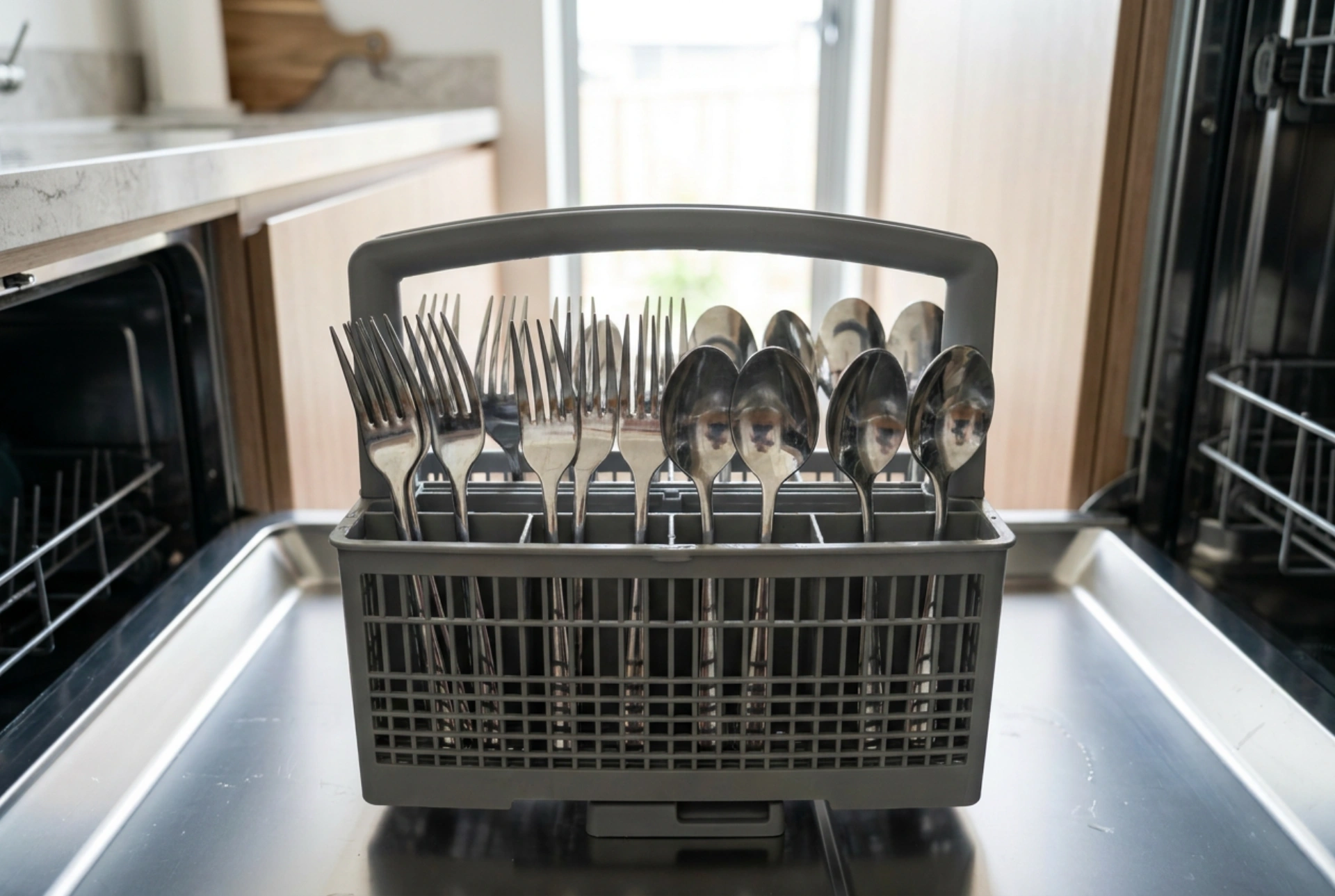
The primary reason cutlery remains dirty after a dishwasher cycle is a phenomenon known as nesting. When identical utensils, particularly spoons, are placed next to each other in the same orientation, their curved surfaces fit together perfectly. This tight contact creates a capillary barrier that prevents water and detergent from penetrating between them. To combat this, you must disrupt the symmetry. Alternating the orientation—some spoons pointing up, others pointing down—creates physical gaps that allow high-pressure water jets to circulate freely around each piece.
The spray arms in a dishwasher rely on rotational kinetic energy and pressure to project water upward. If cutlery is packed too tightly, it acts as a physical shield, casting a spray shadow over neighboring items. Ensuring that there is adequate space between each utensil allows the water droplets to maintain their velocity and effectively dislodge food particles through mechanical action.
Handles Up or Handles Down: The Scientific Verdict
From a purely mechanical cleaning perspective, cutlery should be loaded with the handles facing down. The widest, most soiled parts of spoons and forks need direct exposure to the high-velocity water jets originating from the spray arms below. Placing the food-contact ends upward ensures they receive the unrestricted impact of the washing and rinsing cycles.
However, safety and hygiene introduce nuances to this rule:
- Knives: Always place knives with the handles up and blades pointing down. This is a crucial safety measure to prevent cuts when unloading. Because knife blades are flat and lack deep curves, they are less prone to nesting and will still clean effectively in this position.
- Forks and Spoons: Place these handles down to maximize water exposure. When unloading, try to touch only the handles to maintain the sanitary state of the prongs and bowls.
Preventing Galvanic Corrosion in the Basket
A lesser-known chemical hazard inside the dishwasher is galvanic corrosion, which occurs when dissimilar metals come into contact in a wet, conductive environment. If you mix sterling silver cutlery with stainless steel in the same basket compartment, the moisture and dissolved salts in the dishwasher detergent create an electrolyte solution.
This setting facilitates an electron transfer between the two metals, leading to the rapid tarnishing of the silver and pitting or dark spots on the stainless steel. To prevent this chemical reaction, always separate silver from stainless steel by placing them in different sections of the basket, or wash them in separate cycles entirely.
The Order of Operations for Spotless Results
The way you unload your dishwasher is just as important as how you load it. Always empty the cutlery basket first before moving on to the upper racks. If you unload the upper racks first, any water pooled in the concave bases of mugs and bowls can spill downward, creating unsightly water spots on your clean cutlery. Furthermore, ensuring your dishwasher water temperature reaches at least 55 degrees Celsius is critical; this temperature is necessary to hydrolyze fats and activate oxygen-based bleaching agents, ensuring no greasy residue remains on your metal utensils.