

Maximising usable volume in micro-apartments requires shifting from static furniture to dynamic, space-on-demand installations. A folding clothes rack acts as a physical valve for spatial tension, offering temporary hanging capacity exactly when and where it is needed without permanently occupying valuable floor area.
The Spatial Geometry of Dynamic Storage
In standard interior design, furniture footprint is calculated flat on the floor plan. However, small-space efficiency relies on cubic volume optimization. A fixed wardrobe or a standing drying rack permanently claims up to one square metre of floor space, regardless of whether it is holding garments or sitting empty. Folding racks exploit the unused vertical plane of walls or door frames, transforming dead space into functional zones.
When collapsed, a high-quality folding rack projects mere centimetres from the wall. This minimizes the visual clutter that psychological studies link to spatial claustrophobia in confined living environments. When deployed, it extends outwards, utilizing the cantilever principle to create an overhead hanging bar. This shift from horizontal floor occupancy to vertical wall suspension allows for unimpeded foot traffic beneath the suspended garments, preserving the natural flow of the room.
Material Science and Load Distribution Mechanics
Selecting the right folding mechanism requires an understanding of mechanical leverage and material science. Unlike stationary wardrobes, a folding rack experiences dynamic load changes every time it is opened, loaded, and closed. The pivot points and hinges must withstand rotational torque and shear stress.
- Anodized Aluminium: Highly resistant to corrosion from damp clothing, lightweight, and possesses a high strength-to-weight ratio. Ideal for damp environments like bathrooms or compact utility closets.
- Stainless Steel: Offers superior tensile strength, making it suitable for heavier winter coats. Brushed finishes also resist scratching from metal hanger hooks.
- Hinge Physics: Look for friction hinges or mechanical locking pins. Friction hinges allow the rack to stay partially open at specific angles, while locking pins ensure the arm cannot collapse accidentally under asymmetrical loading.
From a mechanical perspective, the load placed on an extended folding rack exerts a pulling force (tension) on the upper wall fixings and a pushing force (compression) on the lower base plate. To prevent failure, the mounting hardware must match the substrate. For drywall, heavy-duty toggle bolts that distribute the load behind the gypsum board are mandatory. For solid brick or concrete walls, nylon expansion anchors provide the necessary friction coefficient to resist shear forces.
Thermodynamics of Airflow and Clothes Drying
In small flats, drying wet laundry often creates moisture regulation challenges. Standard floor-standing clothes horse designs trap pockets of humid air beneath the garments, slowing down evaporation and increasing local relative humidity, which can lead to condensation and mould. Folding racks mounted higher on the wall leverage natural convection.
Warm air rises. By suspending wet laundry higher in the room's vertical profile, garments are exposed to warmer, drier air currents. Spacing hangers at least five centimetres apart on a wall-mounted folding rack creates clear aerodynamic channels. This allows air to flow upward through the wet fabric, carrying moisture away efficiently via natural evaporation. Placing the rack near a heat source, such as a radiator, enhances this effect, provided there is a safe clearance to prevent overheating of the textiles.
Strategic Placement Strategies
To maximize the utility of a folding rack, placement must align with daily domestic habits and thermal zones:
The Entryway Transition Zone
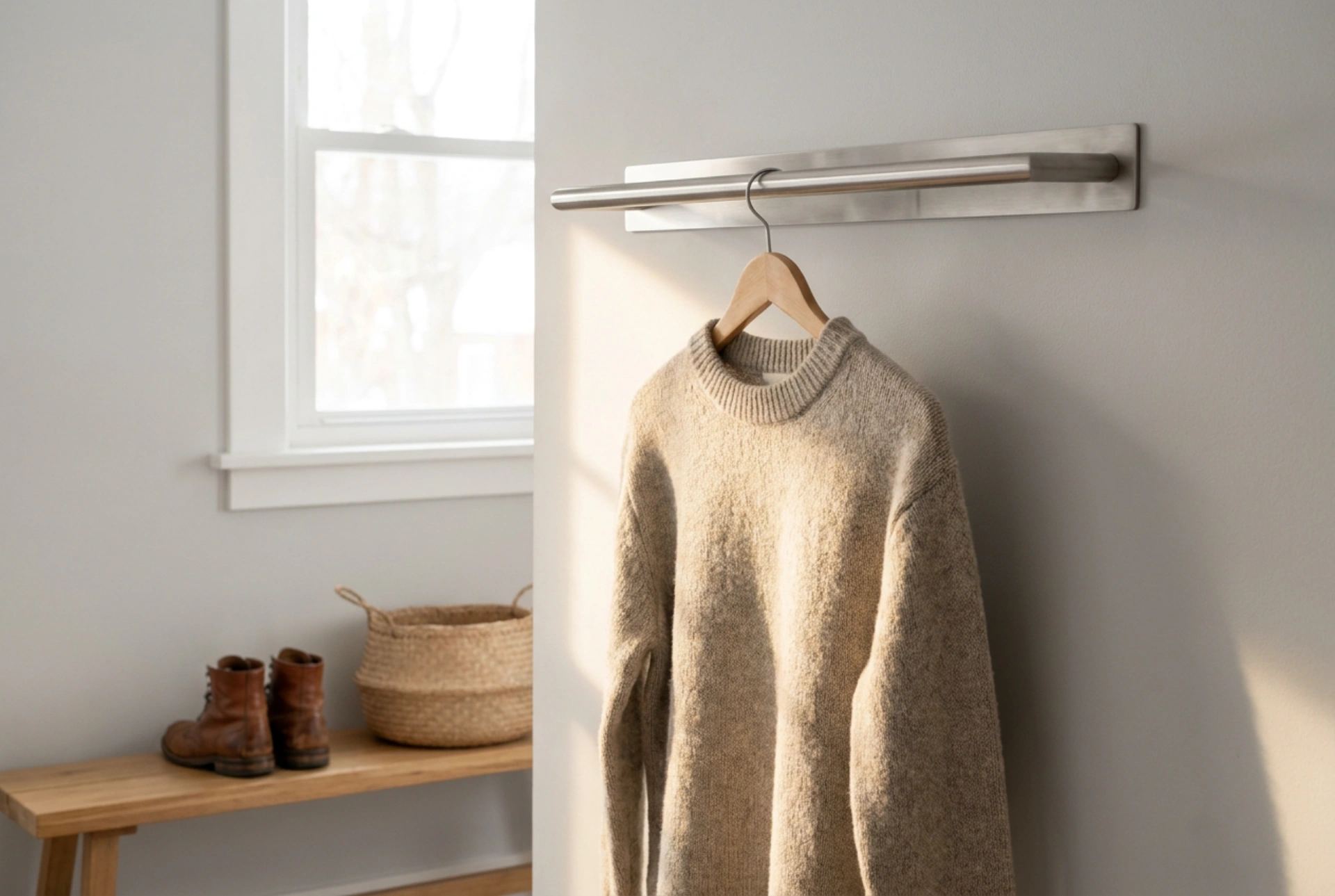
An entryway in a small flat is often too narrow for a traditional coat stand. A folding rack mounted at shoulder height provides immediate hanging space for damp coats or guest jackets. Once dry or cleared, the rack folds flat, restoring the corridor's full clearance width to prevent physical obstruction.
The Laundry Micro-Zone
Mounting a folding rack directly above a washing machine or inside a shallow utility cupboard creates an instant vertical drying station. It allows garments to be transferred directly from the drum to hangers, reducing wrinkles and eliminating the need for subsequent ironing, which saves both energy and physical space.
The Bedroom Valet Station
Positioned near a wardrobe, a folding rack serves as an excellent valet station for airing out garments worn once or preparing the next day's outfit, keeping worn clothing separate from clean items without cluttering chairs or bed corners.