

Over time, starch, synthetic microfibres, and mineral scale build up on your iron's soleplate, creating drag and risking permanent damage to delicate garments. Restoring a smooth glide requires an understanding of material science to dissolve these deposits chemically rather than scraping them off mechanically.
Understanding Soleplate Materials and Deposit Chemistry
Modern irons use various soleplate coatings, each with distinct physical properties. Ceramic coatings offer excellent heat distribution but are brittle and prone to micro-fractures. Teflon (PTFE) coatings are highly non-stick but chemically soft and easily scratched by metals. Stainless steel is harder but still vulnerable to abrasive cleaners that dull its polished finish.
The residues that accumulate on these surfaces typically fall into three categories:
- Carbonised Organic Matter: Burnt laundry starch or fabric softeners that have undergone thermal degradation under high heat.
- Thermoplastic Polymers: Microscopic synthetic fibres (like polyester or nylon) that have melted and fused to the soleplate when ironing at excessive temperatures.
- Mineral Scale: Calcium carbonate deposits ejected from steam vents when tap water is used.
Avoiding mechanical abrasion is crucial. Scratches on a soleplate create microscopic pockets where starch and fibres trap even faster, leading to a rapid cycle of degradation.
Thermal Softening and Weak Acids: The Dissolution Process
To clean a soleplate safely, you must match the cleaning agent to the chemical nature of the deposit. For mineral scale, weak acids are highly effective. Acetic acid (found in white vinegar) or citric acid reacts with calcium carbonate to form water-soluble salts and carbon dioxide. This process dissolves the bond holding the scale to the soleplate without attacking the underlying metal or ceramic.
For melted synthetic fibres, thermal softening is key. Thermoplastic polymers soften at specific temperatures. By heating the iron slightly to its lowest synthetic setting (around 60°C to 80°C), you can bring the melted fibres back to a highly viscous, pliable state. Once softened, they can be rolled off the surface with a mechanical tool softer than the soleplate itself, such as a wooden spatula or a coarse cotton cloth.
Safe Cleaning Protocols: Step-by-Step
Depending on the type of build-up, choose one of these non-abrasive protocols:
The Acid-Compression Method (For Limescale and Light Starch)
This method is performed when the iron is completely cold and unplugged.
- Soak a clean, thick cotton towel in a 1:1 solution of warm water and white vinegar or a 5% citric acid solution.
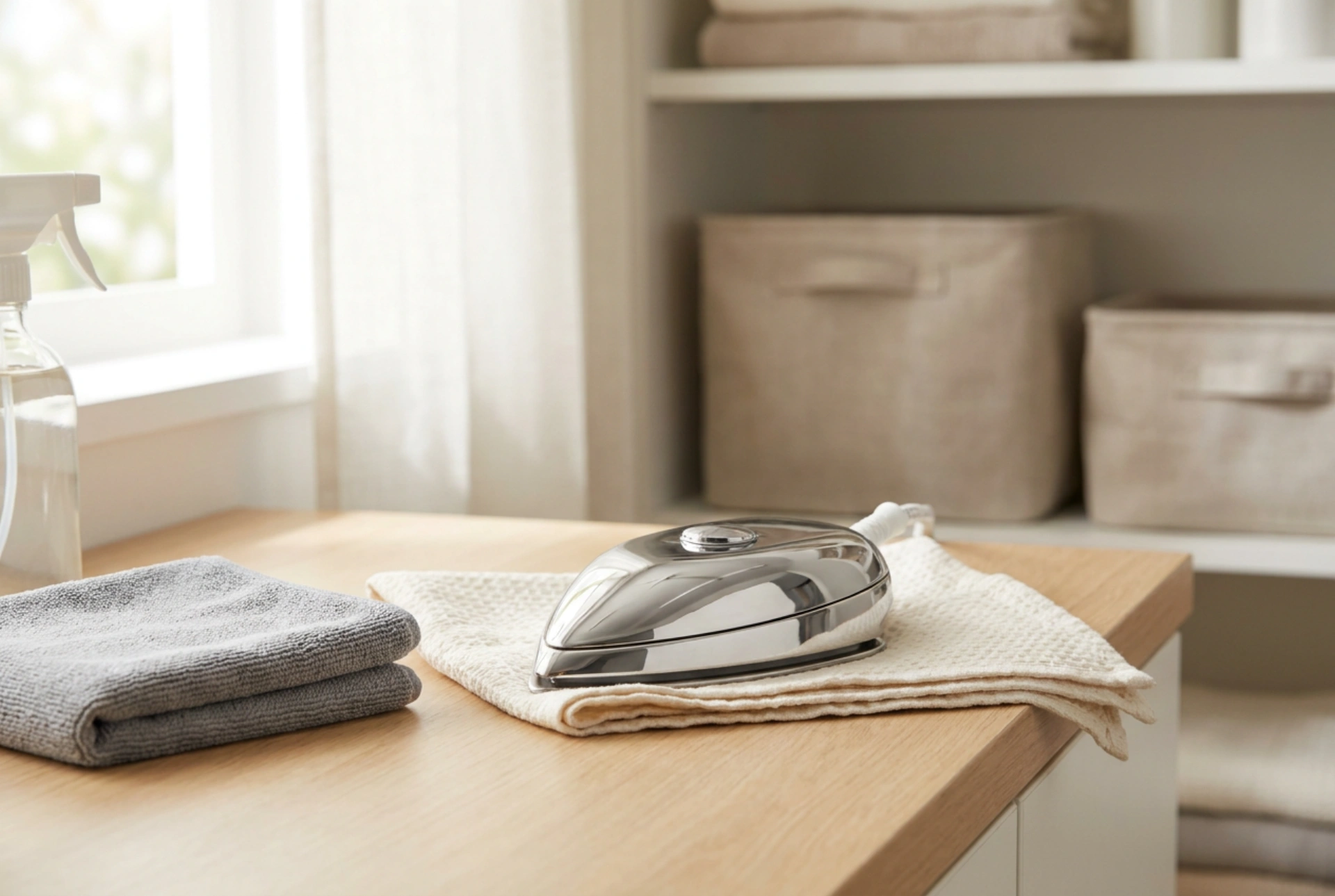
- Place the towel flat on an ironing board and rest the cold iron soleplate directly onto the wet fabric.
- Leave it undisturbed for 30 to 45 minutes. The acid will migrate into the alkaline scale, breaking its crystalline structure.
- Lift the iron and wipe the soleplate firmly with a clean, damp microfibre cloth to lift the dissolved residue.
The Sodium Bicarbonate Paste (For Heavy Carbonisation)
Sodium bicarbonate (baking soda) has a Mohs hardness rating of only 2.5, making it softer than copper, steel, and ceramic, but hard enough to act as a gentle physical buffer.
- Mix two parts sodium bicarbonate with one part water to form a thick, non-runny paste.
- Apply the paste to a cold soleplate using your fingers or a soft sponge, concentrating on the stained areas. Avoid getting paste into the steam vents.
- Gently rub in small circular motions using a microfibre cloth. Do not apply heavy downward pressure.
- Wipe away all paste residue with a clean, damp cloth, then run the steam function over an old towel to clear the vents.
Preventing Future Buildup
The most effective maintenance is preventive. Always match your iron's temperature setting to the fabric composition to prevent polymer melting. Wipe the soleplate with a damp cotton cloth after every use once the appliance has cooled down to prevent starch accumulation from hardening. Finally, use demineralised or distilled water to eliminate scale formation entirely inside the steam chamber.