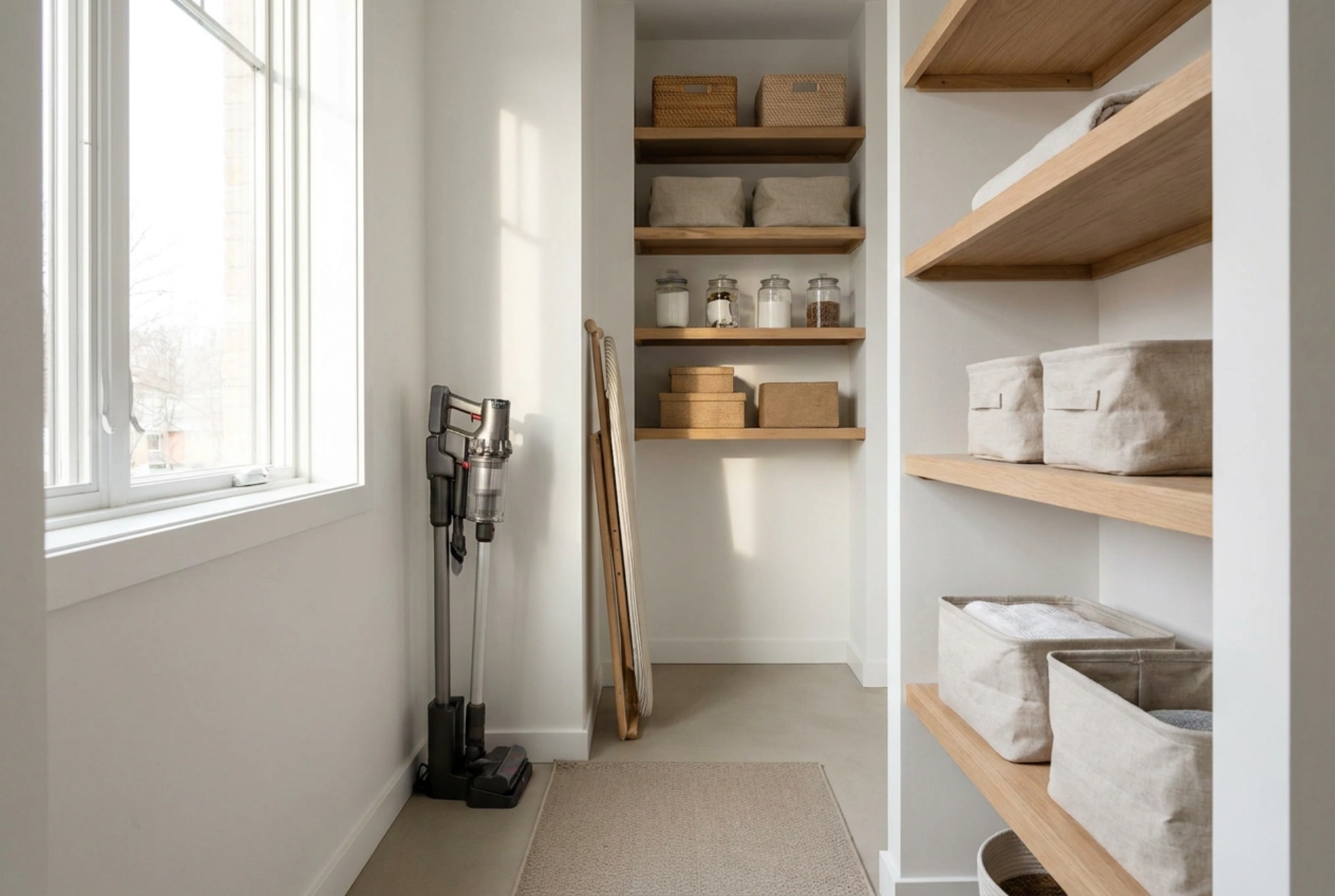


Allocating dedicated space for bulky utility items like vacuum cleaners and ironing boards inside a standard wardrobe requires a strategic approach to ergonomics, structural load, and spatial geometry. By understanding how to utilise vertical axes and distribute weight, you can transform a chaotic cupboard into a highly functional storage hub.
The Physics of Weight Distribution and Ergonomics
When organising heavy or awkwardly shaped appliances, the primary consideration must be physical ergonomics and structural safety. A vacuum cleaner, particularly a cordless model with a heavy motor unit, or a traditional cylinder vacuum, exerts concentrated gravitational force. Storing heavy motor units at or below waist height minimises the physical strain of lifting and prevents potential structural damage to wardrobe shelving.
In contrast, an ironing board is lightweight but possesses high vertical surface area. Its main challenge is lateral stability. When stored upright, the centre of gravity is high, making it prone to tipping. Placing the ironing board in a narrow, dedicated slot—either between a partition wall and the wardrobe frame or secured with a tension strap—prevents kinetic energy transfer that could knock down adjacent items.
Vertical Partitioning and Tension-Based Segregation
Standard wardrobes are often designed for hanging clothes, leaving a significant amount of dead space at the bottom. Creating a dedicated utility column is the most efficient way to reclaim this volume. You do not need complex carpentry to achieve this; instead, you can utilise retrofitted vertical dividers or tension rods.
A vertical partition wall, made of lightweight MFC (melamine-faced chipboard) or plywood, can be secured using simple L-brackets or heavy-duty mounting tape designed for structural shear strength. This partition divides the wardrobe into a narrow vertical slot (approximately 15–20 cm wide) specifically for the folded ironing board and the vacuum wand, leaving the remaining wider section free for shelves or low-hanging garments. By compartmentalising the cabinet, you eliminate the risk of items shifting and blocking the door mechanism.
Mechanical Mounting and Cantilevered Load
To keep the wardrobe floor clear for easy cleaning, consider mounting the vacuum attachments and the ironing board onto the inner walls or the inside of sturdy wardrobe doors. However, this introduces cantilevered force—a pulling force exerted on the hinges and the wardrobe carcass.
If mounting an ironing board bracket on a door, ensure the door is supported by at least three high-quality cup hinges capable of bearing the combined weight. For hollow-core wardrobe doors, standard screws will not hold; you must use hollow-wall anchors or toggle bolts that expand behind the door panel to distribute the pull force across a larger surface area. For vacuum accessories, magnetic strips or custom-fit clip organisers mounted directly to the solid side panel of the wardrobe carcass offer a secure, vibration-resistant solution that utilises otherwise wasted depth.
Thermal Dynamics and Safety in Enclosed Spaces
A crucial but often overlooked aspect of appliance storage is thermal management. Vacuum batteries (lithium-ion) and steam irons retain residual heat immediately after use. Storing a hot iron or a freshly run vacuum in a tightly sealed wardrobe can lead to heat accumulation, which accelerates the degradation of battery cells and can cause moisture buildup from lingering steam.
To mitigate this, ensure that irons are placed on a heat-resistant silicone mat or a dedicated steel cradle that isolates the soleplate from wood or melamine surfaces. Allow the vacuum cleaner battery to cool down to room temperature before docking it inside an enclosed cabinet. If possible, introduce passive ventilation to the wardrobe—such as a small slatted vent insert or maintaining a microscopic gap in the door seals—to allow latent heat and humidity to dissipate safely.
Optimising the Layout: A Step-by-Step Checklist
- Measure clearances: Ensure the vertical slot has at least 160 cm of height for the ironing board and at least 120 cm for the assembled vacuum wand.
- Secure the base: Place a non-slip rubber mat at the bottom of the utility compartment to prevent the vacuum head and ironing board legs from sliding outward.
- Organise cords: Use hook-and-loop cable ties to coil power cords tightly, preventing them from tangling with other household items or getting caught in wardrobe doors.
- Utilise upper zones: Store lightweight, less frequently used laundry items, like iron refills or spare vacuum filters, on shelves directly above the utility compartment.