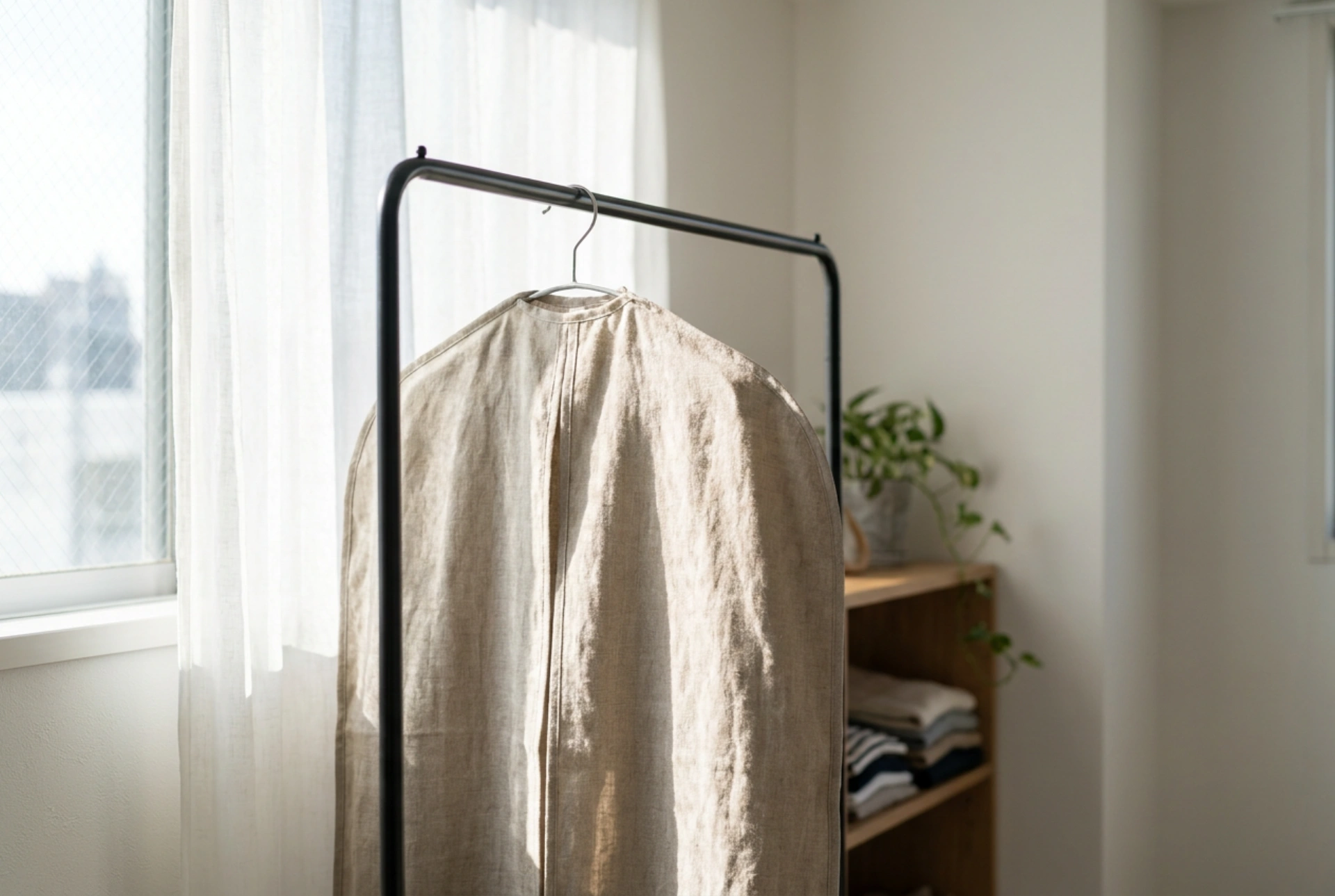


Open wardrobes and clothes racks offer quick access and a minimalist aesthetic, but they expose garments to airborne dust, fabric-fading ultraviolet radiation, and humidity fluctuations. Using a well-designed garment rack cover is the most effective physical barrier to preserve textile fibres without sacrificing the spatial layout of your room.
The Physics of Airborne Dust and Fabric Wear
Household dust is not just unsightly; it is chemically active and physically abrasive. Composed of skin cells, outdoor mineral particles, pollen, and microscopic synthetic fibres, dust settles on garments through a combination of gravity and electrostatic attraction. Synthetic textiles like polyester, nylon, and acrylic act as dielectric materials, easily accumulating static charges that actively pull dust from the surrounding air. When these abrasive mineral particles settle into the weave of a garment, they act like microscopic sandpaper. Every time you handle or move the clothing, these sharp dust particles grind against the delicate warp and weft yarns, breaking down the fibres, causing premature pilling, and weakening the structure of wool, silk, and cotton alike. A physical barrier, such as a continuous textile cover, intercepts these particles before they can settle into the weave.
Ultraviolet Radiation and Photo-Oxidation
Even when kept indoors, garments on open racks are subjected to daylight containing ultraviolet (UV) radiation. UV-A and UV-B wavelengths possess sufficient photon energy to break the chemical covalent bonds within dye molecules, a process known as photo-oxidation or photodegradation. This leads to irreversible fading, particularly on natural fibres like cotton, linen, and silk, which are highly susceptible to solar degradation. Furthermore, UV radiation initiates the degradation of polymer chains in synthetic fibres, causing them to become brittle and lose their tensile strength. Densely woven garment covers, particularly those made from natural materials like heavy linen or unbleached cotton canvas, serve as an opaque shield, scattering and absorbing these destructive wavelengths before they reach your wardrobe.
Selecting the Right Material: Breathability versus Impermeability
When selecting a cover, material science plays a critical role. Plastic covers made from PVC or PEVA are completely impermeable to air and moisture. While this may seem ideal for dust prevention, it creates a dangerous microclimate. Fluctuations in room temperature cause moisture in the air to condense on the inner walls of plastic covers. Because there is no ventilation, this trapped moisture creates a high-humidity environment perfect for fungal spores. Mold and mildew feed on organic finishes, starch residues, and natural fibres, leaving permanent stains and musty odours. Conversely, woven fabrics like linen and cotton allow air to pass through freely, balancing internal and external humidity levels. These natural fibres possess inherent microscopic gaps that allow air molecules to circulate while remaining small enough to block the passage of dust particles and lint.
Optimal Design and Maintenance Practices
To maximise the protective capabilities of a garment rack cover, structural design must be considered. Look for covers that offer complete top and side closure, ideally utilizing an overlapping fabric flap or high-quality zippers that prevent dust from settling through the top hanger bar opening. The bottom of the cover should extend slightly below the longest garments to prevent updrafts of floor dust. Maintenance of the cover itself is equally vital. Over time, the outer surface of the cover will accumulate a layer of dust and allergens. Washing the cover every three to six months in a gentle cycle with a pH-neutral detergent ensures that this accumulated dust does not migrate through the fabric weave onto the clean clothes underneath.