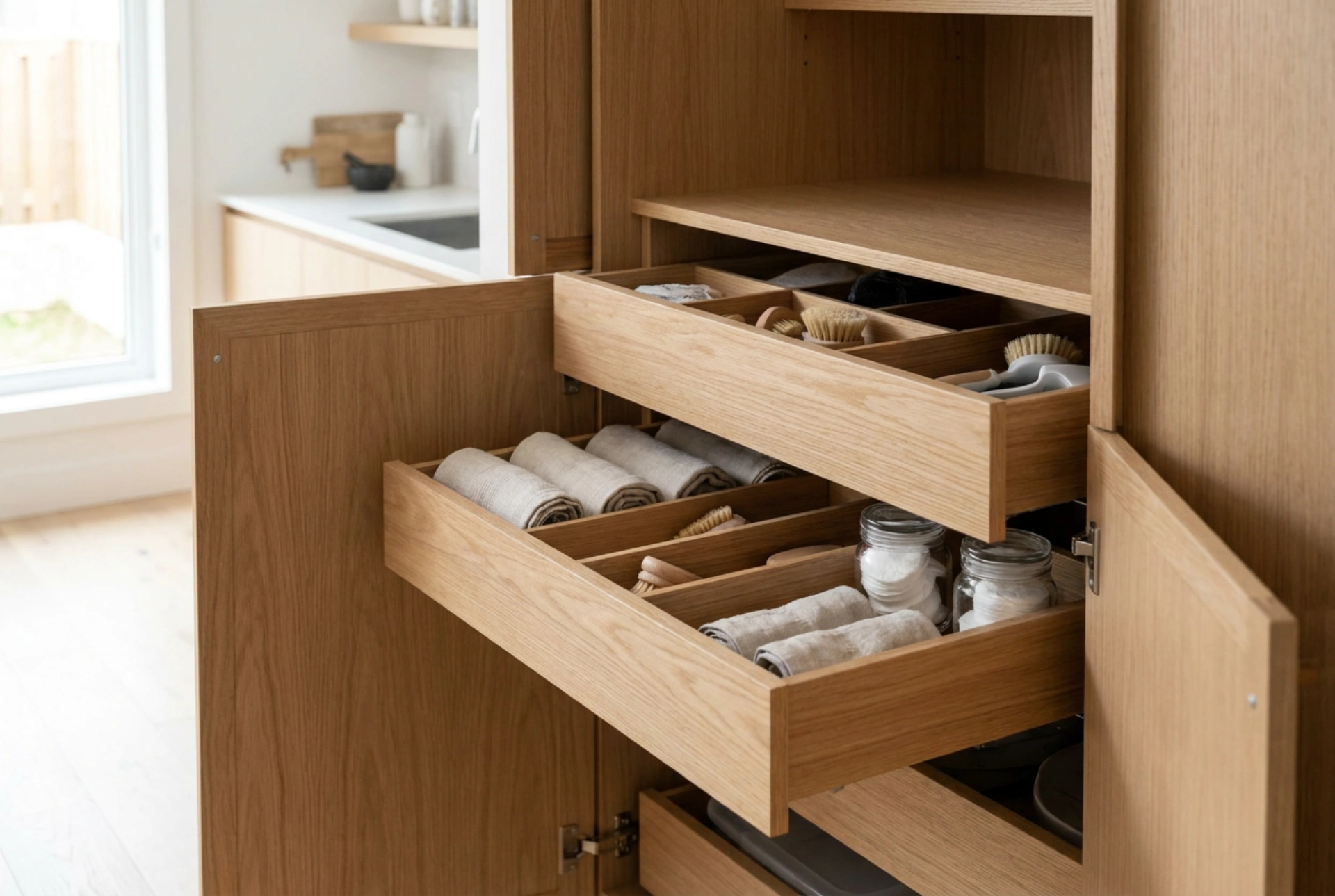


Utilizing the vertical plane for storage is one of the most efficient ways to maximize usable square footage in modern living spaces. A tall, floor-to-ceiling cabinet equipped with slender, pull-out drawers transforms disorganized clutter into a highly structured, easily accessible system by utilizing kinetic efficiency and precise spatial division.
Ergonomics and the Physics of Vertical Accessibility
Horizontal storage systems, such as deep shelves, suffer from the 'layering effect,' where items placed in front block the visibility and retrieval of those behind. This leads to spatial dead zones and forgotten inventory. Tall cabinet drawer systems solve this by converting depth into a pull-out vertical array. When a drawer is extended, its entire contents are exposed simultaneously from an overhead perspective, eliminating the need to reach behind objects.
Human ergonomics dictates that the most efficient storage zone lies between the knees and the chest—often referred to as the primary reach zone. In a tall cabinet, frequently used small items should reside in this middle zone to minimize spinal flexion and shoulder strain. Less frequently accessed items are allocated to the extreme upper and lower zones. By applying this vertical zoning, you align your household storage with natural human biomechanics, reducing physical fatigue during repetitive daily tasks.
Mechanical Engineering of Drawer Slides and Stability
The functionality of a tall cabinet depends heavily on its hardware. Heavy-duty, full-extension ball-bearing slides are critical for maintaining smooth kinetic movement under load. Ball-bearing runners distribute weight evenly across steel spheres housed in a metal track, reducing friction coefficients and ensuring that even fully loaded drawers glide effortlessly. Unlike simple roller runners, ball-bearing slides resist lateral twisting, preventing the drawer from binding or jamming when pulled from an off-center angle.
Structural safety in tall cabinets is governed by gravity and leverage. When multiple drawers are extended, the center of gravity shifts forward, potentially exceeding the footprint base and causing the unit to tip. To prevent this, tall cabinets must be securely anchored to structural wall studs using L-brackets or heavy-duty anchors. Additionally, incorporating an anti-tilt mechanism—which physically prevents more than one or two drawers from being opened simultaneously—is a critical mechanical safeguard for tall, shallow units.
Material Chemistry: Dividers and High-Friction Liners
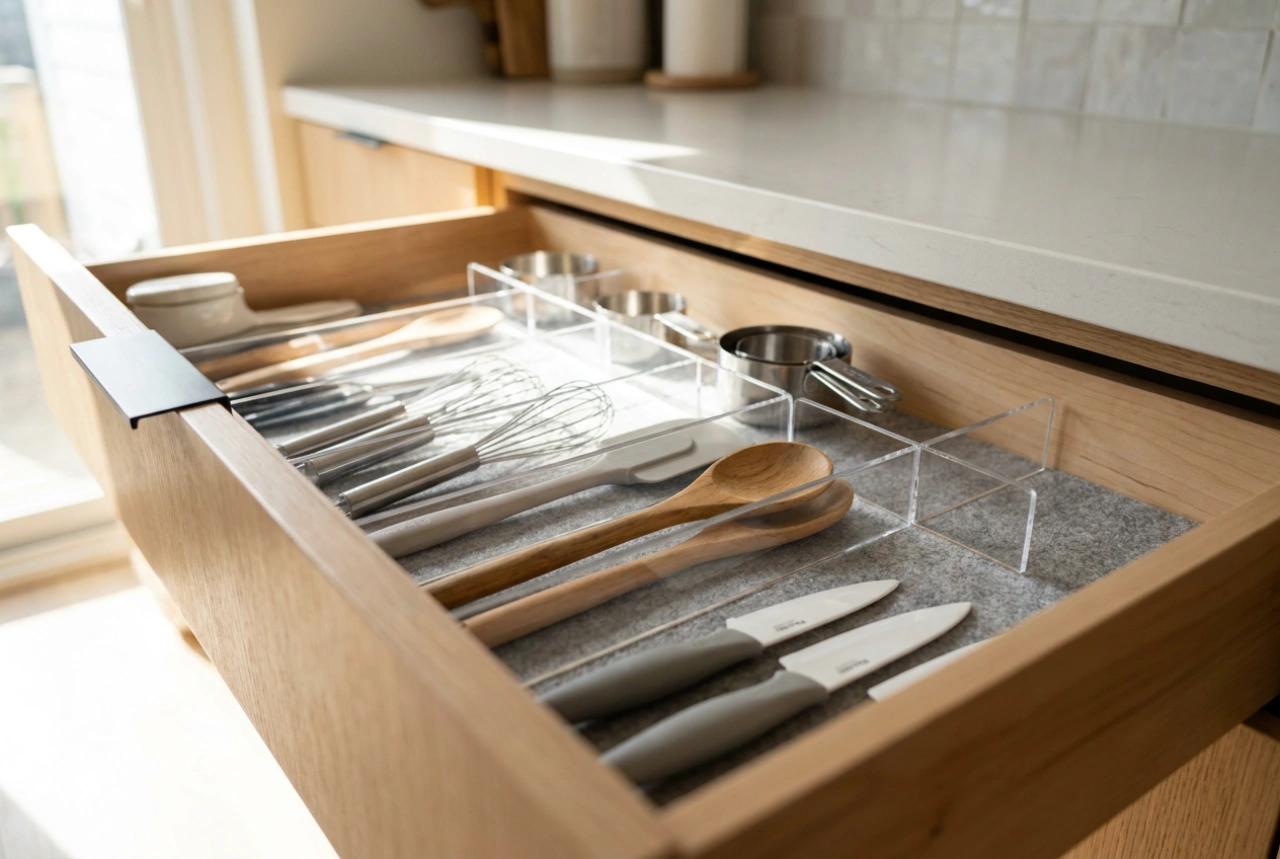
When a drawer is opened or closed, kinetic energy is transferred to the items inside. Without intervention, inertia causes loose items to slide backward or forward, resulting in chaotic mixing. To counteract this, internal compartmentalization is necessary. Custom wooden or polymer dividers create physical barriers that limit lateral movement, maintaining the classification of small components like hardware, craft supplies, or cosmetics.
To absorb kinetic energy and dampen vibration, drawers should be lined with high-friction materials. Soft, cellular polymers like ethylene-vinyl acetate (EVA) or silicone liners provide high grip and shock absorption. The microscopic surface structure of these materials increases the coefficient of friction between the item and the drawer bottom, keeping delicate items stationary during sudden movements. Furthermore, choosing chemically inert, non-reactive liners prevents chemical bonding or oil migration between stored plastic items and the drawer surfaces over time.
Managing Microclimates and Dust Prevention
Tall, enclosed cabinets act as physical barriers against environmental contaminants. Gravitational settling causes airborne dust particles to fall downward, landing on exposed horizontal surfaces. By housing items within sealed drawer boxes, you significantly reduce the accumulation of particulates. For items sensitive to humidity, such as metal components prone to oxidation or paper goods prone to degradation, wooden drawer boxes made of breathable materials like birch or cedar help buffer ambient moisture, maintaining a stable relative humidity inside the drawer cavity.
Strategic Loading and Center of Gravity
Proper loading technique is essential to maintain both the mechanical longevity of the cabinet and its physical stability. Always load the heaviest items—such as metal tools, bulk liquids, or glass containers—in the lowest drawers. This keeps the overall center of mass of the cabinet as low as possible, reducing the risk of tipping. Lighter items, such as textiles, small plastic organizers, and paper supplies, should occupy the upper tiers. When loading individual drawers, distribute weight evenly from front to back and side to side to avoid uneven wear on the slide tracks.
Quick Checklist for Cabinet Setup
- Securely anchor the cabinet frame to wall studs to prevent tipping.
- Install full-extension ball-bearing slides rated for the expected load capacity.
- Place the heaviest items in the lowest drawers to maintain a low center of gravity.
- Line drawers with high-friction silicone or EVA liners to absorb kinetic energy.
- Implement vertical zoning, placing daily essentials in the primary reach zone between knee and chest height.