

Storing collectible coins in albums requires a deep understanding of material science and mechanical friction to prevent permanent micro-scratches and chemical surface degradation. By managing the chemical purity of the storage materials and applying correct physical handling techniques, collectors can preserve the original mint luster and physical grade of their coins for decades.
The Chemical Threat: Selecting Acid-Free Archival Plastics
The primary hazard of long-term album storage is chemical degradation caused by unstable plastics. Many standard, inexpensive album pages contain polyvinyl chloride (PVC). Over time, PVC breaks down due to heat and light exposure, releasing volatile plasticizers and acidic hydrochloric gases. This process leaves a sticky, green residue on the metal surface, which chemically etches the coin and destroys its natural finish. To prevent this, always select album pages made from chemically inert, archival-grade polymers. Materials such as polyethylene, polypropylene, and polyester film do not contain harmful plasticizers. These polymers are highly stable, resisting chemical breakdown and ensuring that no acidic compounds contact the coin face.
The Physics of Friction: Eliminating Micro-Abrasions
Even in a chemically safe album, physical movement can cause micro-scratches. Dust particles present in the air are highly abrasive, often consisting of microscopic silica crystals that are harder than coinage metals like copper, silver, and gold. When a coin is slid directly into a plastic album pocket, any trapped dust acts as an abrasive agent, scratching the polished fields of the coin. To eliminate this risk, implement a double-barrier system. Place the coin into an archival-safe paper-and-polyester flip or an inert acrylic capsule before placing it into the album pocket. This ensures that the coin surface remains completely stationary relative to its immediate protective layer, shifting any sliding friction to the outer interface of the holder and the album page.
Handling Mechanics: Preventing Fingerprint Corrosion and Scratches
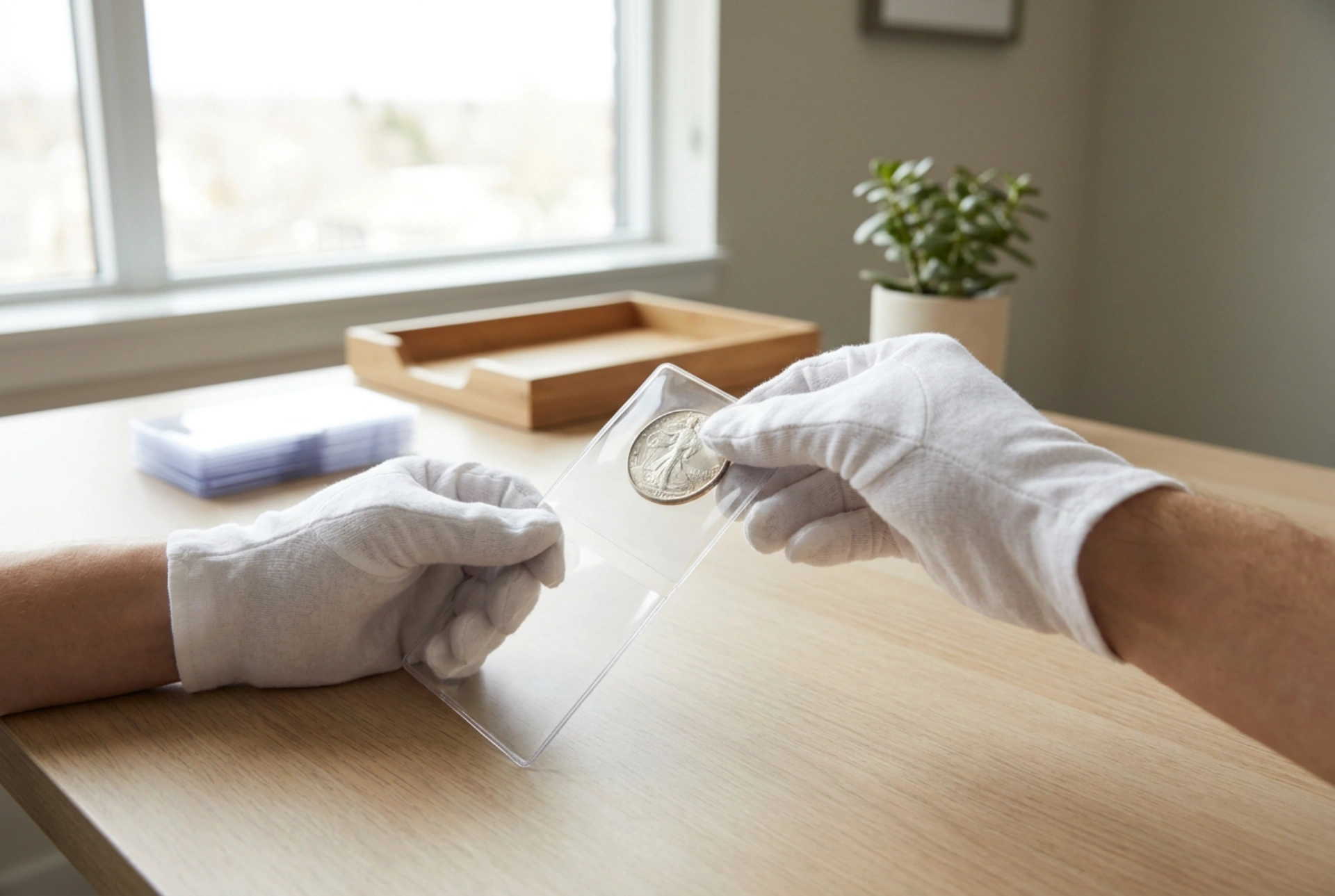
Proper handling is the foundation of physical preservation. Human skin naturally secretes oils, amino acids, and salts such as sodium chloride. When these substances touch a coin, they initiate localized electrochemical corrosion, permanently etching a fingerprint into the metal. Always wear clean, powder-free nitrile or soft cotton gloves when handling coins. When inserting a coin into its protective sleeve or holder, hold the coin strictly by its rim, which is the third side, between your thumb and forefinger. Never touch the obverse or reverse faces. Gently slide the coin into the sleeve with a continuous, controlled motion, ensuring the face does not rub against the edge of the opening. Work over a soft, padded surface, such as a clean microfiber cloth, to prevent damage in case a coin is accidentally dropped.
Controlling the Microclimate: Humidity and Oxidation
Chemical reactions, including the oxidation of silver and copper, require moisture to act as a catalyst. High relative humidity accelerates the formation of tarnish and corrosion. To prevent this, store your coin albums in an environment with stable temperature and humidity, ideally around 35% to 45% relative humidity. Avoid storing albums in basements, attics, or near external walls where temperature fluctuations can cause condensation. Placing a small, rechargeable silica gel packet inside the cabinet or outer container holding your albums will actively absorb excess moisture from the air, maintaining a dry microclimate that inhibits chemical reactions on the metallic surfaces.
Physical Pressure and Album Orientation
The physical orientation of your stored albums affects the long-term condition of your coins. Storing coin albums horizontally, stacked on top of each other, creates significant downward gravitational pressure. This constant weight presses the plastic pages tightly against the coin surfaces, increasing the risk of the plastic sticking to the coin or transferring micro-textures under pressure. Always store coin albums vertically, standing upright like books on a library shelf. This distribution of weight prevents localized compression, reduces mechanical stress on the album pages, and minimizes the risk of friction-induced damage during retrieval.