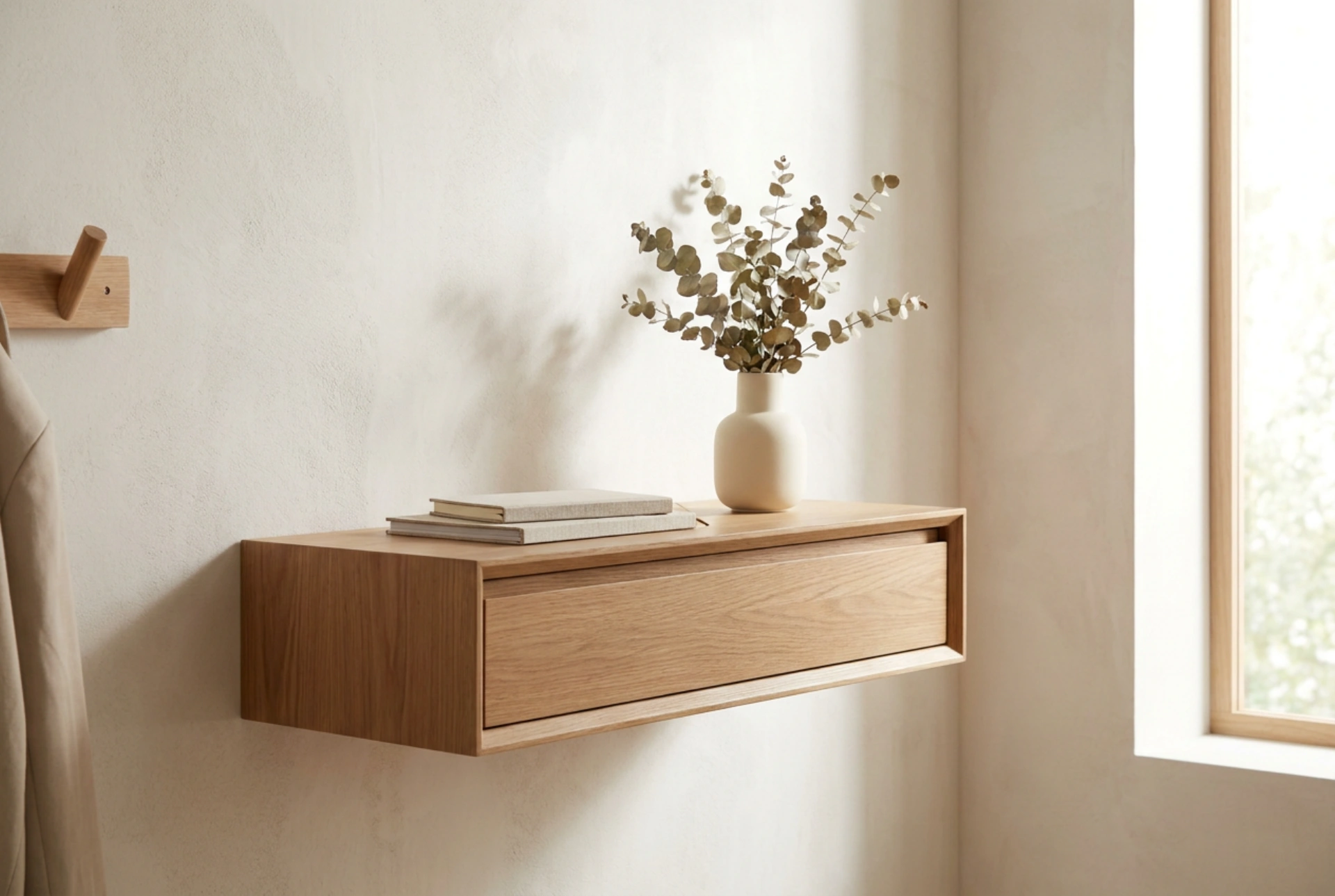


An entryway serves as the high-traffic transition zone of the home, where daily essentials like keys, mail, and accessories frequently accumulate into chaotic clutter. Installing a wall-mounted shelf with an integrated drawer leverages vertical space and provides a dedicated, concealed storage system that maintains visual order near the threshold.
The Physics of Transit: Why Entryway Clutter Accumulates
The entryway is a thermodynamic hotspot of domestic movement. As you cross the threshold, the physical deceleration triggers a cognitive offloading process: objects held in hands—such as keys, transit cards, and loose change—are dropped onto the nearest flat surface. Without a designated boundary, this kinetic energy dissipates into static clutter. A floating drawer shelf acts as a targeted physical barrier. By enclosing the storage space within a drawer, you introduce a mechanical step (opening and closing) that acts as a cognitive filter. This micro-barrier prevents the visual noise of loose objects while containing the dust and microscopic debris brought in from outdoors.
Structural Mechanics: Ensuring Stable Wall Anchoring
A floating shelf relies entirely on cantilever physics, where the downward force of gravity on the shelf's edge creates a rotational shear stress on the wall anchors. To prevent sagging, the mounting technique must match the wall substrate. For masonry or concrete walls, nylon expansion plugs or sleeve anchors are essential, as they expand radially against the drill hole, converting friction into high load-bearing capacity. When mounting to plasterboard (drywall), you must locate the vertical timber studs using density sensors. Fastening directly into timber studs with wood screws provides maximum tensile strength. If a stud is unavailable, heavy-duty metal toggle bolts should be used instead of plastic self-drilling anchors; toggle bolts distribute the load behind the hollow plasterboard face, preventing the drywall from crumbling under the downward leverage of the shelf.
Material Science: Addressing Humidity Fluctuations
Entryways are subject to rapid microclimatic shifts. Every time the external door opens, cold, humid air from outside mixes with warm, dry indoor air. This rapid fluctuation in relative humidity causes organic materials like wood to expand and contract across their grain. If the drawer shelf is constructed of solid wood, the joints can warp or bind over time, preventing smooth operation. To mitigate this, choose a unit constructed from high-density fibreboard (HDF) or birch plywood finished with a moisture-resistant polyurethane sealer. When installing, ensure a mechanical clearance of at least 1.5 millimetres between the drawer box and the outer casing. For the gliding mechanism, metal ball-bearing runners are superior to simple wood-on-wood slides, as they rely on rolling friction rather than sliding friction, maintaining smooth movement regardless of ambient humidity levels.
The Ergonomic Routine: Designing an Entryway Workflow
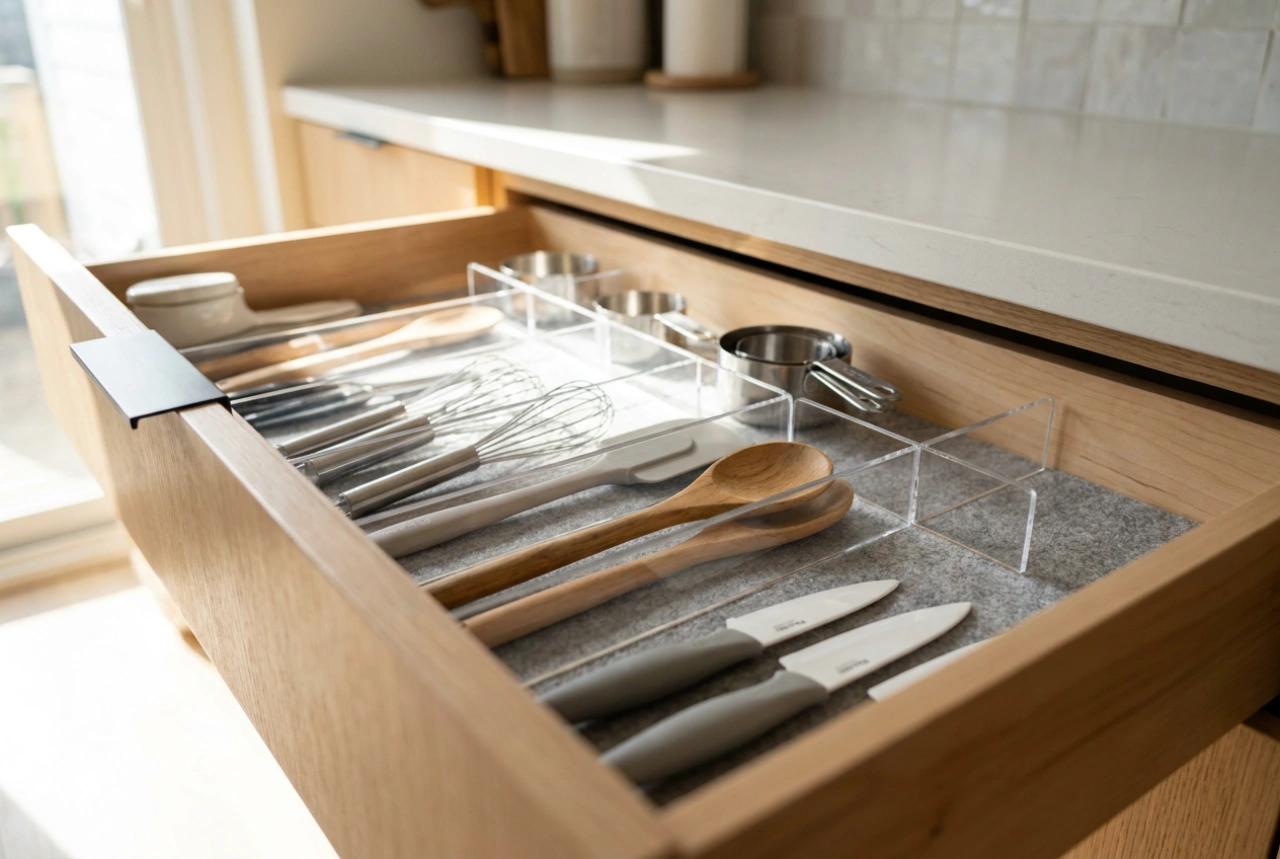
Organising small items is not just about having a storage container; it requires a systematic order of operations. Position the shelf at elbow height—typically between 100 and 110 centimetres from the floor—to align with the natural arc of a human arm carrying bags or keys. Inside the drawer, use high-friction silicone or cork inserts to prevent items from sliding and clashing when the drawer is opened. Divide the drawer interior into distinct zones using modular bamboo or felt trays: one compartment for metallic items (keys, coins), one for paper (incoming letters), and a soft-lined compartment for delicate optics (sunglasses). By dedicating a specific physical coordinate to each class of object, you reinforce a tactile habit loop that eliminates the search time during your departure sequence.