

Preserving the pristine shape of a baseball cap requires an understanding of structural tension, material stiffness, and gravity. Standard hanging methods often concentrate load on vulnerable components like the crown or visor, leading to permanent creases and warped profiles.
The Mechanics of Cap Construction and Deformation
To prevent deformation, one must understand how a baseball cap maintains its shape. Structured caps rely on a stiffened fabric panel called the buckram—typically a woven cotton or polyester fabric treated with starch, sizing agents, or thermoplastic adhesives. Unstructured caps, by contrast, rely entirely on the tension of the outer fabric paneling. The visor, or brim, features an internal stiffener made of either compressed paperboard or moulded polyethylene. When you hang a cap by a single point—such as hooking the crown fabric over a sharp peg—gravity pulls the surrounding fabric downward. This creates a localized shear stress that exceeds the elastic limit of the buckram or the fabric weave. Over time, the stiffening agents in the buckram crack or bend permanently, leaving a visible crease that cannot be easily steamed out. Similarly, hanging a cap by the small top button (the squatchee) concentrates the entire weight of the cap on a single point of fabric, stretching the top panels and pulling the cap into an unnatural conical shape.
The Rounded Peg Method: Supporting the Crown’s Arc
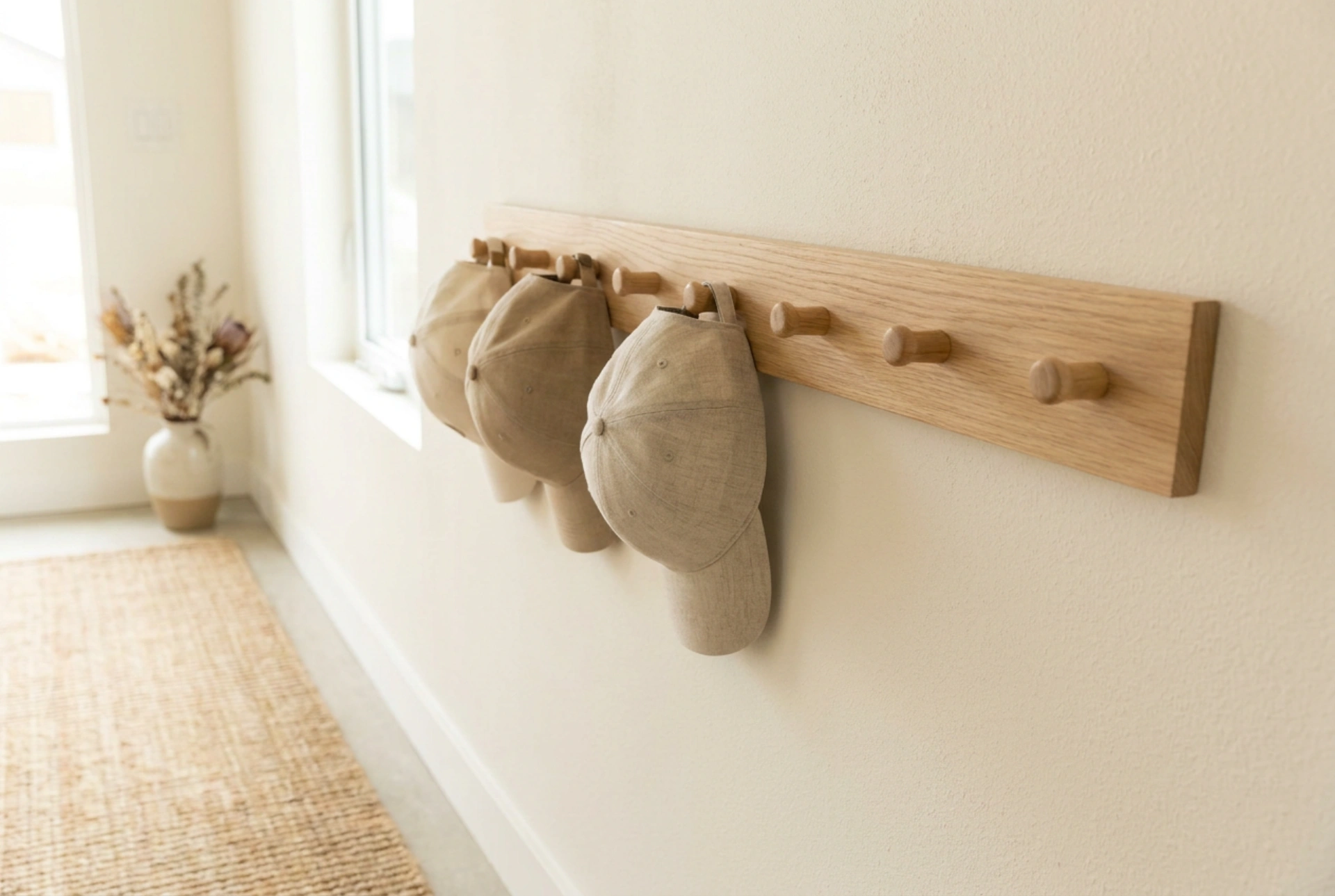
The most effective wall-mounted hanger systems utilize the principle of load distribution. Rather than hanging a cap by its adjustment strap or its top button, the cap should rest naturally on a support that mimics the human head. This prevents focal stress points and allows gravity to work with the cap's design rather than against it.
- Peg Diameter: Use wooden dowels or pegs with rounded, spherical tops that measure at least 3 to 5 centimetres in diameter. This wide, curved surface distributes the gravitational load across a larger portion of the cap’s internal dome.
- Placement: Place the cap over the peg so the contact point lies deep within the crown, near the center. The sweatband should bear the majority of the weight, as it is constructed of heavier, multi-layered fabric designed to handle friction and sweat.
- Angle of Suspense: The hanger peg should angle slightly upward (around 15 to 30 degrees) to prevent the cap from sliding forward and putting undue pressure on the front panel buckram. This angle ensures the cap sits securely without sliding.
Utilizing Clothes Hangers with Tension Clips
When space dictates the use of a closet rod, a standard clothes hanger modified with suspended clips provides an organised solution. However, applying a metal or high-tension plastic clip directly to the delicate cotton or wool panels of a cap can pinch the fibres, crush the buckram, and leave deep, permanent indents. To avoid this, clip the cap solely by its rear adjustment strap. Snapbacks, fabric straps, and leather buckles are designed to withstand high tensile stress. Hang a horizontal rod hanger and use plastic-coated tension clips to grasp the center of the adjusted rear strap. Let the crown hang naturally downward. Because the strap is anchored to the reinforced side panels of the cap, the weight is distributed symmetrically along the seams, keeping the front buckram completely free from physical stress or pressure.
Material Physics: Managing Moisture and Tension
Natural fibres like cotton and wool are highly susceptible to hygroexpansion and fibre memory. When these fibres absorb moisture from sweat, high humidity, or light rain, the hydrogen bonds within the cellulose or protein structures temporarily weaken. If a damp cap is hung improperly, the gravity-induced stretching becomes locked into the fabric as it dries. This is why caps must be thoroughly dry before being placed on any hanging system. If a cap is slightly damp, place it over a dedicated dome-shaped form or a clean, rolled-up towel to air dry before transferring it to a hanger. Keep the storage area well-ventilated and within moderate humidity levels (around 40% to 50%) to ensure the starch and adhesives in the buckram do not soften and cause the front panel to sag under its own weight.