

Managing a cramped entryway wardrobe requires understanding spatial geometry, airflow physics, and the material science of textiles to prevent degradation during off-season storage.
The Microclimate of Small Wardrobes: Airflow and Humidity
Small, enclosed spaces like hallway wardrobes are highly susceptible to microclimatic shifts. When outerwear is worn outside, it absorbs ambient moisture and microscopic pollutants. Placing these garments immediately into a closed, poorly ventilated wardrobe raises the local relative humidity. When relative humidity exceeds 60%, it creates an ideal breeding ground for mildew and mould spores.
Stale air also accelerates the breakdown of natural oils in wool and leather. To combat this, a basic rule of physics applies: air must circulate to facilitate evaporation. Never pack a small wardrobe to its absolute physical capacity. Maintaining a 15% physical void space allows natural convection currents to move air through the textiles, carrying moisture away from the fibres and preventing musty odours from settling into the fabrics.
The Chemistry of Textile Preservation: Pre-Storage Protocols
Before transitioning garments to long-term seasonal storage, they must undergo chemical purification. Human skin naturally sheds lipids, proteins, and acidic sweat. Even if a coat looks clean, invisible microscopic organic residues remain embedded in the fibres. Over months of storage, these residues undergo oxidation, leading to irreversible yellowing and fabric weakening.
Furthermore, keratin-loving pests, such as the larvae of the common clothes moth, are highly attracted to these organic compounds. Washing or dry-cleaning garments eliminates these biological triggers. Ensure every item is completely bone-dry before storing. Residual moisture locked inside a synthetic garment bag acts as a greenhouse, facilitating fungal growth that can rot natural fibres like cotton, silk, and wool within weeks.
Storage Dynamics: Folding, Hanging, and Compression
How a garment is stored physically alters its molecular structural integrity over time. Heavy coats, tailored jackets, and structured woollen blazers must be suspended from wide, contoured wooden hangers. Slim wire hangers concentrate the gravitational pull on a very narrow surface area, causing the shoulder seams to warp, stretch, and eventually fail under the garment's own mass.
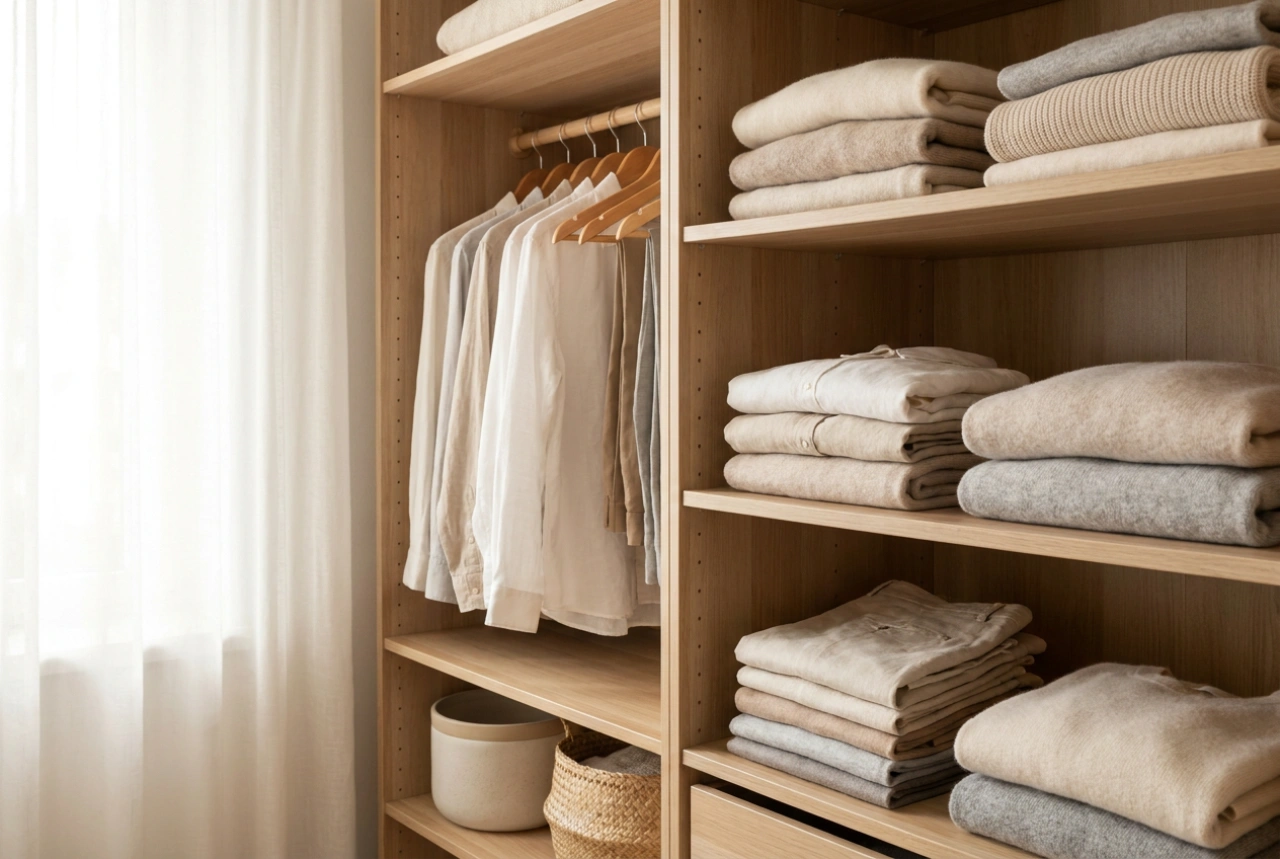
Conversely, knitted items such as sweaters, cardigans, and scarves should never be hung. Knitted fabrics are composed of interlocking loops of yarn. Continuous gravitational tension pulls these loops downward, permanently elongating the garment and thinning the weave. These should be folded loosely and stacked on shelves, with the heaviest items at the bottom to prevent the compression of delicate fibres like cashmere.
For synthetic fills and bedding, vacuum compression bags are highly efficient volume-savers. However, natural down coats should never be vacuum-sealed. Down relies on its loft—the three-dimensional structure of the feathers that traps air—to provide thermal insulation. Compressing down for several months can permanently snap the delicate plumules, reducing the garment's warming efficiency by up to 50%.
Material-Safe Moisture and Pest Control
To maintain a stable equilibrium inside a small wardrobe, active environmental control is necessary. Avoid synthetic chemical mothballs containing naphthalene or paradichlorobenzene, which release toxic, persistent organic pollutants that bind permanently to synthetic fabrics and pose health risks. Instead, utilise natural pest repellents containing volatile organic compounds, such as cedrol found in cedarwood, or lavender essential oils. These compounds naturally disrupt the olfactory senses of destructive insects without leaving hazardous chemical residues.
To control humidity without active dehumidifiers, utilise physical desiccants. Sacks of activated charcoal or silica gel packets placed in the corners of shelves work via adsorption. Their porous microscopic structures attract and trap water molecules directly from the air, keeping the internal wardrobe climate dry and stable throughout seasonal transitions.