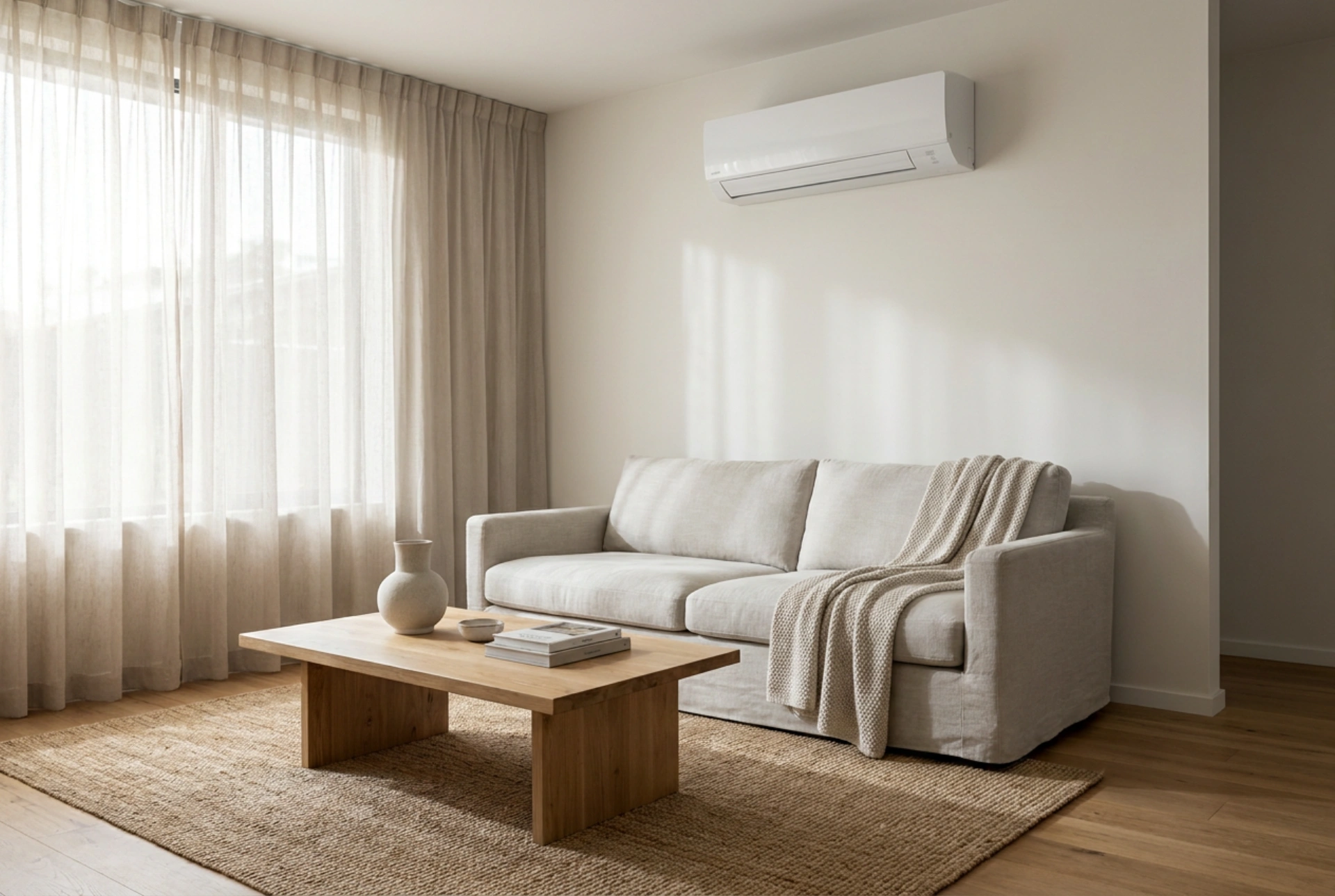


Using an air conditioning unit for heating is one of the most thermodynamically efficient ways to warm a room, operating as an air-to-air heat pump by reversing its refrigeration cycle. Understanding the physics of this heat transfer and implementing specific operational techniques can significantly lower household energy consumption while maintaining optimal thermal comfort.
The Thermodynamics of Reverse-Cycle Heating
Traditional electric heaters rely on resistive heating, converting electrical energy directly into thermal energy with a maximum theoretical efficiency of 1:1 (a Coefficient of Performance, or COP, of 1.0). In contrast, an air conditioner with a heating function does not generate heat directly; instead, it relocates existing thermal energy from the outdoor air indoors. Even at sub-zero temperatures, ambient outdoor air contains thermal energy that can be harvested.
By utilising a reversing valve, the unit swaps the roles of its heat exchangers. The outdoor coil becomes the evaporator, absorbing heat from the cold outside air as refrigerant boils at a low temperature. This vapourised refrigerant is then compressed, raising its pressure and temperature significantly. The hot gas flows to the indoor coil, which now acts as the condenser. As the indoor fan blows air across this hot coil, the refrigerant condenses back into a liquid, releasing its latent heat of vaporisation into the living space. This cycle can achieve a COP of 3.0 to 4.5, meaning for every kilowatt of electricity consumed, up to four kilowatts of heat energy are transferred into the home.
Optimising Airflow and Stratification
Because hot air has a lower density than cold air, it naturally rises toward the ceiling—a physical phenomenon known as thermal stratification. To heat a room efficiently, the physical laws of convection must be managed. When cooling, an air conditioner directs air upwards to fall naturally. When heating, the system must work against this natural buoyancy.
- Direct the Louvres Downwards: The motorised vanes (louvres) should be set to point directly towards the floor at a steep angle. This forces the warm, high-velocity air down to the living zone, where it mixes with cooler air and gradually rises, creating a more uniform temperature distribution.
- Avoid Auto Fan Speeds During Heat-Up: Set the fan speed manually to medium or high during the initial heating phase to ensure the warm air has enough kinetic energy to reach floor level. Once the target temperature is achieved, a lower, continuous fan speed can maintain equilibrium.
- Clear Obstructions: Ensure there are no high bookshelves, tall furniture, or curtains directly beneath or in front of the indoor unit, as these will deflect the airflow back up to the ceiling-mounted thermostat, causing the system to cycle off prematurely.
Maintaining the Thermal Exchange Loop
The efficiency of heat transfer depends entirely on unobstructed thermal contact between the air and the metal fins of the heat exchanger coils. Any accumulation of dust, pollen, or soot acts as an insulating barrier, forcing the compressor to work harder to achieve the same temperature differential.
Clogged indoor filters restrict the volume of air passing over the condenser coil. When airflow drops, the heat cannot be dissipated into the room efficiently, causing internal pressures to rise and increasing electrical current draw. Cleaning the primary mesh filters every two to four weeks with lukewarm water is crucial. Externally, the outdoor evaporator coil must remain clear of dead leaves, debris, and snow. If the outdoor unit cannot draw sufficient ambient air across its fins, the evaporation process stalls, dropping the system’s COP and forcing the unit into frequent, energy-consuming defrost cycles to melt ice build-up on the coils.
Operational Strategies for Maximum Efficiency
Modern inverter compressors are designed to modulate their speed continuously rather than cycling on and off. To leverage this technology, avoid the temptation to turn the unit off completely when leaving the room for short periods, and do not crank the thermostat to maximum to heat the room "faster".
Setting the thermostat to a reasonable 20°C to 22°C allows the inverter to settle into a low-power, steady-state maintenance mode. Drastic temperature adjustments force high-frequency operation, bypassing the high-efficiency curves of the compressor. Additionally, during cold weather, the system will periodically enter an automatic defrost cycle to clear frost from the outdoor coil. Allowing this cycle to complete uninterrupted prevents coil damage and maintains long-term thermodynamic efficiency.