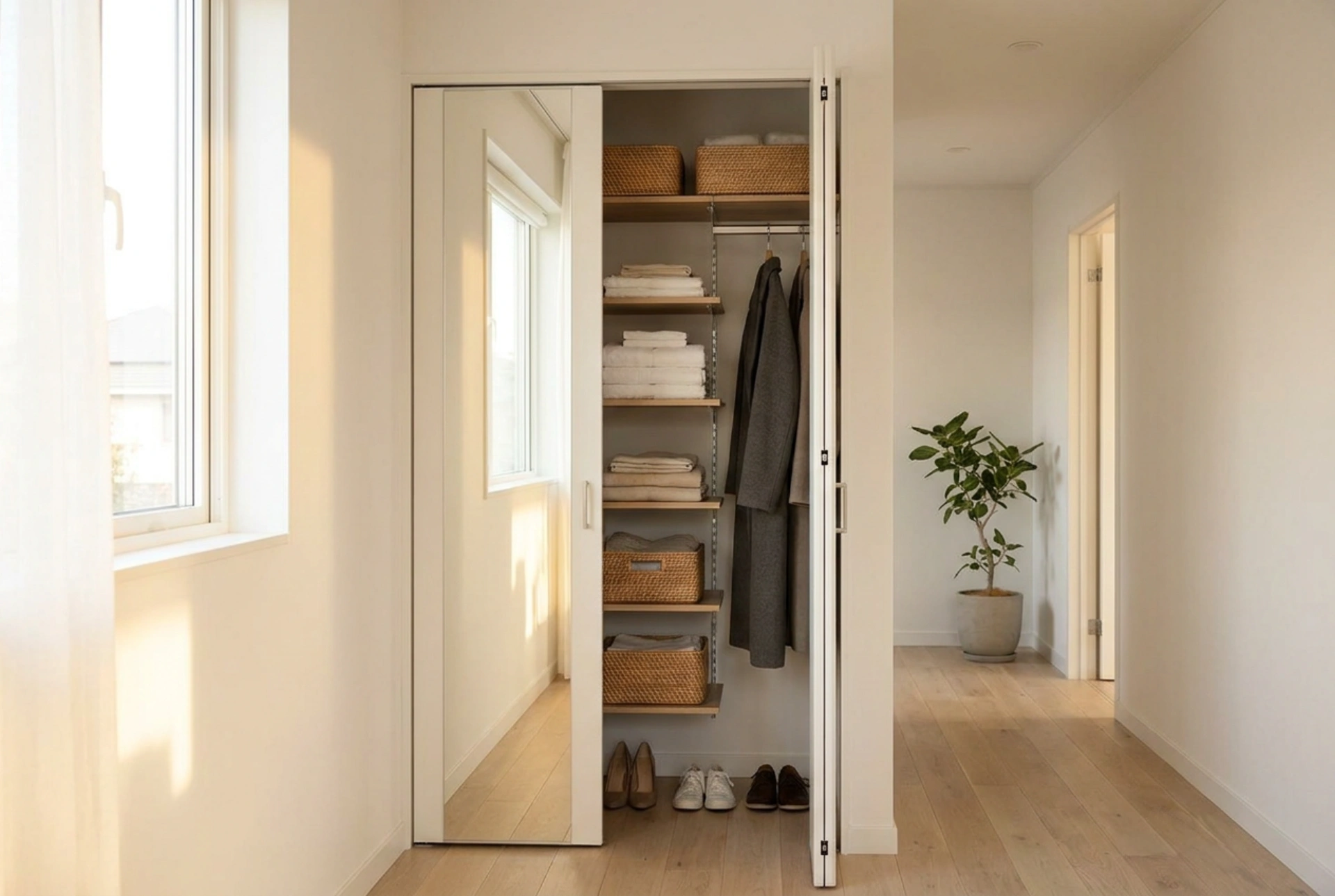


Optimising a narrow hallway wardrobe with a mirrored door requires a balance of physics, ergonomics, and material science to prevent physical compression and moisture build-up. By understanding how airflow, gravity, and light interact within confined spaces, you can transform a cramped storage unit into a highly functional, breathable system.
Maximising Vertical Space and Managing Friction
In a narrow wardrobe, horizontal depth is restricted, meaning garments must be organized vertically to prevent lateral crushing. When clothes are packed tightly together, friction increases, making extraction difficult and damaging delicate fibers through constant shearing forces. To counteract this, use slim, non-slip hangers covered in textured materials like velvet, which increase friction against the hanger itself while reducing the physical profile of each unit. This allows garments to hang freely without sliding off, while maximizing the gaps between individual items. Additionally, install staggered hanging rods. Placing one rod slightly forward or higher than another utilizes the three-dimensional diagonal space, preventing the shoulders of bulky coats from compressing against one another. Compression not only creases fabrics but also traps dust and limits the recovery of natural fibers like wool, which rely on loft (trapped air) to maintain their structure and thermal properties.
The Science of Air Circulation and Moisture Control
Hallways are transition zones where outdoor humidity and wet outerwear meet indoor air. Placing damp coats or umbrellas directly into a sealed, narrow wardrobe creates a microclimate high in relative humidity. Without proper ventilation, stagnant air facilitates the growth of mold spores and musty odors. To prevent this, adhere to the 80/20 rule: never fill more than 80% of the wardrobe's physical volume, leaving 20% empty for passive air convection. When air can flow freely, moisture evaporates naturally instead of condensing on cold wooden or metal interior walls. For seasonal storage, utilize breathable woven storage boxes made of linen or canvas rather than airtight plastic bins. Plastic traps residual moisture, leading to anaerobic degradation of organic materials. Placing generic desiccant sachets, such as silica gel, in the lower corners of the wardrobe helps absorb excess atmospheric water vapor, maintaining a relative humidity level below 50%, which is the threshold for mold proliferation.
Harnessing Light Reflection and Visual Ergonomics
A mirrored door on a narrow hallway wardrobe is not just a functional tool for dressing; it is an optical device that alters the perception of spatial volume. Mirrors reflect light at an angle equal to the angle of incidence. To maximize this effect, position the wardrobe directly opposite or adjacent to a natural light source or a warm-toned LED fixture. This scatters photons across the narrow hallway, neutralizing shadows that make small spaces feel oppressive. Inside the wardrobe, install low-profile LED strip lights with a neutral color temperature (around 4000 Kelvin) along the vertical frame. This side-lighting technique illuminates the entire depth of the shelves, eliminating dark zones where items easily get lost. When every item is clearly visible, the physical search time is reduced, preventing the disruption of organized layers during daily use.
Ergonomic Loading and the Center of Gravity
The structural integrity of a narrow wardrobe relies on how weight is distributed. For safety and ease of access, load the wardrobe according to the laws of gravity and frequency of physical movement. Heavy, dense items such as winter boots, specialized cleaning tools, or storage boxes filled with seasonal gear should always reside at the very bottom. This lowers the center of gravity of the entire wardrobe unit, preventing structural sway when the heavy mirrored door is opened. Daily essentials—such as keys, wallets, and frequently worn jackets—should be positioned in the golden zone between hip and shoulder height. This minimizes the physical effort required to retrieve items, reducing bending and stretching movements that can strain the body in a tight hallway. Upper shelves should be reserved for lightweight, low-frequency items like extra pillows or hats, ensuring that if anything falls during retrieval, it carries minimal kinetic energy and poses no hazard.