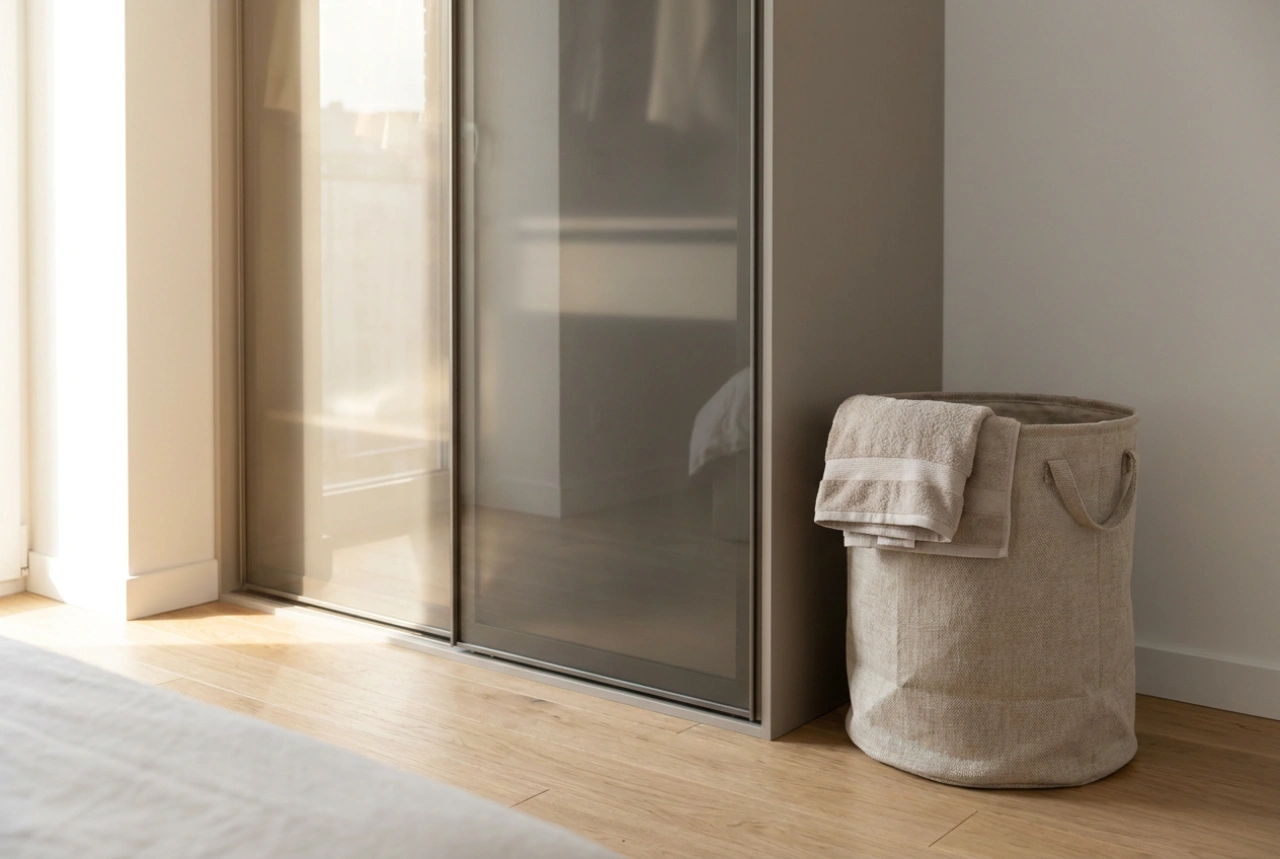


Positioning a clothes rack in the bedroom requires balancing daily convenience with fabric preservation and spatial physics. The ideal location protects textiles from dust, humidity, and UV damage while maintaining natural movement pathways in the room.
Managing Airflow and Humidity to Protect Fabrics
Every night, the human body releases moisture, which increases relative humidity in the bedroom. Clothes worn during the day also retain body heat and sweat. Hanging these garments immediately in an unventilated corner or directly against a cold external wall creates a microclimate ripe for mold and mildew. Cold walls trigger condensation when warm, humid indoor air meets them. To prevent fabric fibers from absorbing this moisture, position your clothes rack at least 10 to 15 centimeters away from external walls. This gap allows for convection currents—natural air movement driven by temperature differences—to dry the fibers and prevent musty odors.
Avoiding Photodegradation from Direct Sunlight
While placing a wooden rack in a sunlit corner looks aesthetically pleasing, solar radiation poses a serious threat to textiles. Ultraviolet (UV) light triggers a chemical process called photodegradation. UV rays break the covalent bonds within dye molecules and weaken natural fibers like cotton, linen, and silk, causing uneven fading and structural brittleness. For optimal preservation, position the rack in a shaded zone of the bedroom or at an angle where direct sunlight cannot penetrate. If placement near a window is unavoidable, utilize dense window treatments or UV-filtering glass films to intercept the destructive radiation.
Optimizing Ergonomics and Spatial Balance
The physical layout of a bedroom dictates your daily routines. A poorly placed rack restricts movement and poses a physical hazard in low-light conditions. Ensure the rack is positioned outside the primary walking path—the trajectory between the bed, the door, and the bathroom. A minimum clearance of 70 centimeters around the rack is necessary to allow comfortable access to hanging items without brushing against them. Furthermore, consider the center of gravity. Freestanding racks, especially when loaded unevenly, can easily tip. Place the rack on a level, hard flooring surface rather than deep-pile carpets to ensure structural stability.
Minimizing Dust Accumulation and Static Electricity
Dust consists of skin flakes, fabric fibers, and outdoor particulates suspended in the air. When air movement slows down, these particles settle due to gravity. Placing a rack directly beneath or adjacent to heating vents or air conditioning units subjects clothing to constant drafts that carry and deposit dust. Conversely, placing a rack too close to doors or high-traffic pathways increases static electricity on synthetic garments, which actively attracts floating dust particles. Position the rack in a draft-neutral zone where air circulates gently but does not create a direct funnel of airborne debris.