

Designing a dual drainage system for a kitchen sink and a dishwasher requires a clear understanding of fluid dynamics and gravitational flow to prevent contaminated water from backing up. By applying basic physics and correct pipe geometry, you can establish a reliable waste system that keeps greywater moving in the right direction.
The Physics of Waste Water Backflow
To prevent dirty water from reversing its path, we must look at how pressure and gravity interact within your kitchen plumbing. A dishwasher does not drain by gravity alone; it utilizes a mechanical pump to forcibly expel waste water. This pressurized stream enters the drainage pipe with significant kinetic energy. If the sink drain offers less resistance than the main waste pipe, the pumped water will naturally follow the path of least resistance, rising up into the sink bowl.
Conversely, when a sink full of water is released, a large volume of liquid enters the drain under hydrostatic pressure. Without proper pipe routing and venting, this rapid flow can create a partial vacuum, pulling water out of the dishwasher's drain hose or pushing waste back into the appliance. This is known as siphoning, and it can be prevented by controlling pressure differentials and flow direction.
The High Loop: Using Gravity as a Barrier
The simplest and most effective mechanical method to prevent dishwasher backflow is the high loop technique. This method relies on gravitational potential energy to create an insurmountable barrier for backflowing water. The dishwasher drain hose must be routed from the appliance up to the highest possible point under the countertop—ideally fastened just beneath the underside of the counter—before looping back down to connect to the sink drain or siphon.
By elevating the hose above the flood level rim of the sink, you ensure that even if the sink fills completely with water, the water level in the drain hose cannot rise high enough to spill back into the dishwasher. Gravity keeps the liquid in the lower sections of the loop, preventing cross-contamination without the need for complex moving parts.
Optimizing Junction Geometry and Siphon Placement
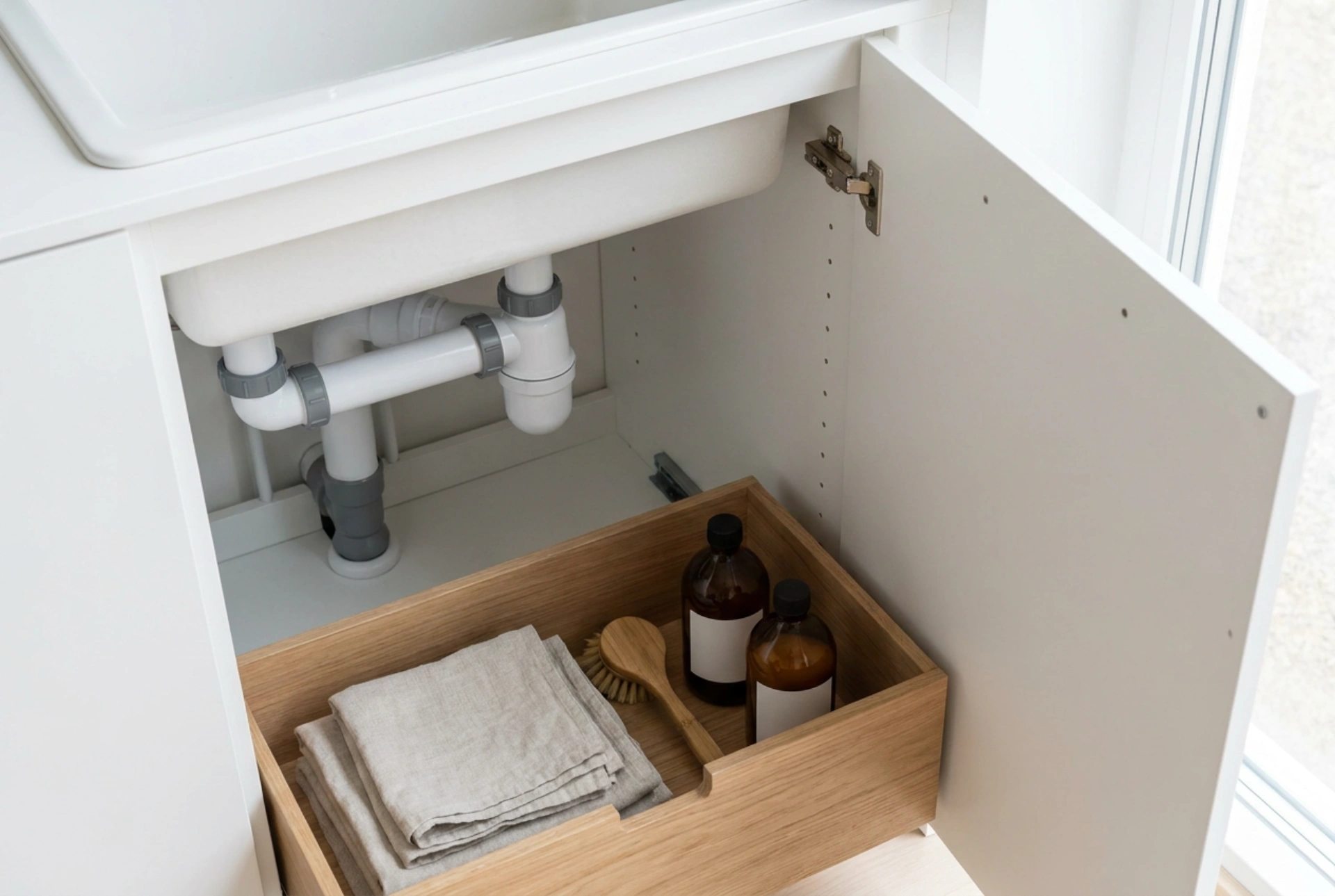
The point where the dishwasher hose connects to the sink plumbing is critical. Using a standard T-junction often leads to turbulence and splashing, which pushes water upward into the sink. Instead, a specialized branch tailpiece with an integrated directional baffle or an angled Y-connector should be used. The Y-connector directs the incoming dishwasher flow downward, matching the natural path of gravity and utilizing the kinetic energy of the pumped water to slide smoothly into the main trap.
- Directional Flow: Ensure the connection point points downward toward the P-trap to harness gravity.
- Trap Placement: The dishwasher connection must always be located on the inlet side of the P-trap (before the water seal) so that sewer gases are effectively blocked by the trap's standing water.
- Air Gaps: In systems where a high loop is insufficient due to local plumbing dynamics, a physical air gap accessory can be installed on the sink deck to completely break any potential vacuum.
Maintaining Correct Slopes and Pipe Diameters
Once the wastewater leaves the sink siphon, it relies entirely on gravity. For horizontal pipe runs under the cabinet, a minimum slope of 2% (approximately 20 millimetres of fall per metre of pipe) is necessary. If the slope is too shallow, water slows down, allowing grease and food particles to settle and create blockages. If the slope is too steep, liquid drains too quickly, leaving solid particles behind to dry and clog the line.
Additionally, avoid sudden transitions in pipe diameter. Standard kitchen waste lines should maintain a consistent diameter of 40mm to 50mm to handle the combined volume of the sink and dishwasher without causing localized pressure drops that disrupt the drainage flow.