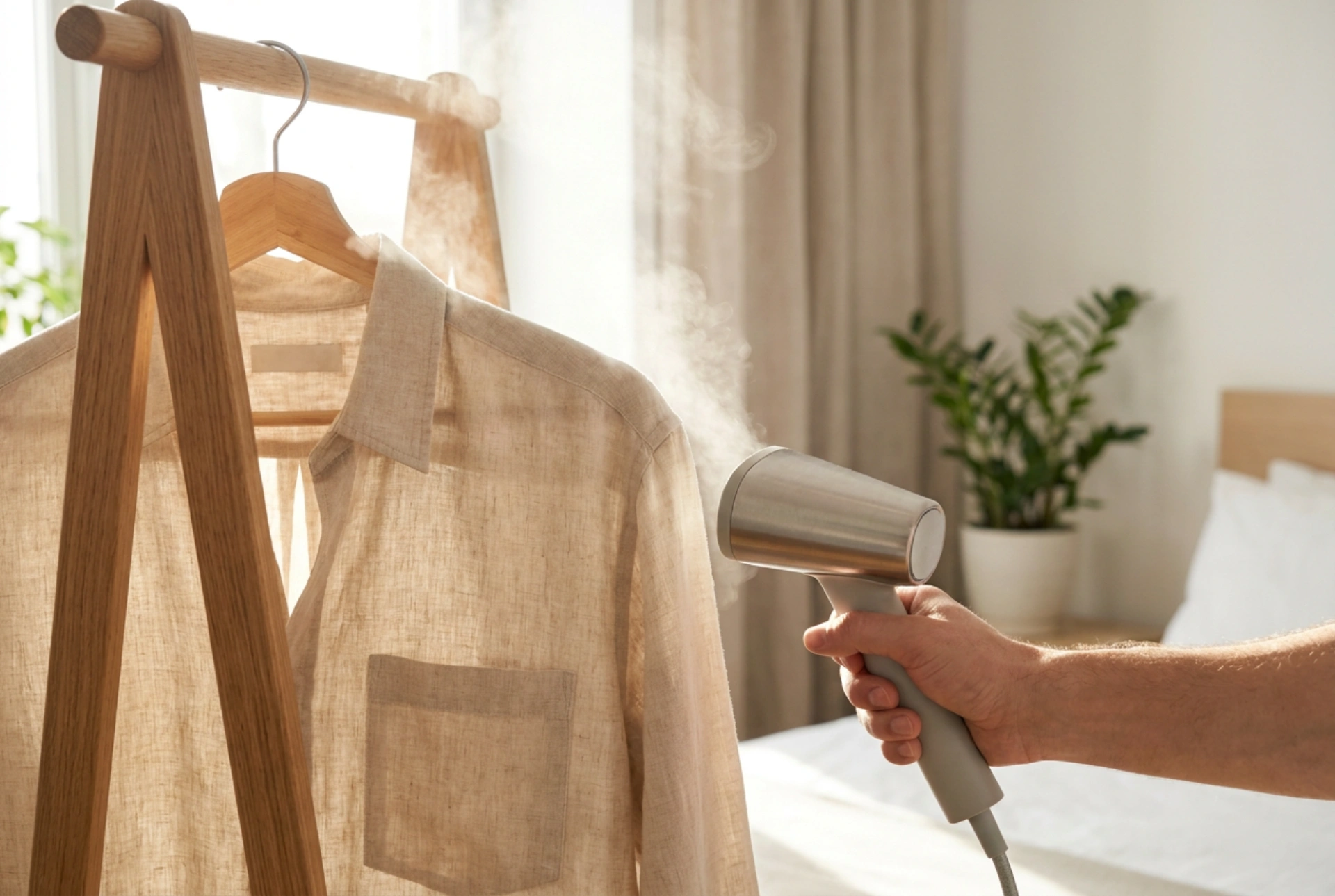


Steam refreshing utilises high-temperature water vapour to instantly relax bound textile fibres, making it an efficient alternative to traditional ironing for delicate or lightly worn garments.
The Physics of Steam and Fibre Relaxation
At a molecular level, woven fabrics like cotton, linen, and wool are held together by hydrogen bonds between polymer chains. When garments crease, these bonds are locked into distorted configurations. Applying heat and moisture simultaneously breaks these temporary hydrogen bonds. The water molecules in steam act as a plasticiser, inserting themselves between polymer chains and allowing them to slide back into their natural, tension-free alignment. Once the fabric cools and dries, new, stable hydrogen bonds reform in the straightened position.
Cordless garment steamers rely on a compact, internal heating block to rapidly heat water to its boiling point, generating dry steam. Because they lack a restrictive cord, these devices allow for a full range of vertical and diagonal movements, which is crucial for maintaining the consistent tension required to smooth out stubborn folds on hanging garments.
Temperature Management and Fabric Sensitivity
Different fibres react uniquely to heat and moisture, requiring careful adjustment of steaming distance and exposure time. Natural fibres such as linen and heavy cotton have high amorphous regions that readily absorb water vapour, meaning they require close contact and intense steam to release deep creases. Conversely, synthetic fibres like polyester, nylon, and acrylic are thermoplastic. They have low moisture absorption rates and soften easily under heat. Excess heat can melt or glaze synthetic fibres, so the steamer nozzle must be held at a safe distance of three to five centimetres.
- Linen and Cotton: Require high steam density. Hold the steamer head directly against the fabric while applying light tension from the bottom of the garment.
- Silk and Wool: Extremely sensitive to high direct heat. Steam from a distance of two to three centimetres to prevent water spotting and thermal damage to delicate protein structures.
- Synthetics: Keep the steamer head moving constantly to avoid localised overheating, which can cause permanent distortion or sheen.
Optimising Steaming Technique and Order of Operations
To achieve professional results, gravity and tension must work in tandem with the thermal action of the steam. Begin by hanging the garment securely on a sturdy, padded hanger. Use one hand to pull the hem of the fabric taut, creating a flat surface. This tension is vital because it guides the relaxed fibres into their aligned state as the steam passes through.
Always work from the top of the garment downward. This prevents damp, freshly steamed areas at the bottom from wrinkling again when you handle the upper sections. For structured garments like shirts, start with the collar, move to the yoke and shoulders, slide down the sleeves, and finish with the main front and back panels. For heavy drapes or thick wool coats, steam from the inside of the fabric outward to allow the moisture to penetrate the dense weave without flattening the surface texture.
Thermal Disinfection and Odour Neutralisation
Beyond crease removal, steam serves as a powerful sanitising agent. High-temperature vapour (typically exceeding 90 degrees Celsius at the nozzle) breaks down the volatile organic compounds responsible for body odours, smoke, and mustiness. The heat destabilises the cell walls of odour-causing bacteria, neutralising them without the need for chemical surfactants or synthetic fragrances.
This process is highly effective for refreshing garments between deep washes, extending the lifespan of the textiles by reducing mechanical wear and chemical exposure in washing machines. However, steam refreshing cannot remove physical oil-based stains; these must be pre-treated chemically, as heat can set protein and oil stains permanently into the fibres.
Water Chemistry and Appliance Longevity
The performance of any portable steamer is deeply connected to the mineral content of the water used. Tap water often contains high concentrations of calcium and magnesium ions. When heated, these minerals precipitate out of solution, forming calcium carbonate (limescale) deposits inside the heating chamber and steam channels.
Limescale buildup acts as an insulator, reducing thermal efficiency and eventually clogging the micro-nozzles, leading to water spitting or complete heating failure. To prevent this, use demineralised or distilled water. If tap water must be used, regular descaling with a mild acid solution, such as diluted citric acid, is essential to dissolve mineral crusts and maintain a consistent, powerful steam output.