

Built-in larder refrigerators—appliances dedicated entirely to cooling without an integrated freezer compartment—offer significantly more usable space and superior temperature consistency for fresh food preservation. Maximising this appliance requires a solid grasp of thermodynamics, relative humidity, and air circulation to prevent premature spoilage and optimise energy consumption.
Understanding Thermodynamic Zones in a Larder Fridge
Unlike combination fridge-freezers, a dedicated built-in larder refrigerator utilizes its entire volume for positive-temperature storage, usually maintained between 2°C and 8°C. However, temperature is not uniform throughout the cavity. In models utilizing static cooling, warm air naturally rises while colder, denser air sinks to the bottom. Understanding this natural convection is crucial for correct food placement.
The Coldest Zone: Bottom Shelves
The area directly above the salad crisper drawers is the coldest part of the refrigerator, hovering around 2°C. This is the optimal environment for highly perishable proteins, such as raw poultry, meat, and fresh fish. Storing these items here not only slows down bacterial proliferation by keeping them well below the danger zone of 5°C, but it also prevents potential cross-contamination through physical dripping.
The Temperate Zones: Middle and Top Shelves
The middle shelves maintain a stable temperature of approximately 4°C to 5°C, making them ideal for dairy products, eggs, cooked meats, and leftovers. The top shelves and door balconies are the warmest zones, often reaching up to 8°C. These areas should be reserved for items containing natural preservatives, such as condiments, mustard, butter, and pasteurised juices, which can withstand slight temperature fluctuations without spoiling.
Mastering Relative Humidity and Ethylene Management
Without the drying effect of a freezer evaporator coil in the same unit, a larder fridge naturally retains a higher level of relative humidity. While this is highly beneficial for preventing fresh produce from dehydrating, it requires active management to avoid mould and rot.
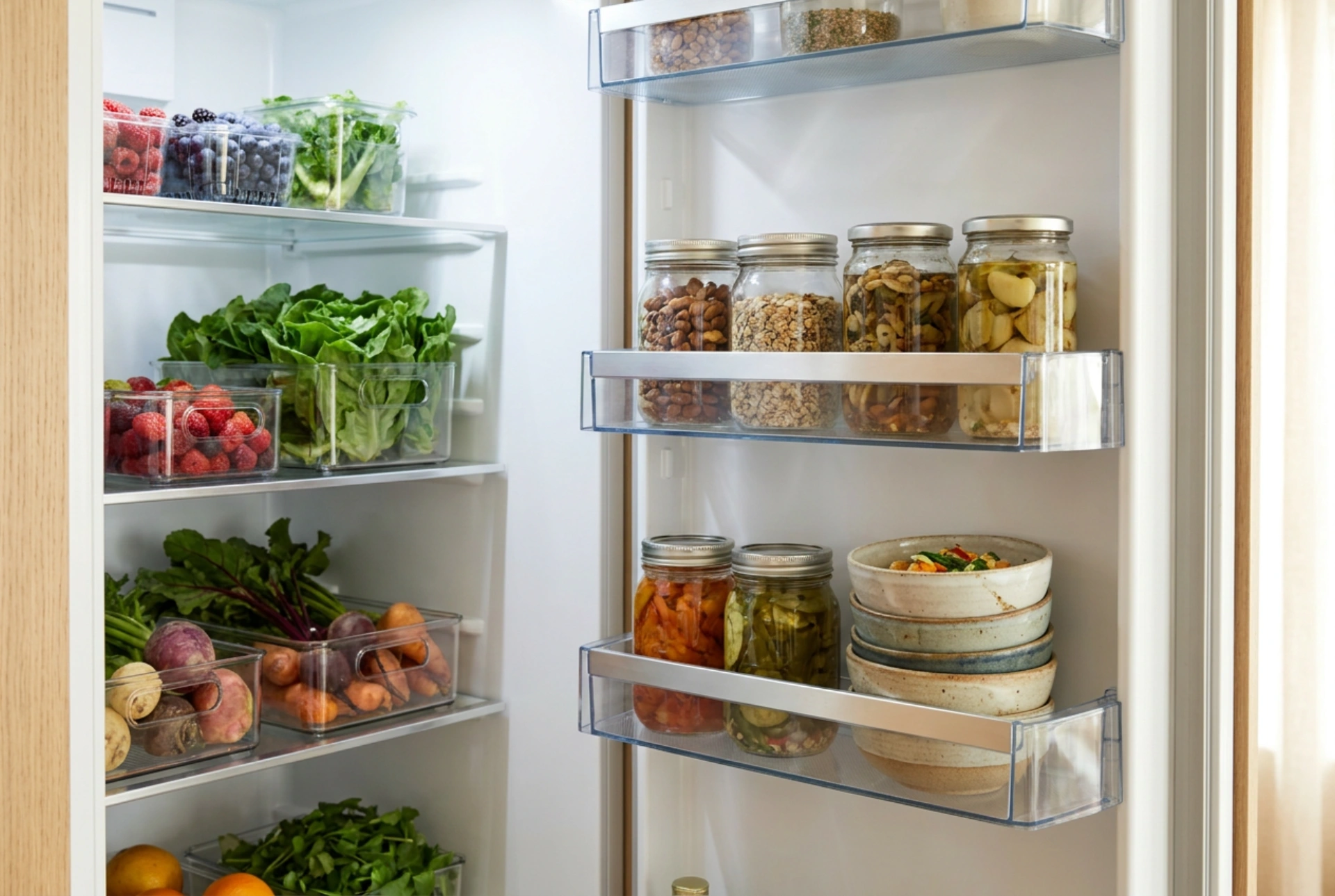
- High-Humidity Storage: Leafy greens, broccoli, and herbs lose moisture rapidly through transpiration. Storing them in dedicated crisper drawers with closed vents traps the moisture, keeping the relative humidity high and preserving cellular turgor pressure.
- Low-Humidity Storage: Fruits and vegetables that are prone to decay should be kept in a lower-humidity environment with open vents to allow excess moisture vapour to escape.
- Chemical Segregation: Many fruits, such as apples, pears, and tomatoes, release ethylene gas—a natural hormone that accelerates ripening. Ethylene-sensitive items, including leafy greens, carrots, and cucumbers, must be stored physically apart from these gas-producers to prevent premature decay and yellowing.
Optimising Airflow and Utilizing Thermal Mass
A common mistake in large larder refrigerators is overpacking, which disrupts the appliance's convective airflow. For a refrigerator to cool efficiently, air must circulate freely around every item. When shelves are blocked, stagnant pockets of warm air form, raising the local temperature and accelerating bacterial growth.
To maintain stable temperatures during frequent door openings, utilise the physical concept of thermal mass. Solid objects and liquids retain cold much better than air. Storing food in glass or ceramic containers rather than plastic wraps introduces high thermal mass into the fridge. When the door is opened, the warm air enters, but the dense glass containers quickly absorb and neutralise the temperature spike once the door is closed, reducing the workload on the compressor and lowering energy usage.
Acoustics, Ventilation, and System Maintenance
Because built-in refrigerators are enclosed within kitchen cabinetry, proper heat dissipation is vital for their performance and longevity. The appliance works by extracting heat from the interior and releasing it into the surrounding environment via the condenser coils at the rear.
Ensure that the ventilation grilles in the kitchen plinth and at the top of the housing unit are never blocked. Obstruction of these paths causes heat to build up behind the cabinet, forcing the compressor to run continuously. This not only increases electricity consumption but can also lead to premature system failure. Additionally, regularly clean the internal condensation drainage channel located at the back wall of the fridge. A blocked drain hole causes water to pool under the vegetable drawers, creating a breeding ground for psychrophilic bacteria and mould.