

Storing plates in deep kitchen drawers is highly ergonomic, but the acceleration and deceleration of drawer movement can subject delicate porcelain to damaging kinetic energy. Securing plates within a drawer insert is not just about organisation; it is about managing friction, momentum, and impact forces to prevent chipping and scratching.
The Physics of Drawer Movement and Ceramic Vulnerability
Every time you pull or push a kitchen drawer, you apply force that causes acceleration. According to Newton's first law of motion, the plates inside want to maintain their state of rest or uniform motion. When the drawer suddenly stops, the plates continue moving forward due to inertia, creating lateral impact forces.
Ceramic tableware, such as porcelain, stoneware, or earthenware, has high compressive strength but very low tensile strength and elasticity. This means while plates can easily support a vertical stack, they cannot withstand sharp, concentrated lateral impacts. When plates slide and collide with each other or the drawer walls, the energy of the impact is concentrated on the extremely thin edges, leading to micro-cracks and chipping. Therefore, the primary goal of any drawer insert is to neutralise this lateral kinetic energy.
The Role of Friction: Anti-Slip Mats and Liners
To prevent plates from sliding, you must increase the coefficient of static friction between the bottom plate and the drawer base. Standard smooth drawer bottoms have a low friction coefficient, allowing even heavy plate stacks to slide during sudden movements.
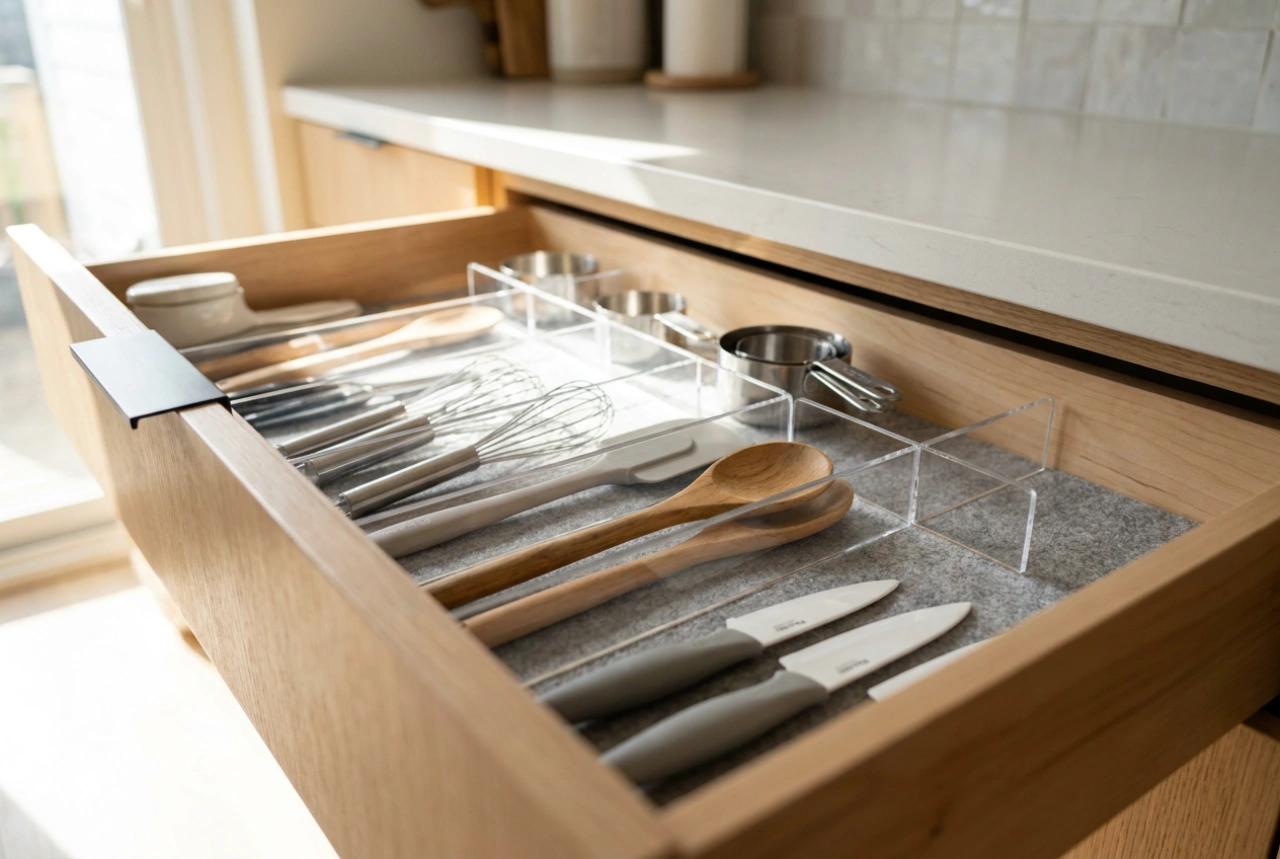
Installing an elastomeric anti-slip mat is the first line of defence. Materials like ethylene-vinyl acetate (EVA) or polyurethane rubbers are excellent because they deform slightly under the weight of the plates, locking the bottom surface in place. When choosing a liner, opt for a textured grid or a high-tack smooth surface. The mat must be cut to fit the exact dimensions of the drawer to prevent the liner itself from sliding. This simple layer absorbs the initial shear forces before they can transfer to the ceramic stack.
Vertical Dividers versus Peg Systems
Once the base is secured, you must address the lateral movement of the entire stack. There are two primary engineering solutions for drawer inserts: peg boards and vertical slot dividers.
- Adjustable Peg Systems: Usually made of sealed wood or durable polymer, these systems use a perforated base plate with moveable pegs. You place the stack of plates in the drawer and insert pegs tightly around the perimeter of the stack. This mechanical barrier physically limits the distance the plates can travel, converting kinetic energy into static pressure against the dampening peg.
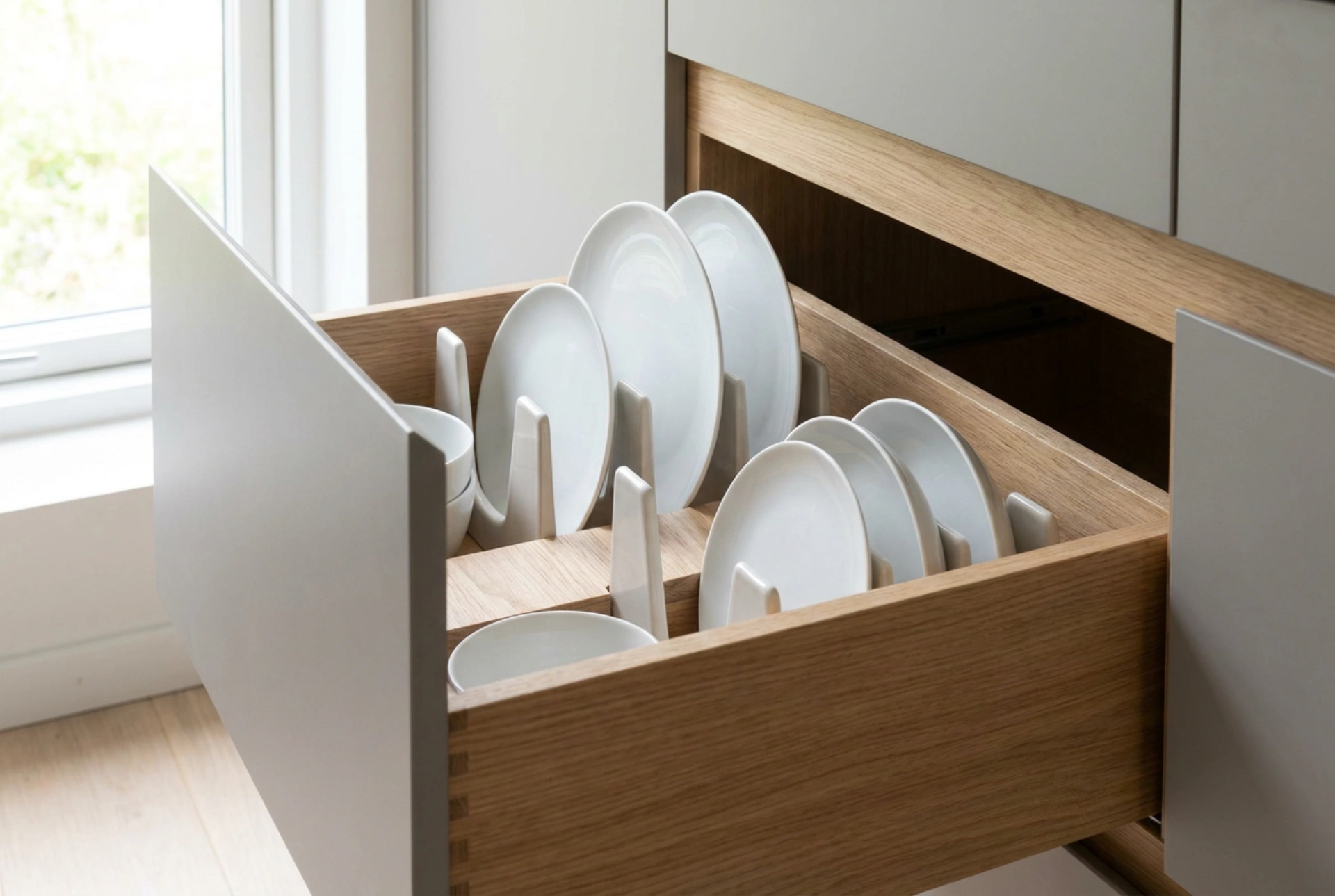
- Vertical Slot Racks: These inserts store plates upright rather than stacked. This is highly efficient for access, but it requires precise slot spacing. The slot must support the plate at multiple points along its circumference to distribute weight evenly and prevent it from rolling or rattling during drawer operation.
Glaze Wear and Inter-Plate Friction
Even if plates do not collide forcefully, the microscopic vibrations caused by daily kitchen activity can cause gradual damage. The underside of most ceramic plates features an unglazed foot ring—a rough, abrasive circle where the plate rested on a kiln shelf during firing. When plates are stacked directly on top of each other, this unglazed ring rests directly on the delicate, glassy glaze of the plate below.
As the drawer opens and closes, tiny relative movements cause this abrasive ring to grind against the glaze. Over time, this results in dull grey rings or scratches on your tableware. To prevent this mechanical wear, insert felt pads or soft silicone spacers between each plate. These spacers absorb vibrations and decouple the hard surfaces, ensuring that the glaze remains pristine.
Selecting Insert Materials for Energy Absorption
When selecting a drawer organiser, the material matters. Hard plastics and metals are durable, but they do not absorb kinetic energy well; instead, they reflect the impact back into the ceramic plate, increasing the risk of breakage. Natural hardwoods like oak, beech, or bamboo possess a cellular structure that naturally dampens sound and vibrations. When a plate shifts against a wooden peg, the wood fibers compress minutely, absorbing and dispersing the kinetic energy. Consequently, timber peg systems and dividers are structurally superior for protecting fragile ceramic glazes.