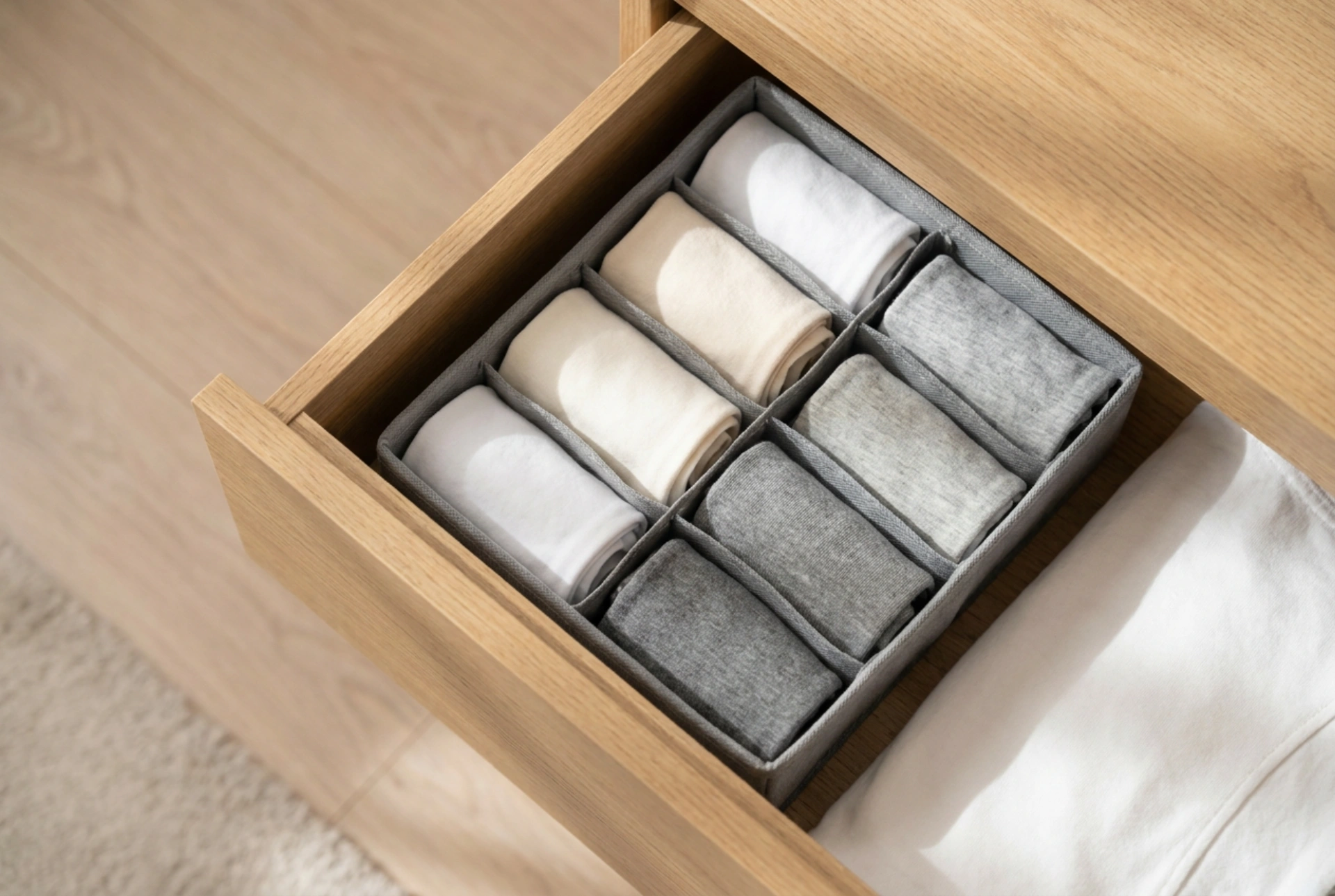


An unorganised underwear drawer causes unnecessary daily friction and accelerates the wear of delicate fibers due to mechanical snagging and compression. Transitioning to a structured, compartment-based system combined with precise folding techniques preserves fabric elasticity and optimises wardrobe microclimates.
The Science of Fabric Degradation in Disorganised Drawers
When undergarments are piled loosely, they experience continuous friction and uneven compression every time the drawer is opened and closed. This mechanical stress breaks down delicate elastane and polyurethane fibers, which are essential for maintaining the elasticity and fit of modern underwear. Furthermore, lack of structure traps stagnant air and residual moisture, creating a microclimate conducive to mildew and mustiness, particularly in natural fibers like cotton and silk. Implementing grid-based dividers isolates each item, eliminating friction and allowing uniform airflow around each garment, which helps maintain a dry, sterile environment.
Selecting the Right Organizer Materials for Fiber Preservation
Not all drawer organizers are created equal, and the chemical and physical properties of the storage medium directly affect your clothing. Fabric organizers made from breathable, non-woven polypropylene are ideal for natural fibers. This material allows air to pass through while preventing dust accumulation. For structured items like brassieres, rigid acrylic or wooden dividers are preferable as they hold their shape under tension, preventing cups from collapsing and losing their molded form.
Avoid low-quality plastics that release volatile organic compounds (VOCs), which can yellow white fabrics over time. If using wooden dividers, ensure they are sealed with a non-reactive, water-based lacquer to prevent natural wood oils and tannins from transferring onto delicate silks and laces.
The Mechanics of Vertical Folding and Grid Storage
The traditional method of stacking underwear horizontally creates a high-pressure environment for bottom-layer garments, distorting their shape and making them hard to retrieve without disturbing the pile. The solution lies in vertical folding, which utilizes gravity and fabric tension to make each garment self-supporting.
Step-by-Step Folding for Knitted and Woven Fabrics
- Lay flat and align: Place the garment on a clean surface, smoothing out any creases to distribute tension evenly across the weave.
- The thirds rule: Fold the sides inward longitudinally to form a neat rectangle. This concentrates the bulk of the fabric in the center.
- The roll-and-tuck: Fold the waistband down or the crotch up to meet the middle, then fold once more to create a compact, stable parcel that can stand vertically in its allocated grid cell.
By storing these parcels vertically inside individual compartments, you ensure that retrieving one item does not apply kinetic force to adjacent items. This preserves the structural integrity of both the fold and the fabric.
Managing Humidity and Odour Control
Underwear is worn in close contact with the skin, meaning residual moisture and oils can persist even after washing. When stored in a dark, enclosed drawer, this can lead to bacterial growth. To maintain an optimal relative humidity of under 50% within your drawer organizer, consider integrating passive moisture regulators.
- Silica gel packs: Positioned in the corners of the drawer, these actively adsorb ambient water vapour from the air.
- Unfinished cedar wood blocks: These provide a natural, mild desiccant effect while releasing pleasant organic compounds that repel fabric pests.
- Baking soda sachet: Sodium bicarbonate placed in a breathable linen bag neutralises acidic odour molecules rather than merely masking them with synthetic perfumes.