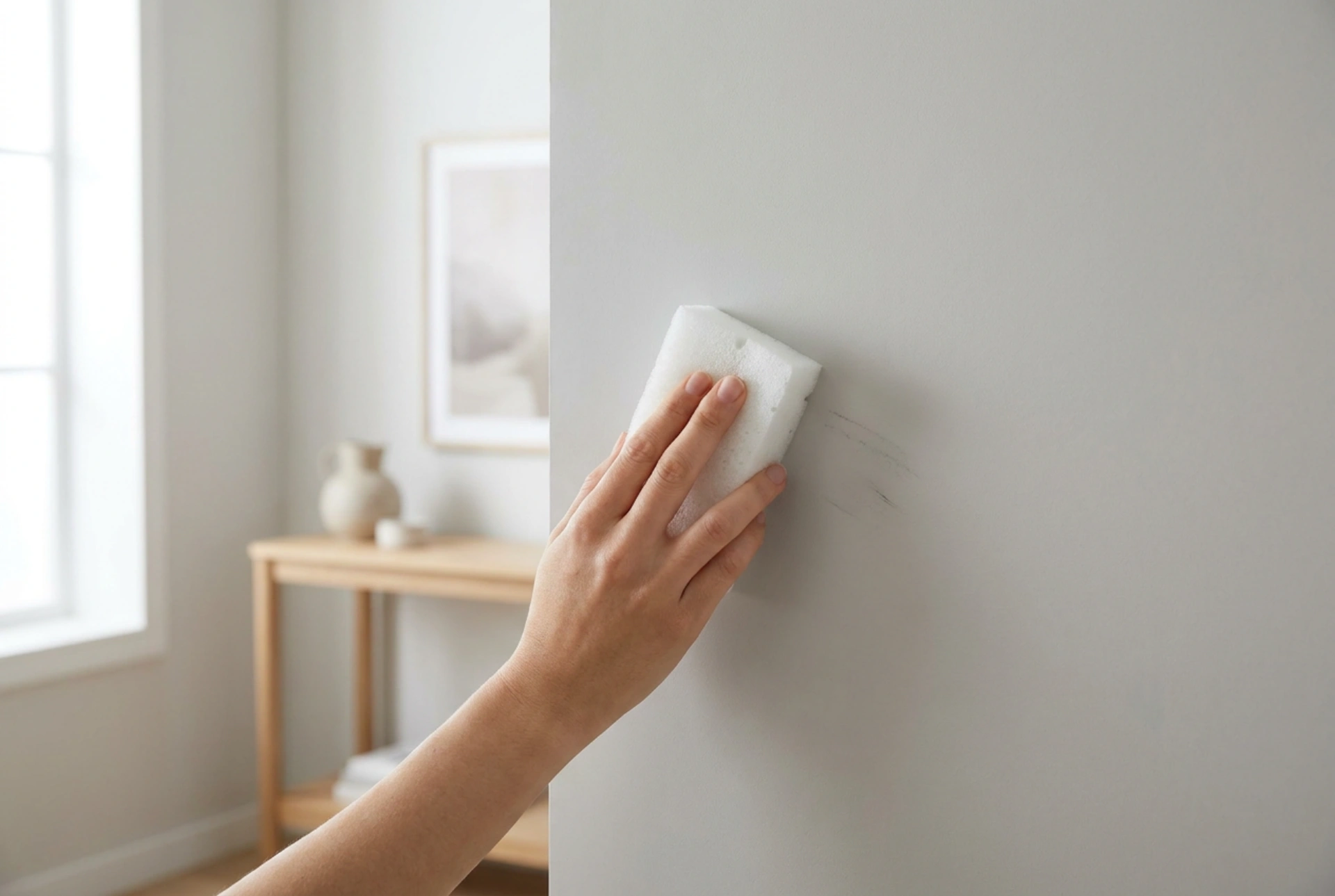


Removing stubborn handprints and smudges from painted walls requires a clear understanding of the physics of micro-abrasion. Melamine foam, often referred to as a magic sponge, offers a highly effective, chemical-free cleaning solution, provided it is applied with precise pressure and moisture control to preserve the underlying paint finish.
The Physics of Melamine Foam: How Micro-Abrasion Works
Unlike traditional cellulose or polyurethane sponges that rely on chemical detergents and suction to lift dirt, melamine foam operates purely through mechanical friction. The sponge is composed of an open-cell melamine-formaldehyde resin copolymer. During the manufacturing process, this resin cures into an incredibly hard, crystalline microstructure. On a microscopic scale, these cured strands are almost as hard as glass. However, because of the open-cell structure, the cured material retains high flexibility and compressibility, forming a porous, web-like matrix.
When you moisten the sponge and glide it across a wall, these microscopic, needle-like strands act like ultra-fine sandpaper, roughly equivalent to a 3000 to 6000 grit abrasive. The foam physically scrapes away microscopic particles of dirt, grease, and ink from the tiny crevices of the painted surface. The open cells then trap and lock in the scraped-away debris, lifting it completely off the wall.
The Chemistry of Handprints and Wall Smudges
To clean effectively, it is essential to understand what makes handprints so persistent. Human skin naturally secretes sebum, an organic oily substance composed of triglycerides, wax esters, squalene, and free fatty acids. When hands touch a wall, this sebum transfers directly to the paint surface, acting as a binder for ambient dust, soot, and dead skin cells. Over time, these lipids undergo mild oxidation, cross-linking with the paint polymers and creating a stubborn, hydrophobic layer.
Wiping the surface with a standard cloth and plain water is rarely successful because water repels hydrophobic lipids. Using heavy liquid detergents can soften the water-based wall paint itself, leading to discoloration. Melamine foam bypasses this chemical incompatibility by shearing the mechanical bond between the sticky lipid layer and the paint film without requiring harsh solvents.
Step-by-Step Technique for Safe Spot Removal
To remove handprints without leaving permanent marks or stripping the paint, you must follow a disciplined physical protocol:
- Moisten and compress: Saturate the melamine sponge with clean, lukewarm water. Do not twist or wring the sponge, as torsional stress tears the delicate resin microstructure. Instead, compress the sponge flat between the palms of your hands. The sponge must be damp, not dripping wet, as excess water can cause the paint binder to swell and weaken.
- Conduct a patch test: Always test the sponge on an inconspicuous area first, such as behind a door or near the skirting boards, to verify that the paint pigment does not transfer to the foam.
- Apply light, feathering pressure: Place the sponge on the smudge and use light, circular motions. Do not apply downward force; let the microscopic structure of the foam do the work. Work from the outside of the smudge inward to prevent spreading the grease.
- Blot and dry: Immediately after lifting the stain, gently blot the damp area with a clean, dry microfibre cloth. This action lifts the suspended water and grime particles before they can re-penetrate the paint pores.
Evaluating Paint Types and Surface Sheens
The durability of your wall paint determines how it will react to melamine foam. Matte and flat paints have a high pigment-to-binder ratio, creating a microscopic roughness that scatters light. When you scrub a matte wall, you physically flatten this rough texture, polishing the surface and leaving a permanent shiny spot. Satin, eggshell, and gloss finishes have a higher concentration of binder, making them more resilient, but excessive friction can still scratch the surface, creating dull patches. Minimising mechanical force is the key to maintaining a uniform wall texture.