

Maximising a narrow hallway wardrobe requires a precise understanding of vertical space dynamics, friction, and moisture control. By applying practical physical layout principles, you can store bulky coats and multiple pairs of footwear in a confined footprint without creating clutter or trapping stale odours.
The Physics of Hanger Selection and Spatial Staggering
In a narrow wardrobe, horizontal depth is your tightest constraint. Standard coat hangers measure approximately 40 to 45 centimetres in width, which often clashes with the shallow depth of compact hallway cabinetry. When garments are hung flat against one another, their natural bulk—especially thick wool or filled down jackets—compresses the adjacent fabric. This compression not only creases the garments but also traps air, reducing natural ventilation and making the wardrobe feel stuffed.
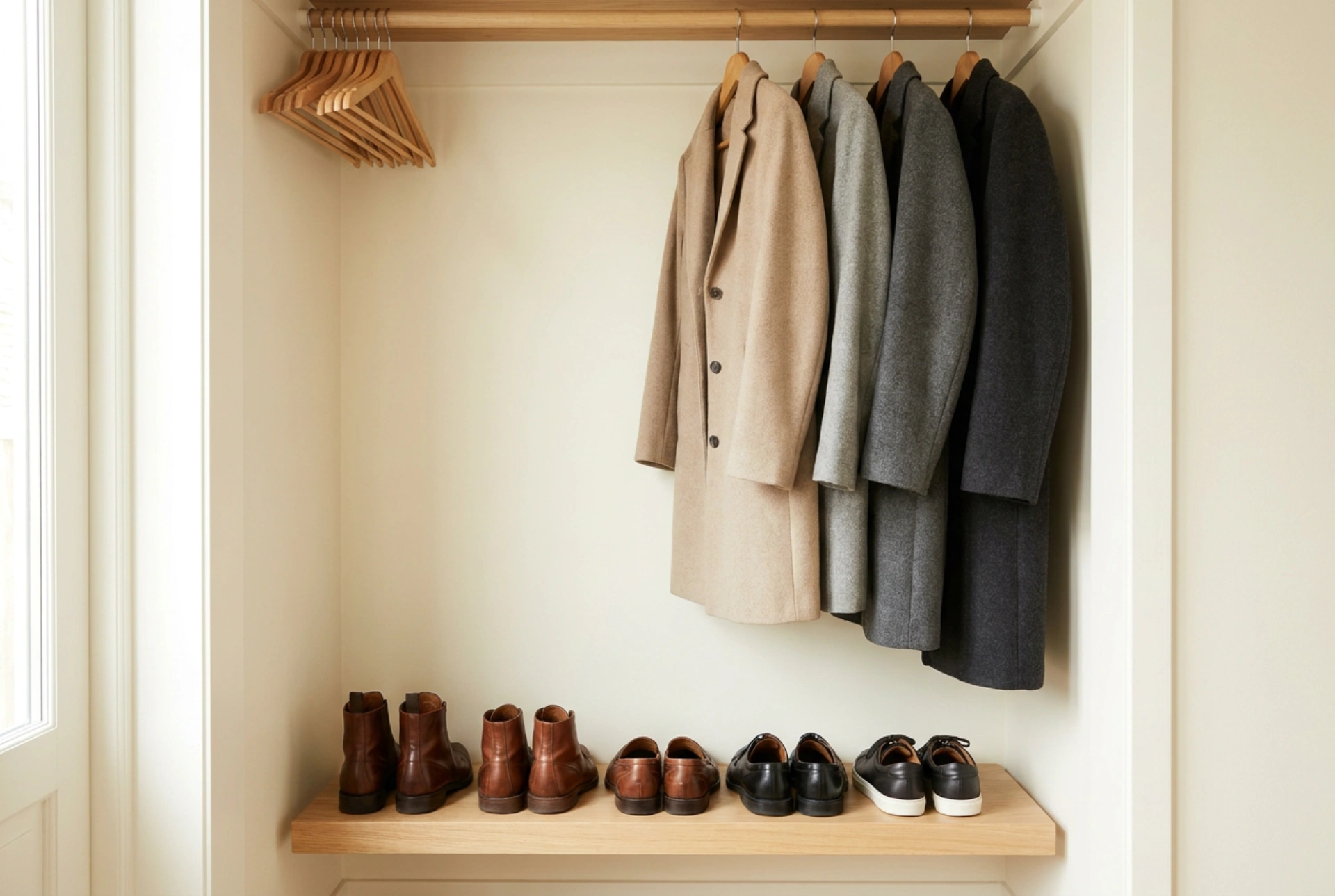
To counteract this, replace thick plastic hangers with slimline wooden or heavy-duty metal hangers coated in high-friction non-slip material. Wooden hangers are superior for heavy coats because they maintain the structural integrity of the shoulders, distributing the weight evenly and preventing fabric stretching. To save crucial horizontal space, employ the staggering technique: alternate the orientation of the hangers or use a pull-out valet rod that runs perpendicular to the back wall. This configuration allows you to slide garments forward for access, turning a shallow depth into a highly functional storage channel.
Moisture Regulation and Airflow Dynamics
Hallway wardrobes are high-traffic zones for damp outerwear and wet shoes. When damp items are sealed in an enclosed space with poor airflow, the relative humidity quickly rises, creating an ideal environment for mould spores to germinate. This process can damage delicate linings and produce persistent, musty smells.
To manage moisture scientifically, never place soaking wet coats directly into a closed wardrobe. Allow them to air-dry in an open space first. Inside the wardrobe, introduce passive desiccant materials. Sacks of activated charcoal are highly porous and naturally adsorb both water molecules and volatile organic compounds that cause odours. Alternatively, blocks of untreated red cedar wood absorb residual moisture while releasing natural phytoncides, which act as a mild, chemical-free deterrent against moths and fungi. Ensure there is a gap of at least two to three centimetres between hung garments to allow convection currents to circulate air throughout the cabinet.
Geometric Footwear Storage and Floor Space Optimisation
Shoes are inherently awkward shapes that consume significant floor area. To fit more pairs into a narrow closet base, you must exploit spatial geometry. The most effective method for flat shoes, heels, and trainers is the heel-to-toe alternating pattern. By placing one shoe facing forward and its partner facing backward, you align the narrow heel of one shoe with the wider toe box of the other. This simple geometric adjustment can reclaim up to twenty percent of your shelf width, allowing for an extra pair per row.
For boots and taller footwear, vertical tension is key. Slouching boot shafts crease leather and trap moisture inside the footbed. Insert simple plastic boot shapers or DIY rolled-up cardboard cylinders to keep the shafts upright, promoting airflow and preserving the material. Utilise raised wire mesh shelving rather than solid wooden shelves; this allows dirt, dried mud, and moisture to fall through to an easily cleanable catch tray at the very bottom, keeping the upper storage surfaces pristine.
The Efficiency Zone: Organising by Frequency of Access
The layout of a narrow wardrobe should mirror your daily physical movements. Divide the space into three distinct access zones based on ergonomics and frequency of use:
- The Primary Zone (Chest to Eye Level): Reserved for daily-wear coats and jackets. Keep these items highly accessible to minimise the time spent searching when leaving the house.
- The Secondary Zone (Floor to Waist Level): Dedicated to footwear, active-use bags, and umbrellas. Using pull-out drawers or angled shoe shelves in this zone prevents you from having to bend down deeply into a dark cupboard.
- The Tertiary Zone (Above Head Height): Perfect for seasonal storage, such as summer hats, gloves, or heavy winter scarves packed in breathable fabric boxes. Keeping these low-frequency items out of sight prevents them from crowding the essential daily-use space.