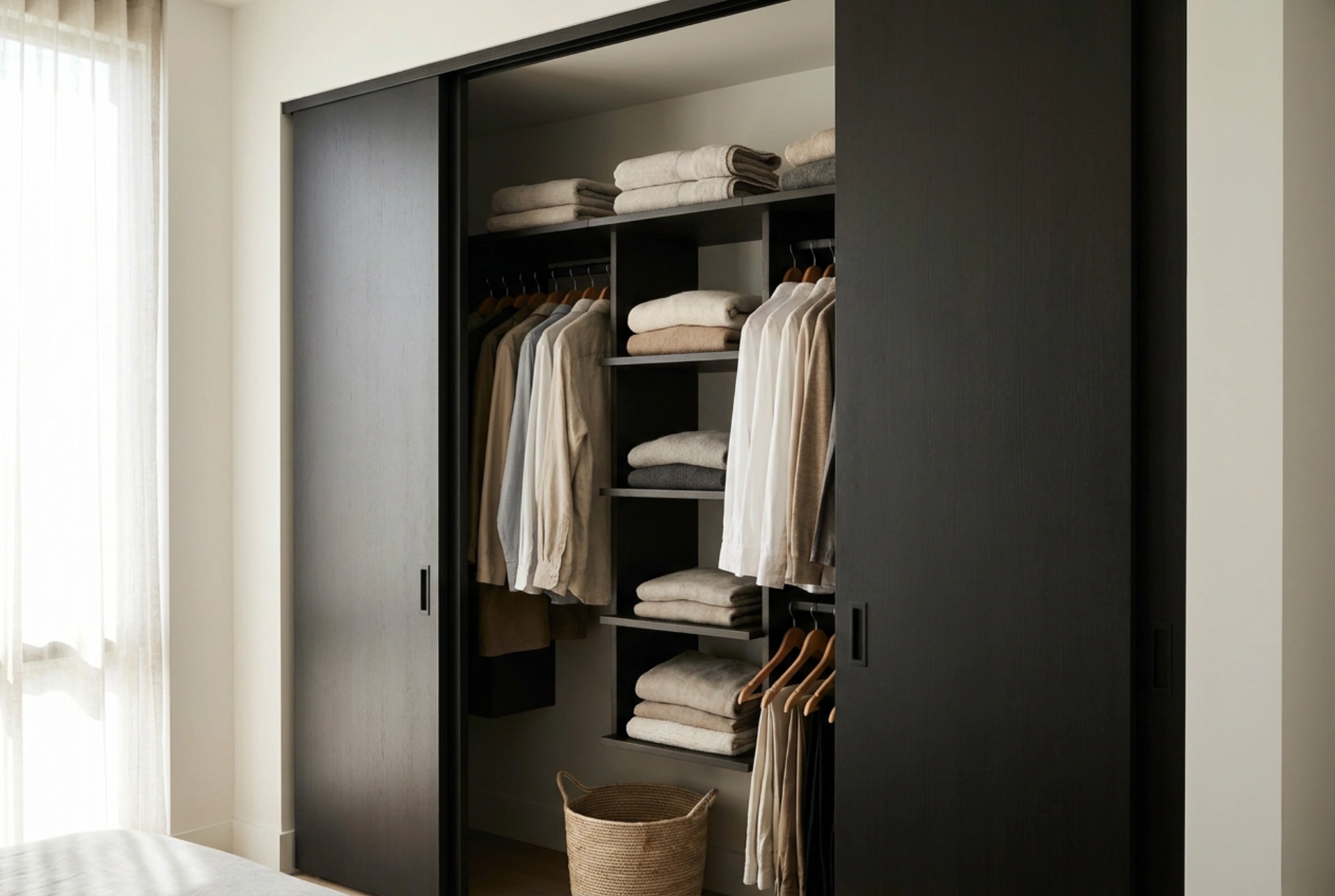


Sliding wardrobe doors solve a fundamental spatial bottleneck by eliminating the clearance arc required by traditional swing doors, allowing full utility of compact rooms and narrow hallways. Understanding the mechanical physics of track alignment and material deflection is essential to maintaining silent, effortless operation over time.
The Physics of Sliding Systems: Bottom-Rolling vs. Top-Hung
Sliding mechanisms rely on two primary load-bearing configurations: bottom-rolling or top-hung tracks. In a bottom-rolling system, the weight of the door panel is supported by lower rollers traversing a floor-mounted track, guided by stabilizers at the top. This configuration lowers the physical centre of gravity, reducing structural stress on the wardrobe frame. This makes it ideal for heavy panels such as mirror glass or solid wood.
Conversely, top-hung systems suspend the doors from a load-bearing header rail, utilising gravity to maintain a vertical hang. This configuration eliminates bottom tracks, creating a seamless floor transition, but places high shear stress on the ceiling or wardrobe top. In both systems, minimising rolling friction is critical. High-quality rollers utilise sealed ball bearings encased in nylon or polyurethane. These materials possess a low coefficient of sliding friction against aluminium tracks, dampening acoustic vibrations and preventing mechanical jerking during movement.
Material Dynamics: Preventing Warp and Deflection
Narrow corridors and bedrooms often experience limited airflow, leading to localised microclimates and rapid shifts in relative humidity. Wood-based door panels, such as MDF or particle board, absorb and release moisture unevenly. This hygroscopic expansion causes the fibres to swell, leading to a physical distortion known as "cupping" or warping.
To prevent this structural failure, sliding doors utilise structural metal frames, typically extruded aluminium or steel, which act as a rigid exoskeleton. Aluminium is preferred for its high strength-to-weight ratio and natural resistance to corrosion. When designing large door panels, the inclusion of tensioning bars (stiffeners) inside the panel allows for manual calibration of structural deflection. If a door warp exceeds two millimetres over its height, it increases kinetic resistance against the adjacent panel, causing scraping and accelerating wear on the wheel bearings.
Ergonomics of Access: Overlap and Drawer Layouts
While sliding doors save external floor space, they introduce internal layout constraints. Unlike hinged doors, which can expose the entire cabinet interior simultaneously, sliding panels always block a portion of the closet. Planning the internal shelving must account for this physical overlap.
- Door Overlap: Standard configurations require an overlap of 20 to 50 mm between the front and rear panels to prevent visual gaps.
- Drawer Interference: Internal drawers or pull-out metal baskets must not be placed directly in the overlap zone, as they will collide with the front door frame when extended.
- Zone Division: Divide the wardrobe into vertical modules that correspond exactly to the width of the open door aperture to maximise reach and convenience.
Tribology and Preventive Maintenance for Track Mechanics
Over time, gravity pulls household dust, hair, and textile fibres into the lower guide channels. When the rollers pass over these microscopic obstructions, they undergo vertical micro-shocks, which gradually deform the round nylon wheels, creating "flat spots" that cause a bumpy glide.
Cleaning and lubrication must follow a strict order of operations:
First, use a vacuum cleaner with a crevice tool to extract loose dirt from the deep recesses of the tracks. Second, wrap a microfibre cloth soaked in isopropyl alcohol around a thin tool to dissolve sticky residues and greases. Never use standard wet mineral oils or grease sprays; these substances are highly viscous and act as dirt magnets, forming an abrasive grinding paste that destroys ball bearings. Instead, apply a thin layer of dry PTFE (polytetrafluoroethylene) lubricant. This creates a dry, micro-thin non-stick barrier that repels dust while keeping the rolling friction coefficient exceptionally low.