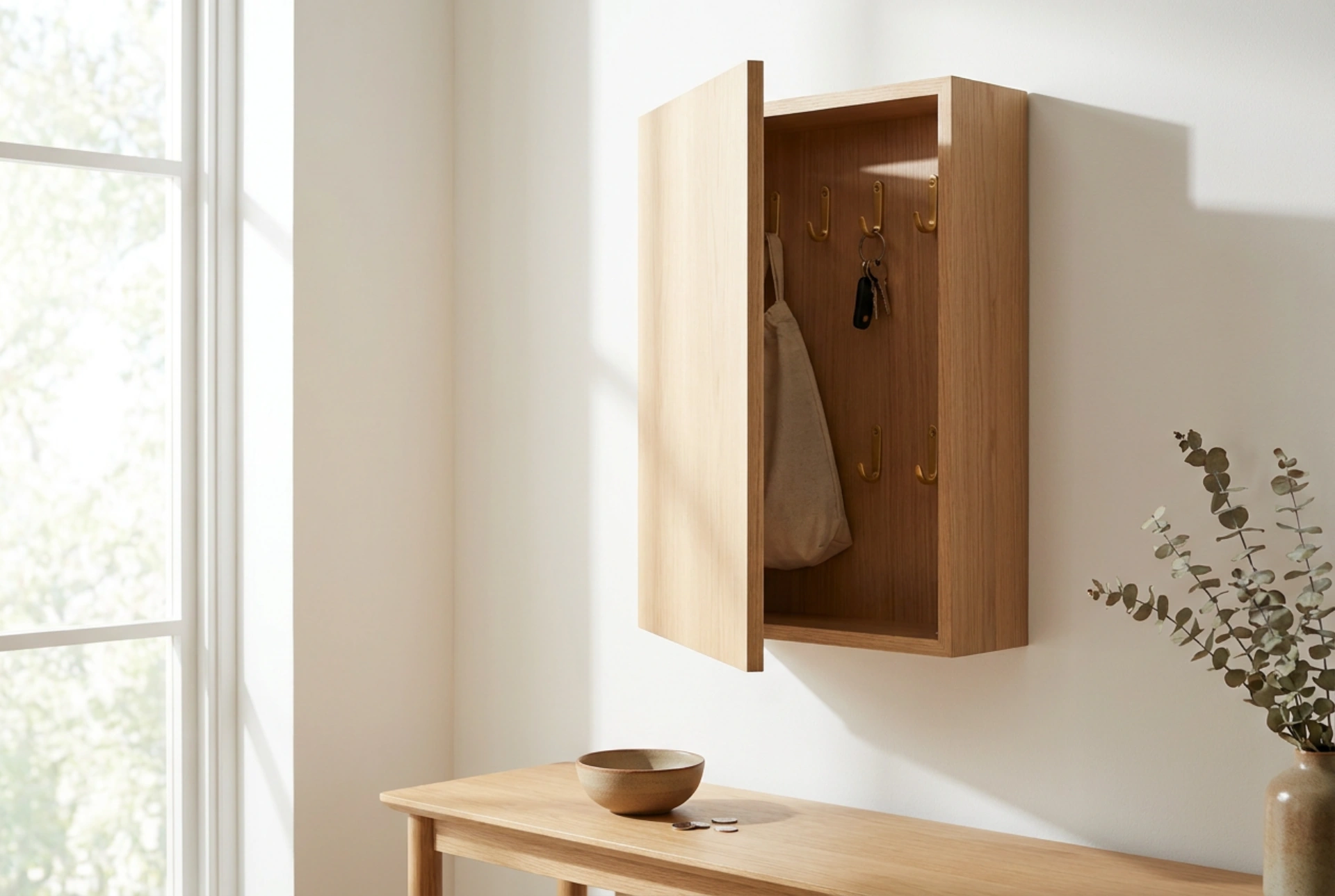


A chaotic entryway creates unnecessary daily friction, but a dedicated, wall-mounted key cabinet offers a structured solution that protects both your keys and your walls. By applying basic principles of ergonomics, material science, and spatial design, you can transform this small transitional zone into a highly functional hub that streamlines your daily departures and arrivals.
The Ergonomics of Entryway Flow and Placement
The success of any entryway organisation system depends on its physical placement relative to the natural movement of the human body. When you cross the threshold of your home, your brain instantly seeks a "landing zone" to shed carried items. To capitalise on this natural habit, your key cabinet must be positioned along this intuitive path of travel.
The optimal height for mounting a key cabinet is between 140 and 150 centimetres from the finished floor level. This range aligns with the average human eye level and shoulder height, allowing you to hang or retrieve keys without bending, stretching, or straining. Furthermore, placement relative to the door's swing is critical. Mount the cabinet on the latch side of the door rather than the hinge side. This ensures that you can access the cabinet immediately upon opening the door, without having to walk around the door leaf or risk the door handle colliding with the cabinet unit.
Material Science: Selecting Wood and Metals for Longevity
Entryways are subject to rapid environmental fluctuations. Every time the external door opens, the cabinet is exposed to drafts, humidity variations, and temperature shifts. Choosing materials that can withstand these thermal dynamics is essential for long-term durability.
- Hardwoods: Solid timbers like oak, walnut, or ash possess tight grain structures that resist warping and bowing when exposed to seasonal humidity. Ensure the wood is sealed with a polyurethane or natural oil finish to repel moisture from wet hands or rain-soaked keyrings.
- Engineered Wood: High-density fibreboard (HDF) with a natural wood veneer offers excellent dimensional stability, as its cross-directional fibres prevent expansion and contraction.
- Hook Materials: Keys are made of hard metals like brass, steel, or nickel-plated brass. To prevent galvanic corrosion—which occurs when different metals touch in a damp environment—and mechanical scratching, choose solid brass or high-grade stainless steel hooks. Avoid cheap alloy hooks that tarnish or bend under the weight of heavy key bundles.
Internal Layout: Calculating Spacing and Hook Mechanics
A poorly designed interior leads to tangled keyrings and dropped fobs. To prevent this, the internal layout of your key cabinet must respect physical clearances. A standard keyring with three to five keys and a modern car fob requires a minimum vertical clearance of 12 centimetres and a lateral clearance of 6 to 8 centimetres from adjacent hooks. This spacing prevents keyrings from overlapping and catching on one another when you are in a rush.
Cabinet depth is another critical dimension. A cabinet with an internal depth of less than 5 centimetres will struggle to accommodate modern, bulky electronic car keys, causing the cabinet door to spring open or fail to latch. Opt for a depth of 6 to 8 centimetres to ensure all contents remain fully enclosed. For a modern aesthetic, some cabinets utilise integrated neodymium magnets embedded just beneath a thin wood veneer instead of traditional hooks. This provides a clean look while utilising magnetic force to hold steel keyrings securely in place.
Mounting Techniques for Long-Term Stability
Every time you hang or pull a set of keys, you exert downward and outward force on the cabinet. Over months and years, this repetitive torque can loosen wall fixings if the cabinet is not mounted correctly. Traditional single-point hanging brackets are prone to pivoting and shifting. Instead, look for cabinets that feature dual-point mounting holes pre-drilled through the solid back panel.
When installing, always match the wall plug to your specific wall type. For solid masonry walls, standard nylon expansion plugs paired with deep-threaded steel screws offer maximum load capacity. For plasterboard (drywall) partitions, use metal self-drilling anchors or hollow-wall toggle bolts that distribute the weight across a larger surface area behind the board. Using a spirit level during installation is non-negotiable; even a minor tilt of one or two degrees can cause cabinet doors to swing open unexpectedly or put uneven tension on the hinges.