

Managing indoor air quality requires understanding the physical differences between airborne particulates and gaseous water vapour. Choosing between a dehumidifier and an air purifier depends entirely on whether your primary household challenge is excess moisture or microscopic air contamination.
The Physics of Humidity: How Dehumidifiers Control Moisture
Dehumidifiers are thermal and mechanical systems designed to lower relative humidity by extracting gaseous water vapour from the air. Most residential units operate on a vapour-compression refrigeration cycle. A fan draws warm, humid air over an evaporator coil cooled by a refrigerant. As the air temperature drops below its dew point, water vapour undergoes a phase change, condensing into liquid droplets that drain into a collection tank. The cooled, dry air is then passed over a condenser coil to reheat it back to room temperature before being recirculated into the room.
Alternatively, desiccant dehumidifiers utilise a chemical rotor containing highly porous materials like silica gel. These materials bind water molecules directly through adsorption, a surface-based physical process. Desiccant systems are highly effective in cooler environments, such as unheated basements, where compressor-based condensation is inefficient due to frost formation on the coils. Maintaining relative humidity between 40% and 55% is critical to halting the biological proliferation of mould spores and dust mites.
The Mechanics of Filtration: How Air Purifiers Clean the Air
Air purifiers do not affect ambient humidity levels; instead, they target suspended particulate matter and gaseous pollutants. These devices rely on mechanical filtration, most commonly utilising high-efficiency particulate air (HEPA) filters. A HEPA filter consists of a dense, random mat of glass fibres. It captures particles through three distinct physical mechanisms: inertial impaction (for large particles that cannot negotiate the airflow paths around fibres), interception (for medium particles that graze the fibres), and diffusion (for extremely small particles influenced by Brownian motion, causing them to collide with the fibres).
To address volatile organic compounds (VOCs), gases, and odours, air purifiers must incorporate an activated carbon filter. Activated carbon undergoes a chemical activation process that creates millions of microscopic pores, drastically increasing its surface area. Gaseous molecules are trapped within these pores via physical adsorption. Unlike mechanical filters, which physically block solids, carbon filters rely on molecular attraction to neutralise chemical pollutants.
Matching the Technology to Your Indoor Environmental Challenges
Selecting the correct device requires diagnosing the root cause of your indoor air issues. Deploying the wrong technology will fail to resolve the underlying problem and waste energy.
- Condensation on Windows and Mould Growth: This is a thermodynamics problem. High moisture levels allow mould fungi to feed on organic substrates like drywall and wood. A dehumidifier is required to strip the moisture from the air, removing the life-support system of the mould.
- Allergies, Pet Dander, and Fine Dust: These are solid particulate issues. An air purifier with a certified HEPA filter is necessary to continuously extract these microscopic irritants from suspension.
- Persistent Cooking Odours and Tobacco Smoke: Smoke is a complex mixture of particulates and chemical gases. Only an air purifier equipped with both a HEPA filter and a dense activated carbon stage can effectively trap both the visible smoke particles and the gaseous odour compounds.
Optimising Placement and Operational Efficiency
For either device to perform optimally, you must manage room airflow and sealing. Dehumidifiers require closed windows and doors to establish a controlled microclimate; leaving windows open introduces a continuous supply of outdoor moisture, rendering the device ineffective. Place dehumidifiers in central areas with unobstructed airflow to allow even air circulation.
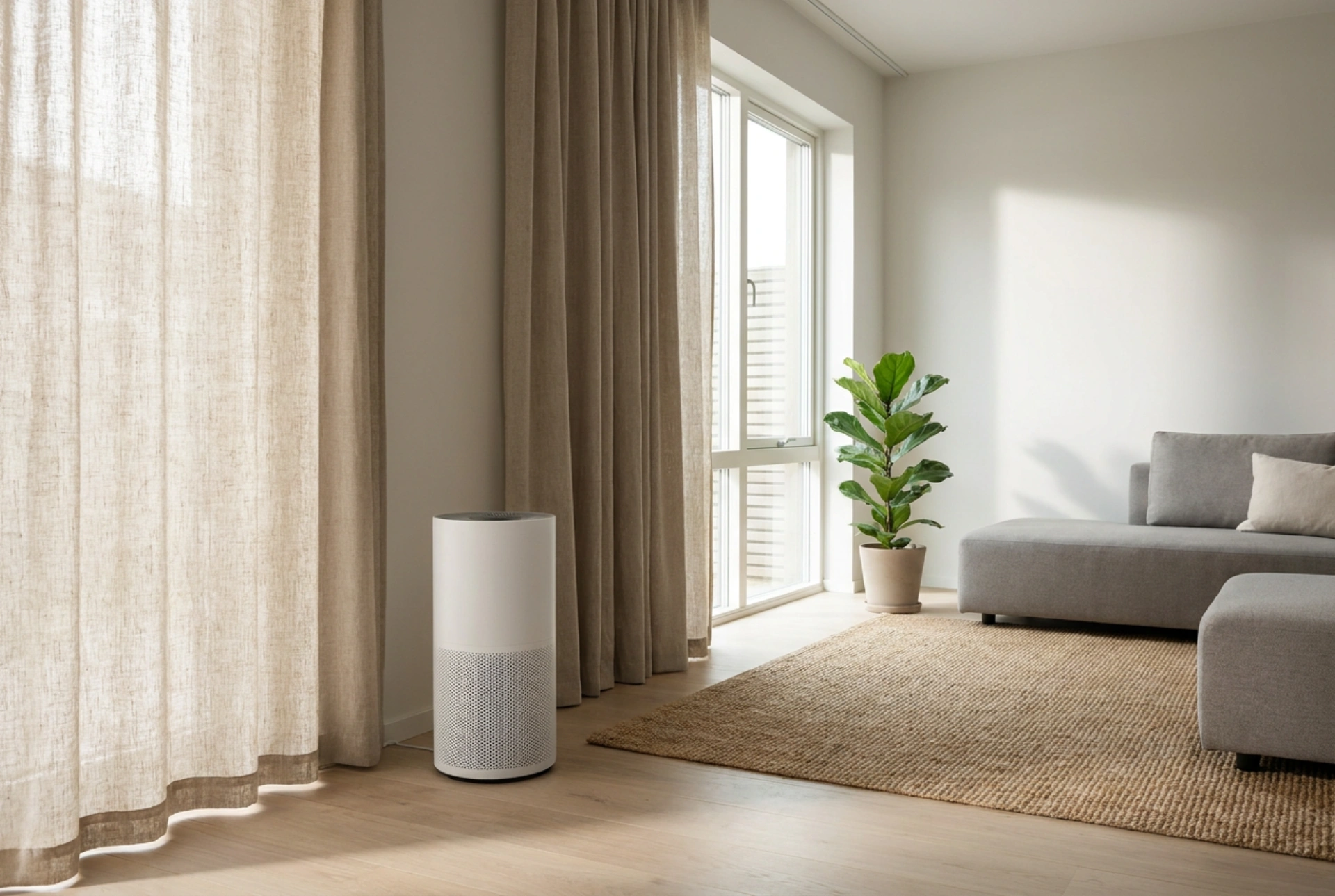
Air purifiers, while also most efficient in closed spaces, can handle some air exchange. Position them away from walls and heavy drapery, which can block the intake grilles. For maximum particle reduction, calculate the Clean Air Delivery Rate (CADR) of the device against the cubic volume of your room to ensure at least four complete air changes per hour.